
WEN Acquisition Corp Faces Critical Deadline Amid Uncertain Business Combination Prospects
A Cayman Islands SPAC with $300 million trust capital targets fintech infrastructure mergers but faces substantial going concern doubts.
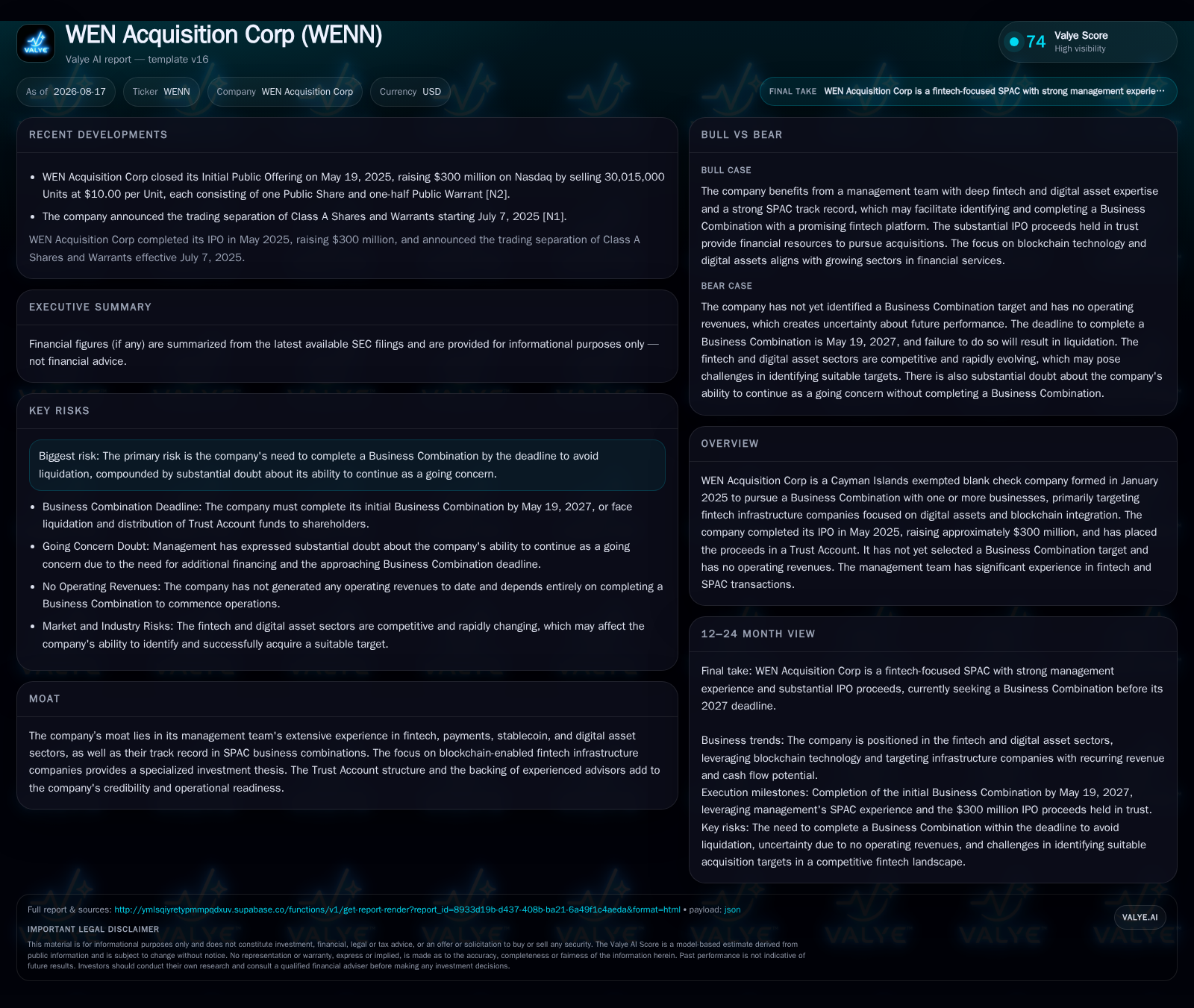
WEN Acquisition Corp is a blank check company focused on fintech and blockchain infrastructure firms, having raised approximately $300 million in its May 2025 IPO. As of its latest quarterly filing, it has yet to announce a Business Combination target and faces significant risk of liquidation given the looming deadline to complete a merger. The company’s experienced management team and sector focus provide credibility, but competitive pressures and redemption risks complicate deal execution. Key near-term indicators include the pace of target evaluation, potential financing needs, and shareholder redemption rates.
Recent Operating Update
As of the most recent quarterly report filed on August 13, 2026, WEN Acquisition Corp remains without an announced Business Combination target or operating revenues, continuing its role purely as a Special Purpose Acquisition Company (SPAC) holding IPO proceeds in a Trust Account [S2], [F1]. Management disclosed significant doubt regarding the company's ability to continue as a going concern given the imminent deadline to consummate a Business Combination or face liquidation, underscoring the urgency in executing a merger within the typical 18- to 24-month combination period post-IPO.
This extended search duration without transaction announcements places WEN Acquisition among SPACs confronting elevated execution risk, where ongoing expenses accrue against no operating income and value creation hinges entirely on securing and closing an attractive deal.
Business Model and Strategic Focus
WEN Acquisition Corp was formed as a Cayman Islands exempted blank check entity in January 2025 to raise capital through an Initial Public Offering that generated approximately $300.15 million in gross proceeds from unit sales comprising Public Shares paired with warrants exercisable at $11.50 per share [S1], [F1]. These proceeds were deposited into a trustee-managed Trust Account until deployment for an acquisition or returned upon liquidation.
The SPAC’s business model centers on identifying and merging with fintech infrastructure companies specializing in blockchain-enabled digital assets like stablecoins [S14]. The management team brings domain expertise across payments and digital asset ecosystems, targeting cashflow-positive platform businesses characterized by recurring revenue streams and efficient operating leverage—attributes conducive to sustainable margins and scalability post-merger
Absent an acquisition, WEN operates without revenue generation while incurring pre-combination costs absorbed against trust funds. The monetization event depends entirely on completing a Business Combination that transitions the company from shell status to an operating public entity.
Industry Context and Competitive Landscape
Within the broader SPAC ecosystem, WEN competes for fintech infrastructure targets against numerous other blank check companies as well as established private equity firms and strategic acquirers possessing greater financial resources or operational scale [S5]. This competitive environment heightens scarcity risk for attractive deals and can inflate acquisition valuations.
Structural considerations such as founder shares held by sponsors and outstanding warrants contribute dilution risks for public shareholders after combination. Moreover, redemption rights exercised by public shareholders reduce available deal capital at closing, frequently necessitating supplemental financing through PIPE transactions or debt issuance—both of which can further dilute equity holders or impose financial covenants [S24]
Regulatory requirements including audited financial disclosures for proxy materials create additional hurdles limiting target eligibility to those capable of timely compliance, thereby narrowing WEN’s acquisition universe.
Growth Drivers
Post-merger growth is expected to derive from acquiring fintech platforms that demonstrate recurring revenue models supporting predictable cash flows alongside defensible competitive moats via blockchain technology integration tailored for traditional financial markets [S14]. Experienced management teams capable of scaling publicly traded companies are also prioritized.
The expanding adoption of digital asset technologies within financial services coupled with increasing regulatory clarity provides secular tailwinds supporting demand for capital infusion into such platforms. WEN’s management expertise ideally positions it to source proprietary opportunities despite intense competition.
Risks and Watchpoints
The primary risk facing WEN is failure to complete a Business Combination before mandated deadlines—resulting in liquidation with only trust account proceeds returned less expenses—eliminating shareholder upside. Market volatility including interest rate fluctuations may complicate deal negotiations or financing availability [S20].
High redemption rates present uncertainty over closing capital availability; unexpected redemptions can force last-minute financing arrangements increasing dilution or jeopardizing deal completion. Limited internal resources—currently only two officers dedicating variable time—may constrain diligence capacity relative to better-staffed competitors [S5]. Potential conflicts related to underwriters entitled to deferred fees contingent on deal closure require ongoing governance vigilance.
Post-combination operational risks include integrating acquired entities into public reporting frameworks while sustaining growth trajectories under new regulatory scrutiny.
What To Watch Next
Key developments that would materially impact WEN’s outlook include:
- Identification or signing of definitive agreements with prospective Business Combination targets;
- Proxy statement filings revealing transaction terms including valuation and anticipated shareholder redemptions;
- Redemption activity trends ahead of shareholder votes affecting available deal capital;
- Announcements of PIPE financing or sponsor equity contributions shaping dilution profiles;
- Regulatory updates influencing attractiveness or feasibility of blockchain-focused fintech acquisitions;
- Progress toward Sarbanes-Oxley Act internal control compliance indicating readiness for public operating status post-merger.
Extensions of combination deadlines could provide temporary relief but increase holding costs absent clear transactional progress.
Financial Profile Discussion
As of June 30, 2026, WEN reported current assets totaling approximately $393 thousand against current liabilities near $199 thousand, yielding a current ratio of roughly 1.97—a modest buffer reflecting short-term liquidity excluding trust account balances held separately under trustee management [F1]. No current debt instruments are reported prior to combination enhancing financial flexibility; however, pro forma capitalization will be influenced heavily by redemption levels plus any incremental financing required at closing [F1]. Maintaining principal preservation within the Trust Account is critical until deployment.
This analysis synthesizes publicly disclosed information as of August 2026 from SEC filings without speculative forecasts regarding unannounced transactions or strategic initiatives. It situates WEN Acquisition Corp within the competitive dynamics and structural challenges typical for emerging fintech-focused blank check companies seeking viable Business Combinations before expiration.
Disclaimer: This is research-only, informational analysis and not investment advice. It may include AI-generated interpretation and general industry context. Always verify important details using primary sources.

Comments