
Westlake Chemical Partners LP: Ethylene Asset Control and Financial Performance in 2025
The partnership’s command over specialized ethylene production assets, underpinned by a long-term sales agreement, shaped its stable yet margin-pressured 2025 financial results.
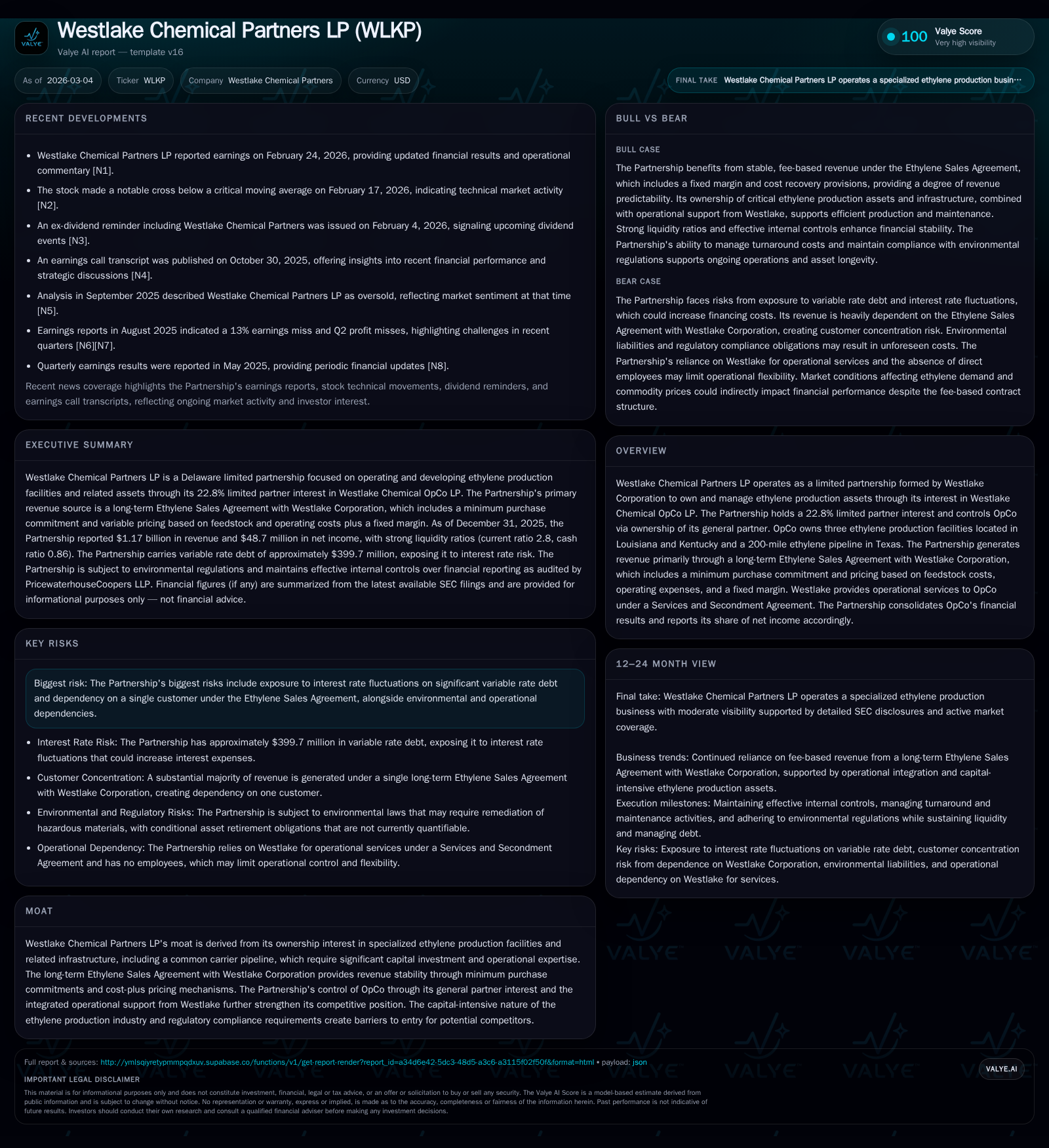
Westlake Chemical Partners LP operates critical ethylene production facilities and a common carrier pipeline through its controlling interest in Westlake Chemical OpCo LP. Its revenue model centers around a fee-based Ethylene Sales Agreement with Westlake Corporation, offering stability via minimum purchase commitments and cost-plus pricing. In 2025, WLKP recorded modest revenue growth but experienced notable declines in operating income and cash flow, affected by rising operational costs and increased turnaround expenditures. The company faces near-term contract renewal considerations and significant variable-rate debt exposure tied to fluctuating interest rates. Monitoring buyer deficiency fee payments and contractual amendments will be key for future performance insights.
Historical Earnings and Volume Trends: Growth Drivers with Operational Backdrop
Westlake Chemical Partners LP (WLKP) reported steady top-line figures for fiscal year (FY) 2025, with revenues edging up by 2.7% to approximately $1.17 billion compared to $1.14 billion in FY2024 [F1]. This moderate increase contrasts with the sharper decline observed between FY2023 and FY2024 when revenues decreased from $1.19 billion to $1.14 billion, partly due to volatile ethylene markets and operational fluctuations.
Despite the modest revenue rebound, operating income fell by 18.2% YoY from $390 million in FY2024 to about $320 million in FY2025 [F1]. Net income followed a similar downward trajectory, declining by nearly 22% to just under $48.7 million [F1]. These profitability contractions underscore mounting cost pressures amid stable volume performance.
Operating cash flow (CFO) exhibited more pronounced deterioration — down over 42% YoY — falling from roughly $485 million in FY2024 to $280 million in FY2025 [F1]. This drop suggests working capital dynamics or elevated operational spending weighed heavily on liquidity despite the relatively steady revenues.
Capital expenditures (capex) rose significantly by nearly 61%, from about $49 million in FY2024 to $79 million in FY2025 [F1]. The increase aligns with intensified maintenance efforts, including periodic turnarounds necessary for ethylene production facilities’ reliability.
Historical performance (annual)
| FY | Rev ($mm) | Net ($mm) | CFO ($mm) | OpInc ($mm) | Rev YoY | Net YoY |
|---|---|---|---|---|---|---|
| 2025 | 1167 | 49 | 280 | 320 | +2.7% | -21.9% |
| 2024 | 1136 | 62 | 485 | 390 | -4.6% | +14.9% |
| 2023 | 1191 | 54 | 452 | 358 | -25.3% | -15.4% |
| 2022 | 1593 | 64 | 464 | 348 |
Source: SEC companyfacts cache [F1].
Capital returns and efficiency (annual)
| FY | FCF ($mm) |
|---|---|
| 2025 | 202 |
| 2024 | 436 |
| 2023 | 405 |
| 2022 | 410 |
Source: SEC companyfacts cache [F1].
Data based on SEC filings for fiscal years ended December 31 [F1].
The divergence between revenue growth and operating profit alongside the substantial falloff in cash flow chiefly reflects higher unit operating costs and increased turnaround expenditures typical of an aging asset base requiring intensive maintenance.
Ethylene Sales Agreement: Revenue Structure and Pricing Mechanics
WLKP's primary revenue source is a long-term Ethylene Sales Agreement (ESA) with Westlake Corporation that governs sales from OpCo's ethylene production assets [S1][S3]. This fee-based contract provides stability via:
A minimum purchase commitment of at least 95% of OpCo's annual budgeted ethylene output; this commitment is measured annually and is not reduced for force majeure events lasting fewer than 45 days [S1].
A pricing formula based on actual feedstock (primarily ethane), natural gas costs plus estimated operating expenses and an averaged maintenance capital expenditure component amortized over planned capacity utilization years; a fixed margin of $0.10 per pound is added after deducting co-product revenues [S1].
Buyer deficiency fees triggered if Westlake fails to meet minimum purchase volumes; these fees cover fixed margins plus unavoided costs for committed pounds not taken and are recognized after the contract year concludes [S1][S3].
An option for Westlake to purchase excess volumes beyond the minimum commitment at adjusted pricing excluding certain fixed costs.
Mechanisms allowing OpCo to recover shortfalls if billed production costs are less than actual incurred expenses proportionate to volumes sold during the contract year [S1].
This framework ensures revenue predictability through guaranteed minimum volumes and cost-based pricing rather than exposure to volatile spot ethylene prices.
Operational Assets Overview
WLKP holds control over OpCo through its ownership of the general partner combined with a limited partner interest of approximately 22.8%, granting operational authority over assets managed jointly with Westlake Corporation [S1].
OpCo operates three key ethylene production facilities:
- Two at Lake Charles Olefins site in Louisiana ('Petro 1' and 'Petro 2').
- One at Calvert City Olefins plant in Kentucky.
Additionally, it owns the Longview Pipeline—a roughly 200-mile common carrier ethylene pipeline running from Mont Belvieu to Longview Texas—providing strategic logistical advantages [S1].
Operational support is provided under a Services and Secondment Agreement with Westlake which supplies utilities plus plant operation and maintenance personnel seconded through December 31 2026 initially—with automatic renewals linked directly with ESA renewals—ensuring continuity of operations [S1][S18].
Liquidity Position and Capital Allocation
As of December 31 2025, WLKP had approximately $44 million in cash and equivalents [F1], supported by revolving credit facilities totaling roughly $400 million owed primarily to wholly owned subsidiaries of Westlake—split between an OpCo revolver ($22.6M) and an MLP revolver ($377M) [F1][S9][S11][S14].
Recent amendments replaced LIBOR benchmarks with SOFR plus applicable margins ranging between approximately 1.75%-2.75%, resulting in a weighted average interest rate near ~5.8% as of year-end [S9][S14].
This variable rate debt exposes WLKP directly to interest expense fluctuations; each additional hundred basis points increase could add approximately $4 million annually in interest expense based on outstanding balances at year-end [S9].
Capital expenditures rose sharply nearly +61% year-over-year driven by maintenance turnarounds required for facility reliability [$79M vs $49M] which impacted free cash flow generation despite positive operating cash flow [$280M] [F1][S6].
Cash distributions historically have been funded primarily from excess cash generated after capital spending though recent cash flow declines raise questions about near-term sustainability absent deleveraging or capex moderation [N3][F1].
Contract Renewal Considerations and Outlook
The ESA currently expires December 31 2026 but includes provisions for automatic one-year renewals contingent on simultaneous extension of related service agreements controlling operations continuity [S1][N1].
Given WLKP's dependence on Westlake Corporation’s purchasing commitments under this framework, future earnings visibility hinges on successful renegotiation or extension of these contracts.
Upcoming key milestones include determination of buyer deficiency fees payable when minimum purchase commitments are unmet—these fees represent deferred revenues recognized post-fiscal year end potentially influencing subsequent period earnings profiles [S3][S19].
Stakeholders should monitor announcements regarding contract renewals or amendments alongside quarterly operational updates as indicators shaping financial stability beyond current term expirations.
Disclaimer: This analysis synthesizes publicly available SEC filings and news disclosures as of early March 2026 without providing investment recommendations or forward-looking forecasts beyond documented facts.
Disclaimer: This is research-only, informational analysis and not investment advice. It may include AI-generated interpretation and general industry context. Always verify important details using primary sources.

Comments