Advanced Drainage Systems Inc.: Leveraging Financial Strength and Capital Strategy to Navigate Infrastructure Sector Cyclicality
An in-depth analysis of how Advanced Drainage Systems’ robust liquidity and strategic capital deployment underpin its market resilience amid sector headwinds.
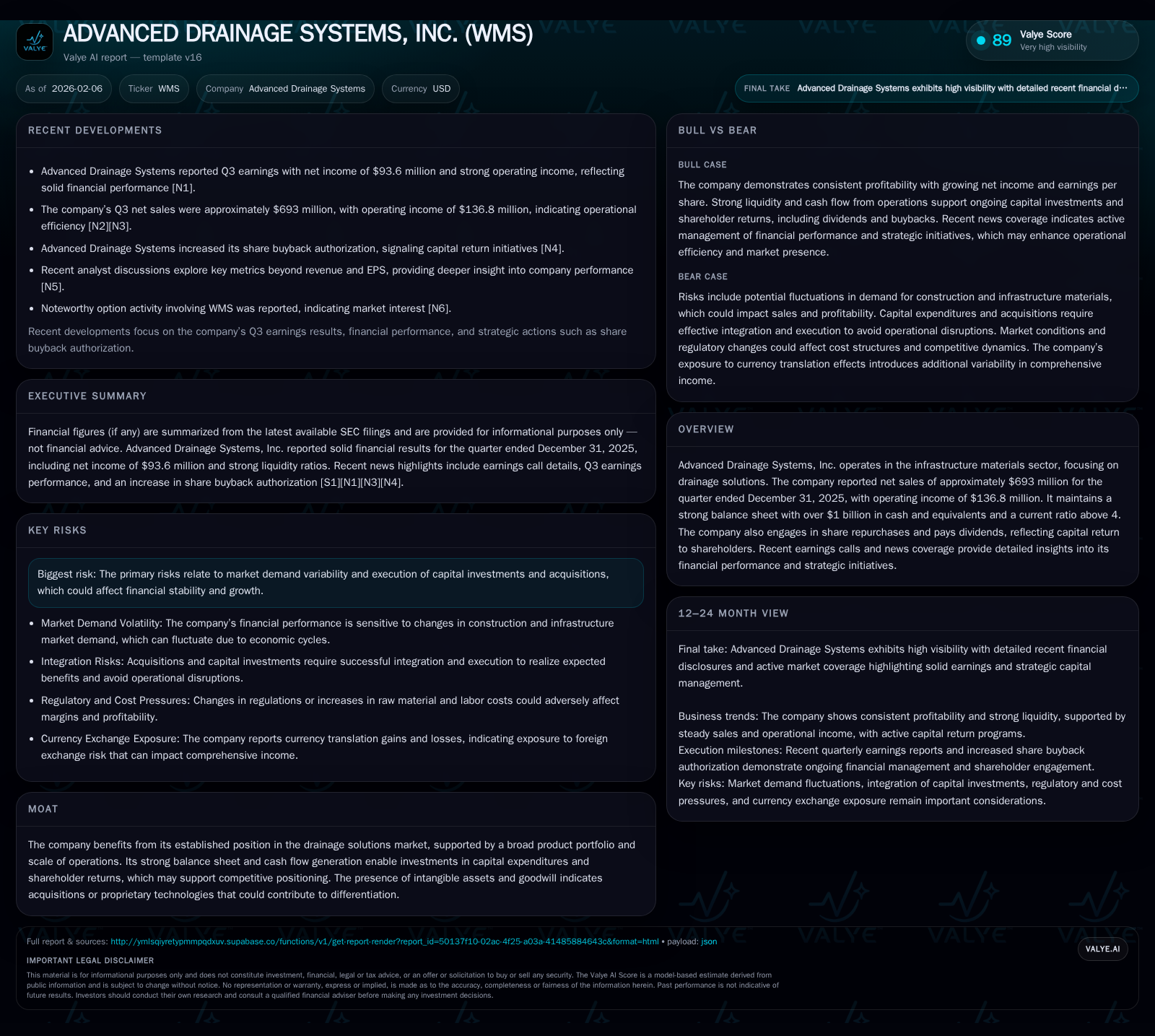
Advanced Drainage Systems (WMS) demonstrated notable financial and operational strength in Q3 2025, underscored by $693 million in net sales and $136.8 million in operating income. The firm’s fortress-like balance sheet—with over $1 billion in cash and a current ratio above 4—affords it significant flexibility for investments and shareholder returns. Its wide-ranging product portfolio, augmented by acquired intangible assets, fosters a defensible market position, while management’s active share repurchases and sustained dividends signal confidence despite cyclical demand risks. Navigating evolving infrastructure spending patterns and execution challenges remains critical to sustaining growth momentum.
Balancing Strength: Decoding WMS’s Financial Fortitude
Advanced Drainage Systems (WMS) enters 2026 exemplifying financial robustness rarely seen in the infrastructure materials sphere. The Q3 ending December 31, 2025 report showcased net sales hovering around $693 million complemented by an operating income of $136.8 million—an encouraging operating margin that reflects well-executed cost control amidst steady top-line performance [N1][F1]. However, what sets WMS apart immediately is its fortress-like balance sheet: cash and equivalents stood at a commanding $1.008 billion as of quarter-end, more than doubling over nine months, while current assets totaled roughly $1.7 billion against current liabilities of merely $413 million, resulting in an enviable current ratio surpassing 4 [S2][F1]. This liquidity cushion not only cushions the company against cyclical downturns but also equips it with ammunition to pursue opportunistic capital expenditures or acquisitions without jeopardizing financial stability.
Such balance sheet strength is especially significant in the capital-intensive drainage sector where project timing can be unpredictable. WMS’s ability to maintain ample working capital underscores its operational prudence and positions it well relative to peers reliant on tighter funding lines or more leveraged structures. It creates optionality in managing both near-term disruptions and medium-term strategic initiatives—a critical advantage when navigating volatile infrastructure spending cycles.
From Product Portfolio to Market Moat: What Sets ADS Apart
Beyond liquidity metrics lies the core of WMS’s enduring competitive footing: its diverse and comprehensive product portfolio spanning drainage pipes, stormwater management systems, fittings, and engineered solutions tailored across municipal, residential, commercial, and agricultural segments [valye_report_excerpt]. Unlike narrow competitors focusing on singular drainage components or geographic markets, ADS leverages scale benefits from breadth. This broad product offering not only caters to varied customer needs but also builds switching costs by integrating products into larger infrastructure assemblies.
Further entrenching its moat is the reported goodwill exceeding $725 million alongside intangible assets netting over $410 million [S2][F1]. These figures reflect accumulated acquisition premiums likely tied to complementary businesses or proprietary technologies enhancing ADS’s solution set. While goodwill can sometimes obscure true economic value if integrations falter, in this context it likely represents differentiated capabilities—whether through specialized polymers for piping systems or integrated design services—which competitors struggle to replicate quickly.
Operationally, this breadth allows WMS flexibility to pivot between end markets and mitigate concentration risk intrinsic to infrastructure-dependent firms. It also enables multi-channel distribution leveraging established customer relationships that smaller rivals cannot match easily. In sum, WMS combines tangible scale advantages with intangible assets that collectively fortify its competitive position.
Capital Allocation in Focus: Share Buybacks and Dividends as Confidence Signals
Capital deployment decisions illuminate management’s confidence in the underlying business health more vividly than earnings alone. Recent disclosures highlight an uptick in share repurchase authorizations alongside consistent dividend payouts [N4][valye_report_excerpt]. After raising buyback limits following Q3 results that exceeded expectations, WMS clearly signals that cash flow generation exceeds near-term investment demands.
This dual pathway of returning capital—dividends supplementing buybacks—indicates a balanced approach prioritizing both shareholder value realization and financial prudence. Instead of hoarding excess cash arbitrarily or overextending on acquisitive growth, management appears calibrated toward long-term value accretion supported by disciplined financial stewardship. Such discipline is vital given the sector’s historic cyclicality.
In practice, share repurchases reduce diluted share count providing EPS accretion potential if operating metrics sustain, while dividends appeal to income-focused investors signaling recurring profit generation capability. Collectively these moves portray a mature capital allocation regime aligned with delivering consistent returns while retaining flexibility.
Risk Radar: Navigating Market Cycles and Investment Execution
Despite strengths, ADS navigates terrain laden with risk vectors common across infrastructure materials providers. The foremost is demand variability linked intrinsically to public works funding levels which can ebb with political or economic cycles [S2]. Downturns could suppress volumes abruptly as project deferrals ripple through fiscal budgets impacting releasable backlog.
Moreover, the execution risk embedded within capital expenditure programs or mergers poses another threat vector. Acquisitions intended to bolster product breadth or geographic reach carry integration complexities—misjudgments here could inflate goodwill without delivering promised synergies [valye_report_excerpt]. Similarly, misallocated capex may erode margins if new facilities underperform or if technological shifts disrupt established product lines.
Financially, although debt levels ($1.27 billion long-term) remain manageable relative to cash flows [S2], protracted downturns could strain covenants or necessitate deleveraging steps reducing maneuverability. Consequently, vigilance remains essential regarding macroeconomic trends affecting infrastructure spend coupled with internal management of deployment risks.
Earnings Deep Dive: Surpassing Expectations in Q3 2025
WMS’s latest quarterly report defies typical cyclical pressures with results topping consensus estimates sharply [N2][N3]. Net sales achieved $693 million narrowly outpacing prior year comparables yet accompanied by an operating income gain near +8% year-over-year—translating into improved operating margins exceeding 19% for the period [N1][F1]. This margin expansion reflects persistent efforts toward operational efficiency including better raw material procurement terms alongside judicious SG&A controls despite overall inflationary input pressures.
Gross profit rose materially owing partly to favorable product mix buttressed by higher-margin engineered systems gaining traction concurrently with modest volume growth [N3]. Such earnings leverage attests to growing fixed cost absorption capacity enabling incremental revenue dollars to convert disproportionately into profit—a hallmark of advancing operational maturity.
Though one-time items like asset disposal gains were negligible this quarter [S2], recurring earnings power paints a promising picture amidst conditions where many peers grappled with margin compression fueled by rising logistics costs or supply chain disruptions worldwide.
Acquisitions & Innovation: Behind the Goodwill and Intangibles
The presence of substantial goodwill ($725 million) paired with intangible assets ($410 million net) demands scrutiny beyond ledger entries—to understand how these investments sculpt strategic differentiation [S2][valye_report_excerpt]. Historically, ADS has pursued bolt-on acquisitions enhancing geographic footprint or extending specialized capabilities particularly around advanced polymer materials used in stormwater systems.
Amortization charges totaling roughly $13.5 million this quarter signify ongoing recognition of consumption against acquired intellectual property rights or customer relationships embedded within these intangibles [S2]. Crucially, these figures are relatively modest compared to overall operating income supporting that acquired assets remain accretive rather than dilutive.
Innovation-wise, investment into R&D focused on sustainability-compliant products addresses tightening environmental regulations shaping public infrastructure projects—a key growth vector going forward. Thus goodwill/intangible balances not only anchor past M&A activity but also reaffirm commitment toward technologically led competitive advantage rather than solely volume-driven growth.
Looking Ahead: Strategic Levers for Sustainable Growth
Forecasts suggest ADS aims to capitalize on favorable long-term infrastructure trends supported by government stimulus packages targeting climate resilience and water management improvements [N10][N11][valye_report_excerpt]. Management anticipates continuing earnings momentum predicated on disciplined capital expenditure alongside selective acquisition opportunities enhancing core competencies.
Moreover, evolving regulatory landscapes encourage adoption of innovative environmental solutions embedded in ADS’s product roadmap creating new avenues for market penetration beyond traditional drainage applications [valye_report_excerpt]. Success hinges heavily on adept execution balancing aggressive growth aspirations against inherent investment execution risks highlighted previously.
In conclusion, Advanced Drainage Systems presents a compelling case study of mature financial stewardship paired with strategically aligned operational execution ensuring it remains well-positioned amid sector cyclicality. Its approach blends prudent liquidity maintenance with active capital returns matched by investments fueling competitive durability—an orchestration demanding ongoing attention as market dynamics evolve.
This analysis is based on publicly available data as of February 6, 2026. It does not constitute investment advice but aims to provide insight into Advanced Drainage Systems’ financial profile and strategic positioning within its industry.
Disclaimer: This is research-only, informational analysis and not investment advice. It may include AI-generated interpretation and general industry context. Always verify important details using primary sources.

Comments