
WORLD ACCEPTANCE CORP Accelerates Branch-Level Expansion with Focus on Efficiency Amid Credit and Regulatory Challenges
WRLD’s recent operational updates highlight increased field incentives and staffing to drive loan growth, balanced by improved marketing efficiency and ongoing credit risk management.
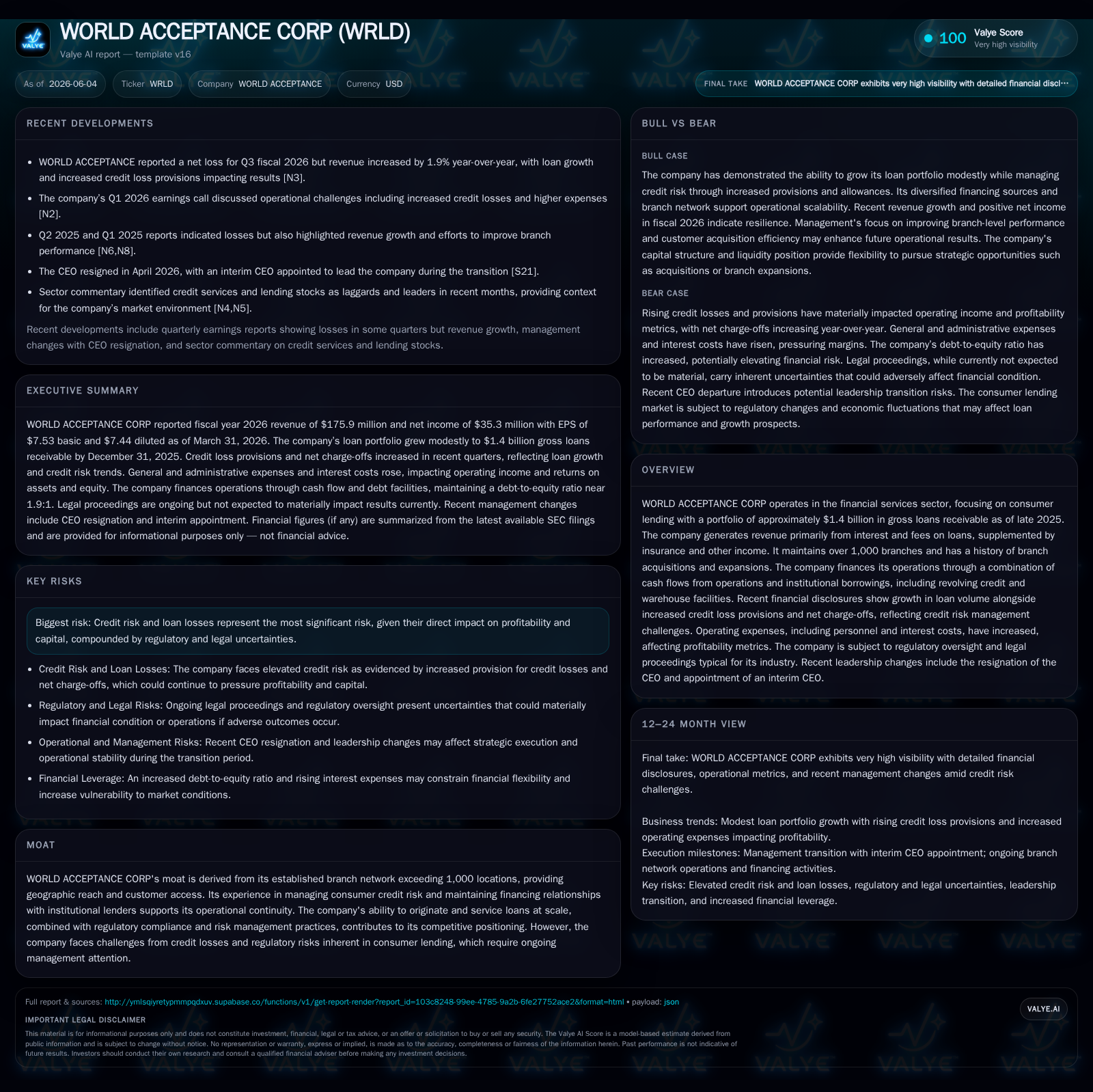
World Acceptance Corp's latest quarterly filing reveals a strategic increase in branch-level incentives and headcount aimed at boosting loan originations across its extensive network. This expansion is accompanied by a slight rise in occupancy costs and a marked reduction in advertising expenses, underscoring efforts to optimize customer acquisition. The company continues to navigate elevated credit losses and regulatory scrutiny, while executive leadership transitions suggest an enhanced focus on analytics-driven management. WRLD maintains solid cash flow generation and access to institutional financing to support its growth initiatives despite the challenges inherent in subprime consumer lending.
Latest Quarterly Operating Update
In its most recent quarterly filing (Q3 fiscal 2026), World Acceptance Corp reported a strategic operational shift marked by a significant increase in field-level incentives alongside expanded branch staffing intended to improve loan origination performance across its broad network of over 1,000 locations [S2]. Occupancy and equipment expenses experienced a marginal increase of approximately 1.2%, totaling $12.4 million for the quarter despite this expansion effort [S2]. Concurrently, advertising expenditures decreased by 15.5%, suggesting enhanced efficiency in customer acquisition programs likely through improved targeting or digital marketing optimization [S2]. These developments illustrate management's focus on balancing growth investments in human capital with disciplined cost control.
Business Model and Revenue Streams
World Acceptance’s business model centers on consumer installment lending with revenue primarily generated from interest income on a substantial loan portfolio valued near $1.4 billion as of late 2025 [S1]. Additional revenues stem from insurance commissions and other ancillary sources; however, these have contracted with insurance commissions declining nearly 5% year-over-year contributing to an overall 8% decrease in combined insurance commissions and other income for the nine months ended December 31, 2025 [S2]. This reflects evolving underwriting policies or product mix adjustments within the ancillary lines.
Expense Management: Incentives Versus Advertising Efficiency
The quarter saw increased investment in field-level incentives aligned with higher branch headcount aimed at boosting front-line productivity. While occupancy-related expenses rose slightly due to scaling physical infrastructure to support these enhancements, the notable reduction in advertising spend underscores progress in marketing efficiency—potentially leveraging analytics to reduce acquisition costs per loan without sacrificing volume growth [S2]. This expense allocation reflects a deliberate shift prioritizing direct customer engagement over broader media spending.
Industry Positioning and Competitive Context
WRLD’s extensive physical footprint provides a distinctive competitive advantage within the subprime consumer finance sector by delivering localized access that many digital-first lenders lack [S1]. This scale facilitates deeper borrower relationships which can be critical for underserved markets. Nonetheless, the company operates amid heightened regulatory scrutiny—including ongoing Consumer Financial Protection Bureau oversight—and macroeconomic pressures that elevate credit risk across the industry [S1]. Peer lenders face similar challenges balancing loan growth aspirations against rising net charge-offs.
Growth Drivers: Branch Network Expansion and Acquisition Efficiency
Growth prospects hinge on leveraging enhanced branch staffing incentivized for productivity gains alongside refined customer acquisition strategies that lower marketing expense ratios [S2]. The alignment of incentives with branch performance aims to increase quality originations while maintaining underwriting standards. Efficient marketing further supports margin improvement potential if loan volumes expand without proportional expense increases.
Risks: Credit Quality and Regulatory Environment
Elevated credit loss provisions remain the primary risk given borrower default probabilities inherent in WRLD’s target subprime segments [S1]. Rising net charge-offs weigh on earnings margins and necessitate vigilant risk management. Regulatory risks persist due to evolving federal priorities impacting compliance requirements; although current legal proceedings are not expected to result in material losses, adverse rulings or protracted litigation could materially affect financial outcomes [S1][S4]. Maintaining compliance while pursuing growth creates ongoing strategic tension.
Governance Update: Leadership Transition
Effective June 3, 2026, J. Tobin Turner was designated Principal Executive Officer for SEC reporting purposes while continuing as Executive Vice President and Chief Operating Officer [S3]. Turner’s background combines academic economics expertise with prior marketing analytics leadership at WRLD, indicating an increased emphasis on data-driven operational strategy amid competitive pressures. The transition followed the departure of interim CEO Janet Matricciani under an orderly succession plan [S3][S28].
Financial Position: Liquidity and Capital Structure
For the nine months ended December 31, 2025, WRLD generated robust operating cash flow totaling $164.8 million utilized for loan funding, acquisitions, debt repayment, and share repurchases [S2]. As of March 31, 2026, total debt approximated $587 million with cash balances near $6 million resulting in high net leverage consistent with capital-intensive consumer lending practices but supported by institutional credit facilities including revolving credit lines [F1][S2]. Effective interest rates including fees were moderate relative to market conditions.
This analysis integrates World Acceptance Corporation’s latest SEC disclosures with sector context highlighting how the company manages growth ambitions against credit risk challenges endemic to subprime installment lending. Execution discipline balancing targeted branch-level investments with underwriting rigor will be crucial amid regulatory complexities and evolving market dynamics.
Disclaimer: This report is for informational purposes only and does not constitute investment advice or research views.
Disclaimer: This is research-only, informational analysis and not investment advice. It may include AI-generated interpretation and general industry context. Always verify important details using primary sources.

Comments