
XCel Brands Faces Liquidity and Profitability Challenges While Leveraging Celebrity Licensing
The latest quarter highlights ongoing operational losses and cash constraints despite brand partnerships and product innovation.
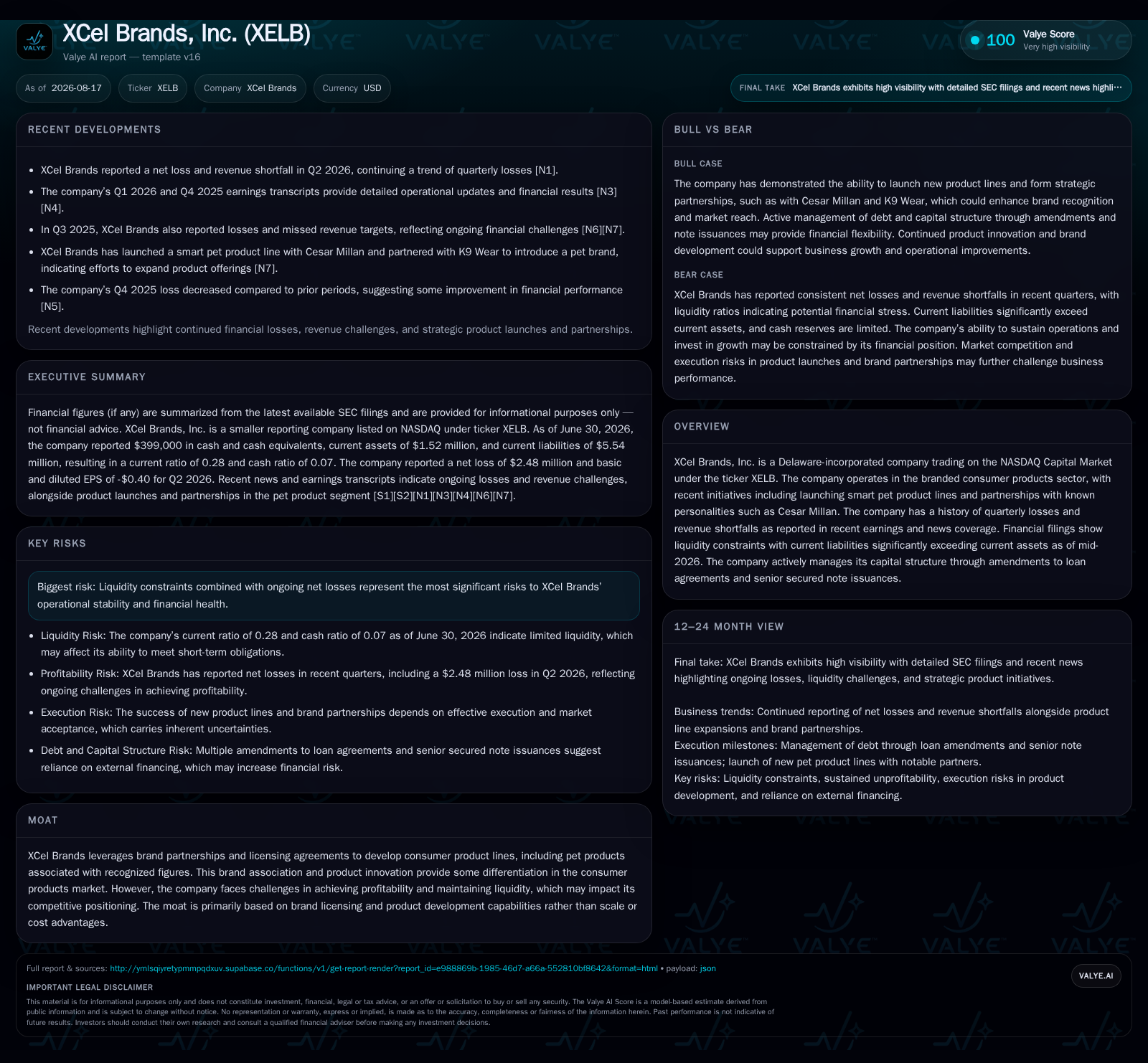
XCel Brands, Inc. continues to navigate a branded consumer products environment marked by revenue shortfalls and negative earnings. Its business model hinges on licensed consumer product lines, including smart pet products associated with Cesar Millan, yet liquidity metrics remain strained with a current ratio well below 1 and significant net debt. The company’s competitive moat centers on brand licensing and partnerships but faces pressure from ongoing operating losses and capital structure complexity. Key growth drivers include expanding licensed brand portfolios and new product development, while watchpoints focus on liquidity management, profitability improvements, and channel execution.
Recent Operating Update
XCel Brands reported its latest quarterly financials in the 10-Q filed August 13, 2026 [S2]. The quarter reinforced persistent challenges with continued net losses and revenue performance that lagged analyst expectations [N1]. While precise quarterly revenue figures are not detailed in recent filings, earlier revenue disclosures confirm subdued top-line scale relative to operating expenses. This gap sustains pressure on cash flow metrics.
Operating income remained negative through the prior fiscal year ending December 31, 2025 with a reported operating loss of $13.2 million and a net loss exceeding $17 million [F1]. These losses underpin the company's ongoing struggle to convert brand licensing efforts into profitable sales growth.
Business Model Overview
XCel Brands operates principally as a licensor of branded consumer products. Its business model centers on securing licensing agreements leveraging celebrity partnerships—most notably with Cesar Millan—to develop proprietary consumer product lines such as smart pet accessories [S1]. Revenue is generated primarily through wholesale sales of finished goods branded under these licenses to retail distributors and through direct e-commerce channels.
The monetization mechanics depend heavily on effective brand management, product innovation that resonates with end consumers, plus distribution partnerships that ensure retail shelf presence and online visibility. Licensing fees constitute a critical component of cost structures impacting margins. Yet because XCel outsources manufacturing and logistics to third-party providers, its gross margin hinges largely on license terms negotiated versus wholesale pricing power.
Retail sell-through rates are essential KPIs for validating product-market fit post-launch; delays or failures here can exacerbate inventory risk—a notable concern given the company's constrained liquidity position [S1]. This outsourcing model reduces capital intensity but increases reliance on supply chain agility, especially when launching new lines like their recent smart pet technology.
Industry Structure and Competitive Position
XCel Brands sits in the branded consumer products sector specializing in licensing celebrity-endorsed brands to create differentiated offerings. Industry peers such as Iconix Brand Group and Sequential Brands Group illustrate parallel models that emphasize portfolio breadth combined with licensing renewal strategies.
Competitive advantage for XCel derives chiefly from its ability to attract brand partnerships that deliver unique consumer appeal—Cesar Millan's association exemplifies this dynamic by providing a recognizable personality imprint on product lines. However, unlike larger peers who leverage scale for cost efficiencies or broader distribution agreements, XCel’s advantage is more tactical: the strength of its relationships and product innovation pipeline rather than volume-driven pricing leverage.
Given the modest enterprise size evidenced by sub-$10 million historical revenues [F1] yet multi-million-dollar operating losses [F1], scalability remains limited without significant capital infusion or operational turnaround.
Growth Drivers
Key levers for XCel’s growth rest in several areas:
- Expansion of Licensed Brand Portfolio: Securing additional celebrity or influencer partnerships can diversify revenue streams beyond existing pet-focused ranges.
- Product Innovation Success: Rolling out new products that capture emerging consumer trends—such as connected or smart pet accessories—increases relevance.
- Channel Development: Increasing penetration across both traditional retail outlets and direct-to-consumer e-commerce platforms enhances sales volume opportunities.
- Strategic Acquisitions or Licensing Deals: Acquisitions providing established brands or new market footholds could accelerate growth if funding conditions permit.
- Brand Awareness Initiatives: Marketing investments to improve consumer engagement will be critical alongside product availability to drive sell-through metrics positively.
Monitoring these drivers requires tracking KPIs like retail sell-through rates post-launch, licensing fee expense control for margin management, inventory turnover efficiency reflecting supply chain health, and direct e-commerce conversion trends.
Risks and Constraints
Several risk factors threaten XCel’s trajectory:
- Liquidity Constraints: As indicated by a current ratio around 0.28 [F1], the company's immediate financial obligation coverage is weak.
Overall execution on these fronts will clarify whether XCel can transition from its current challenged state toward sustainable profitability within the branded consumer products ecosystem.
Financial Profile Discussion
As of June 30, 2026, XCel Brands held approximately $399 thousand in cash and equivalents against total debt around $13.3 million based on March-end data—implying substantial net debt near $12.9 million [F1]. The disparity between current assets ($1.52 million) and liabilities ($5.54 million) resulted in a low current ratio of about 0.28 [F1], pointing to acute short-term funding pressures that constrain daily operations.
This liquidity scarcity aligns with persistent operational losses exceeding $13 million annually [F1], reflecting structural challenges converting licensed brands into consistently profitable product sales. The company has responded by amending loan agreements multiple times throughout early 2026 [S5], including issuing senior secured notes with related security interests tied partly to intellectual property assets [S6], aiming to shore up near-term capital requirements.
Additionally, equity raise mechanisms such as the common stock purchase agreement committed by White Lion Capital up to $15 million provide potential albeit conditional options for capital infusion subject to market execution [S27]. Nonetheless, dependence on external financing underscores vulnerability until operating improvement materializes sustainably.
It does not constitute investment advice but provides an industry-informed analytical perspective respecting evidence boundaries.
Disclaimer: This is research-only, informational analysis and not investment advice. It may include AI-generated interpretation and general industry context. Always verify important details using primary sources.

Comments