
Xperi Inc. Battles Declining Revenue and Restructuring Headwinds in Technology Licensing
Xperi's 2025 financial results underscore tension between shrinking revenues and ongoing efforts to streamline operations within its IP licensing business.
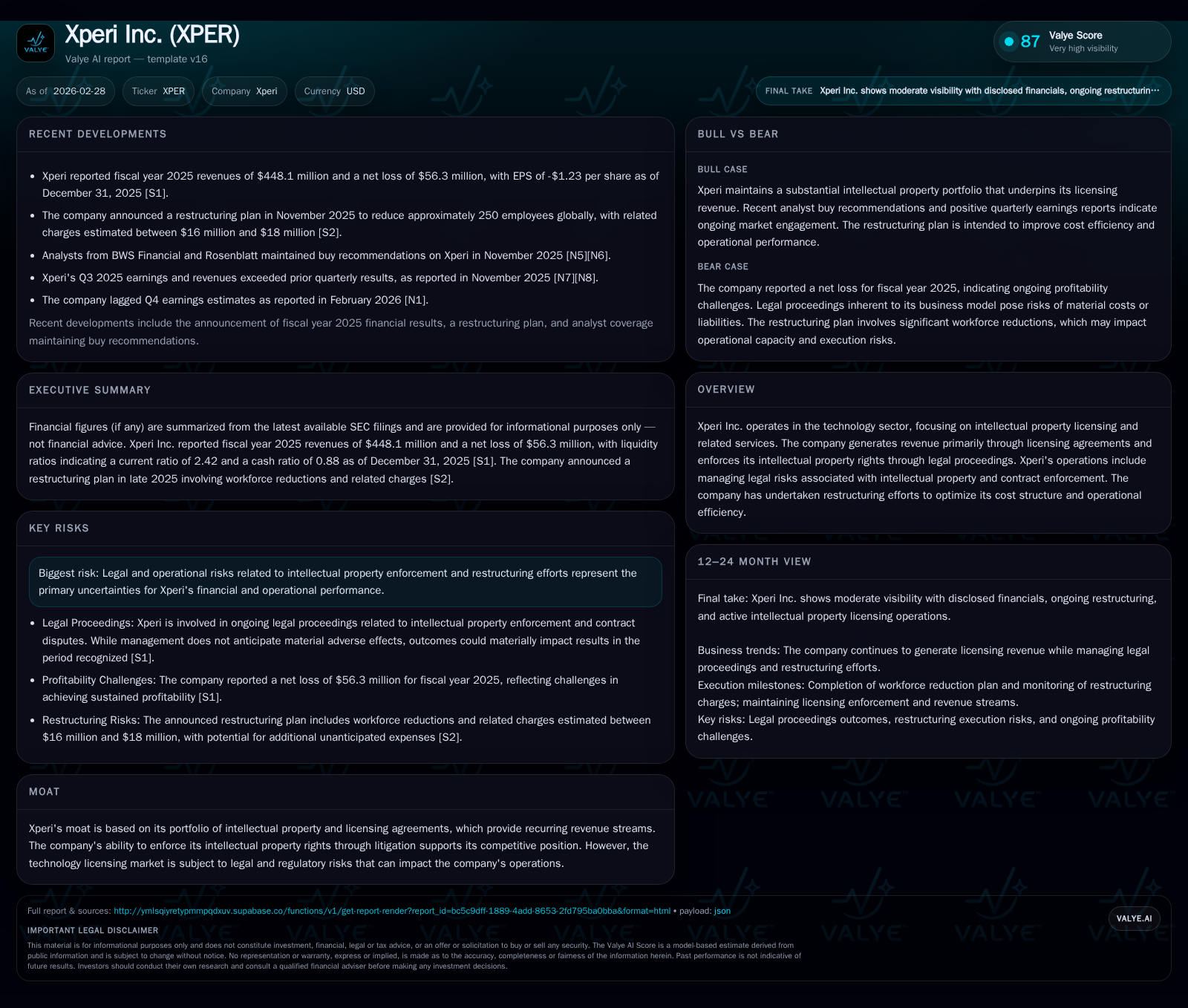
Xperi Inc. reported a continuation of declining revenue in FY2025, dropping 9.2% year-over-year to $448.1 million. Operating losses narrowed by nearly half, yet net income deteriorated due largely to restructuring charges. The company’s licensing model provides solid recurring royalty streams protected by litigation, but legal risks and contract enforcement challenges persist. A strategic restructuring plan initiated late in 2025 aims to optimize costs and improve operating efficiency, with estimated charges of $16-$18 million focused on workforce reductions. Despite headwinds, Xperi maintains healthy liquidity with a current ratio above 2 and over $96 million in cash reserves. Capital deployment has slowed significantly, with no share repurchases in 2025 following $20 million in buybacks in 2024.
Historical Revenue Trends and Operating Performance
Xperi’s financial trajectory from fiscal year 2022 through 2025 reveals a pattern of contracting revenues paired with improving operating results but persistent net losses. Revenue peaked at about $521 million in FY2023 before retreating to approximately $493.7 million in FY2024 and further down to $448.1 million in FY2025 — a sharp overall decline representing a -9.2% decrease just between FY2024 and FY2025 [F1].
Despite the top-line pressure, operating loss substantially narrowed from an outsized -$749 million loss in FY2022 (impacted by significant non-recurring items) down steadily over the ensuing years to -$43.7 million in FY2025 [F1]. This nearly halved operating loss from the prior year bluntly signals ongoing cost control measures and operational improvements amid revenue pressures.
However, net income tells a different story largely due to one-time restructuring charges incurred in FY2025: net losses widened sharply to -$56.3 million after a less severe -$14 million net loss in FY2024, indicating volatility driven more by extraordinary items than core operations [F1].
Operating cash flow exhibited improvement turning positive relative to previous years’ outflows but remained constrained at just -$515,000 versus -$55.3 million one year earlier, highlighting fragile cash generation dynamics [F1]. After accounting for capital expenditures near $5.4 million, free cash flow stayed modestly negative by roughly -$5.9 million.
Historical performance (annual)
| FY | Rev ($mm) | Net ($mm) | CFO ($mm) | OpInc ($mm) | Rev YoY | Net YoY |
|---|---|---|---|---|---|---|
| 2025 | 448 | -56 | -1 | -44 | -9.2% | -302.2% |
| 2024 | 494 | -14 | -55 | -87 | -5.3% | +89.7% |
| 2023 | 521 | -137 | 0 | -130 | +3.8% | +82.0% |
| 2022 | 502 | -757 | -28 | -749 |
Source: SEC companyfacts cache [F1].
Capital returns and efficiency (annual)
| FY | Buybacks ($mm) | FCF ($mm) | ROE% |
|---|---|---|---|
| 2025 | 0 | -6 | |
| 2024 | 20 | -60 | -3.3 |
| 2023 | -13 | -33.8 | |
| 2022 | -43 | -163.5 |
Source: SEC companyfacts cache [F1].
Table summarizes revenue contraction alongside narrower operating losses but continued negative net results; cash flow recovering but still under stress.
Intellectual Property Licensing Model: Strengths and Challenges
Xperi’s principal business model centers on monetizing its intellectual property portfolios through licensing agreements that generate recurring royalty income streams [S1]. These royalties form the backbone of consistent revenues despite market fluctuations.
The company actively enforces its licensing rights against infringement or breach via litigation when necessary — an aspect critical for protecting revenue integrity and supporting competitive moat , [S4]. This enforcement capability sustains recurring license fees that underpin the company's predictable cash flows.
However, this model also exposes Xperi to significant legal and contractual risks; disputes over license terms or patent validity are both frequent and costly [S1], [S4]. The technology licensing space is subject to evolving regulation and judicial interpretations which could affect revenue certainty.
The recurring nature of IP royalties is an advantage over transactional revenue models seen elsewhere in tech sectors but maintaining this steady income requires sustained legal vigilance and timely contract renewals.
Legal Risk Profile and Litigation Impact on Operations
Legal proceedings constitute a pervasive operational facet for Xperi given its reliance on intellectual property enforcement [S4], [S5]. Historically, the company has engaged actively both offensively and defensively in litigation ranging from infringement claims to contract disputes.
Management acknowledges the inherent unpredictability of these matters; while they do not anticipate any material adverse cumulative effect on overall results or liquidity at present, individual case outcomes can produce significant swings within reporting periods [S1], [S4], [S5].
Ongoing litigation expense contributes non-trivial costs that weigh on profitability margins; potential liabilities or settlement impacts remain part of the risk profile requiring close monitoring.
2025 Restructuring Plan: Strategic Objectives and Costs
In Q4 2025, Xperi initiated a global workforce reduction plan cutting approximately 250 jobs across all functions as part of broader efforts to optimize cost structure and enhance operational efficiencies [N1], [S12]. This action responds directly to financial pressures evidenced in recent years.
The restructuring is expected to run through mid-2026 with anticipated aggregate charges between $16 million and $18 million predominantly tied to severance payouts payable largely in cash [S12]. While imposing short-term earnings headwinds reflected in FY2025 net losses, this foundational reset targets longer-term margin improvement.
This initiative reflects management’s recognition that controlling overhead is essential for transition toward sustainable profitability given the constricting top-line environment.
Prospects for Revenue Recovery and Growth Catalysts
Signals for stabilizing or reversing revenue declines are cautiously framed within Xperi’s recent disclosures [N1], [S1], [S2]. Potential drivers include successful resolution of ongoing patent disputes which may unlock additional licensing inflows and expansion into new IP domains leveraging existing technological expertise.
Conversely, regulatory uncertainties surrounding technology patent enforcement and competitive erosion from alternative technologies represent persistent headwinds.
Post-restructuring operational efficiency gains could support margin expansion if licensing revenues hold steady or grow marginally though management stops short of explicit guidance on near-term topline rebounds [N1].
Capital Structure, Liquidity, and Cash Flow Trends
Xperi enters calendar year-end 2025 with a solid liquidity buffer: cash & equivalents stand near $97 million against current liabilities totaling approximately $111 million yielding a healthy current ratio of about 2.42 — underscoring short-term balance sheet stability [F1], [S9].
Total current assets at about $267 million provide additional coverage beyond immediate liabilities supporting working capital needs.[F1]
Debt repayment details are limited beyond disclosed notionals; however, given negative earnings profiles free cash flow remains under pressure with CFO nearly neutral at end-FY25 [-$0.52M] coupled with modest capex [$5.38M] sustaining slightly negative free cash flow around-$5.9M aligning with the restructuring outlays deploying liquidity prudently.[F1]
Capital Deployment: Dividends, Buybacks, and Returns Analysis
Following a buyback program totaling nearly $20 million executed during FY2024, Xperi halted repurchases entirely in FY2025 signaling conservatism amid ongoing operational challenges [F1], [S13], [S14]. There were no dividend distributions reported.
Calculated return on equity for FY2025 stands negative around -13%, reflecting sustained bottom-line deficits against shareholder equity of over $429 million as of FY24-end [F1].
This restrained capital return policy suggests prioritization of balance sheet fortification and restructuring funding over shareholder payouts during the transitional phase.
Key Milestones Ahead and Metrics to Monitor
Attention should remain fixed on near- to mid-term developments including:
- Completion timeline for restructuring program targeted for mid-2026 completing workforce reductions [N1], [S12].
- Outcomes from pending legal settlements that can influence licensing-related revenue streams materially.[S4]
- Operating cash flow evolution indicating effective cost control translating into stronger liquidity generation post-restructuring.
- Any management commentary updates hinting at topline stabilization or growth beyond currently observed declines.
Monitoring these markers will offer direct insight into whether Xperi’s repositioning translates into sustainable profitability enhancements amid an inherently risk-laden IP licensing landscape.
This report synthesizes publicly filed SEC documents and recent news releases without offering investment advice or forecasts beyond documented disclosures.
Disclaimer: This is research-only, informational analysis and not investment advice. It may include AI-generated interpretation and general industry context. Always verify important details using primary sources.

Comments