XTL Biopharmaceuticals Ltd.: Navigating IP Assets and New Frontiers in Autism Therapeutics
XTL Biopharmaceuticals operates as an intellectual property portfolio company with recent strategic moves into autism therapeutics and web data services.
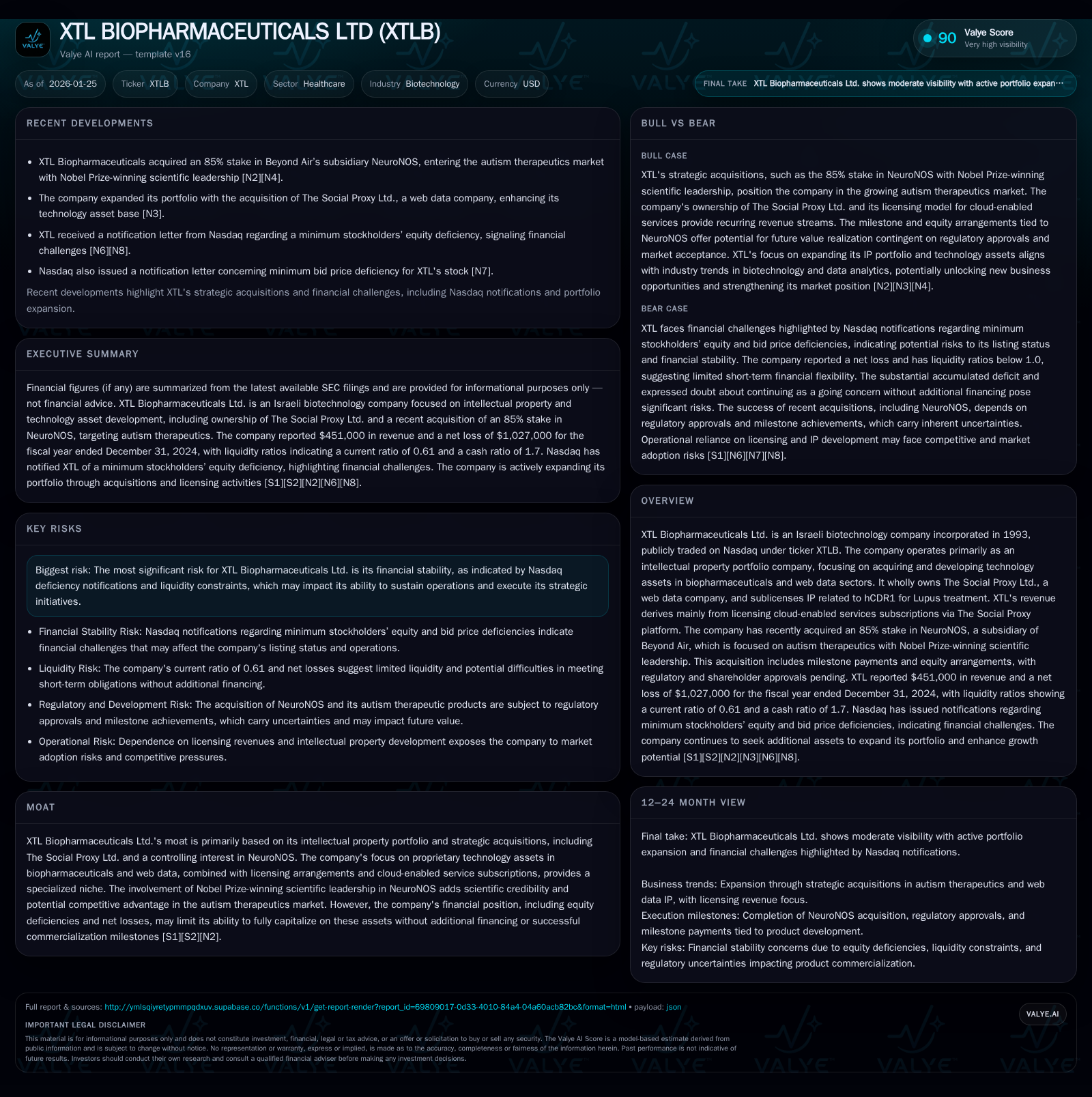
XTL Biopharmaceuticals Ltd. is an Israeli biotechnology company primarily focused on managing a portfolio of intellectual property assets, including a web data platform and sublicensed biopharmaceutical IP. Its recent acquisition of an 85% stake in NeuroNOS, a company targeting autism therapeutics with Nobel Prize-winning scientific leadership, marks a significant strategic pivot. Despite these growth initiatives, the company faces financial headwinds, including Nasdaq equity deficiency notifications and continued net losses, raising questions about its operational sustainability without additional funding. The firm’s business model spans licensing cloud-enabled services through The Social Proxy platform and developing early-stage biopharma assets, with key challenges rooted in capital constraints and commercialization pathways.
What Changed Recently
XTL Biopharmaceuticals made a significant strategic move in January 2026 by acquiring an 85% stake in NeuroNOS, a subsidiary of Beyond Air focused on autism therapeutics. This transaction, announced on January 13, 2026, includes milestone payments and equity arrangements. The acquisition is contingent upon regulatory and shareholder approvals, which remain pending as of this date [N6][N7][N9]. Concurrently, the company continues to operate The Social Proxy Ltd., a wholly owned subsidiary offering cloud-enabled web data services, which remains the primary driver of current revenue.
However, recent disclosures revealed Nasdaq deficiency notifications related to minimum stockholders’ equity and minimum bid price requirements, highlighting financial distress and raising concerns about compliance with listing standards [N2][N4][N8]. The share price and trading activity reflect these challenges, with market data showing volatility and limited liquidity [N3][N5].
Business Model as a System
XTL Biopharmaceuticals functions primarily as an intellectual property portfolio company, with two main operational pillars: the web data platform The Social Proxy and a sublicensed biopharmaceutical IP portfolio related to hCDR1 for treating lupus (SLE). Revenues derive predominantly from licensing cloud-enabled subscriptions via The Social Proxy platform, which supplies proxy-based data extraction services designed for ethical and compliant use of web data [S1][S4].
The company’s biopharmaceutical activities are more asset-based and developmental in nature, focusing on sublicensing and strategic acquisitions rather than internal drug development. Historically, XTL pursued therapeutic programs across various indications (hepatitis B and C, diabetic neuropathic pain, schizophrenia, SLE, multiple myeloma), most of which have been terminated. This history suggests a shift away from direct pharmaceutical R&D towards managing and monetizing IP assets [S3].
The recent acquisition of NeuroNOS introduces a new dimension: early-stage biotech focused on autism therapeutics with a foundation in Nobel Prize-winning scientific leadership. This deal expands XTL’s portfolio into a high-potential specialty area but also increases operational complexity and capital requirements. The transaction structure involves milestone payments and equity exchanges contingent on due diligence, regulatory approvals, and shareholder consent, illustrating the intricate nature of integrating such assets [S5][N6][N9].
Financially, XTL’s cost of services includes hosting, carrier services, subcontractors, and amortization of intangible assets related to its technology platforms. Sales and marketing expenses are primarily linked to The Social Proxy and encompass salaries, subcontractors, advertising, and intangible assets amortization. General and administrative costs cover management, consultants, professional fees, investor relations, and business development [S1][S2].
Industry Map & Competitive Battlefield
XTL straddles two distinct but specialized markets: web data services via proxy and intellectual property portfolio management in biopharmaceuticals.
Web Data Proxy Services
The Social Proxy platform operates in a niche segment of cloud-enabled web data extraction and proxy services. This market is characterized by increasing demand for scalable, secure, and privacy-compliant data solutions, especially as internet privacy regulations tighten globally. Competitors include specialized proxy service providers, data aggregators, and AI-driven data analytics firms.
XTL’s differentiation rests on its ethical approach to data utilization, transparency, and compliance, which are critical given heightened scrutiny on web data practices. The ability to offer subscription-based cloud services enables recurring revenue streams, but scalability depends on maintaining robust infrastructure and evolving with regulatory changes [S4].
Autism Therapeutics & Biopharmaceutical IP
The acquisition of NeuroNOS positions XTL in the autism therapeutics sector, a complex and competitive field within neurodevelopmental disorders. This segment is marked by significant scientific challenges, high R&D costs, and lengthy regulatory pathways. The involvement of Nobel Prize-winning scientists provides scientific credibility and a potential moat, but the pathway to commercial success is uncertain and capital intensive.
Within biotech, XTL’s model of acquiring and sublicensing IP contrasts with traditional drug development firms focused on internal pipelines. Competitors in autism therapeutics range from large pharma to specialized biotech startups, many pursuing novel mechanisms of action and personalized medicine approaches.
The combined portfolio approach means XTL operates at the intersection of tech-driven data services and high-risk biotech development, requiring diverse expertise and financing strategies.
Where the Economics Become Real
XTL’s reported revenue of $451,000 indicates modest current scale, primarily from The Social Proxy subscriptions. Gross profit margins are not disclosed explicitly but cost of service expenses include fixed and variable components such as hosting fees and amortization of intangible assets [S9].
The net loss of approximately $1,027,000 highlights the company’s ongoing operational burn, amplified by sales, marketing, and administrative expenses tied to both technology and biopharma activities [S9]. The current ratio of 0.61, derived from $1.34 million in current assets against $2.2 million in current liabilities, underscores near-term liquidity constraints [S9]. Cash and equivalents stood at $371,000 at the end of 2024, suggesting limited runway without new financing or revenue growth [S9].
The NeuroNOS acquisition adds milestone-based payments and potential equity dilution, introducing financial obligations that will pressure liquidity further until clinical and regulatory progress can unlock value [N6][N9].
Recurring revenues from The Social Proxy offer some stability, but the platform must scale its customer base and manage hosting and subcontracting costs efficiently to improve margins. The amortization of intangible assets indicates capitalized IP investments, which will require commercialization success to justify their valuation.
XTL’s non-cash compensation, including stock options valued via Black-Scholes models, also impacts reported expenses but does not affect cash flow directly [S1][S2].
Diligence Questions / Disconfirming Signals
Financial Sustainability: Given the Nasdaq deficiency notifications for minimum equity and bid price, how does XTL plan to meet listing requirements and avoid delisting? Are there concrete financing plans or capital raises underway?
NeuroNOS Integration Risks: What is the detailed timeline and probability of regulatory and shareholder approvals for the NeuroNOS acquisition? How will XTL manage the operational risks and capital demands of early-stage autism therapeutics development?
Commercialization Pathway: What are the concrete clinical and regulatory milestones for the NeuroNOS autism program? How well validated is the underlying IP, and what is the competitive landscape in terms of ongoing clinical trials and alternative therapies?
Revenue Growth from The Social Proxy: What is the current customer base size and churn rate? How scalable is the platform technically and commercially, particularly given evolving privacy regulations?
IP Portfolio Monetization: Beyond NeuroNOS and The Social Proxy, what other IP holdings does XTL have, and what are the prospects and timelines for monetizing those assets?
Capital Allocation and Burn: How does the company prioritize spending between technology services growth and biopharmaceutical development? Is there sufficient financial discipline and transparency to sustain operations?
Market and Regulatory Risks: How might geopolitical or regulatory developments in Israel or global markets impact XTL’s operations, especially considering its cross-sector footprint?
Management and Governance: Does XTL have the necessary expertise and governance frameworks to manage its diversified portfolio and complex transactions, including integration of high-profile scientific assets?
Conclusion
XTL Biopharmaceuticals Ltd. presents a unique case of an IP portfolio company balancing technology-driven web data services with nascent biopharmaceutical ventures. The recent acquisition of NeuroNOS offers a strategic entry into the autism therapeutics market, leveraging high-profile scientific leadership. However, the company’s financial condition, marked by recurring losses and Nasdaq equity deficiencies, poses significant operational challenges. The business model’s hybrid nature demands strong execution capabilities in both technology and biotech domains, alongside effective capital management.
The evolution of XTL will hinge on successful integration and advancement of NeuroNOS, scaling subscription revenues from The Social Proxy, and navigating financial and regulatory hurdles. Given limited disclosed clinical progress and ongoing liquidity concerns, the company remains in a high-risk, early-stage position. Observers should monitor developments on financing, regulatory approvals, and operational execution to better assess future prospects.
This analysis is based on publicly available information as of January 2026 and does not constitute investment advice or recommendations.
Disclaimer: This is research-only, informational analysis and not investment advice. It may include AI-generated interpretation and general industry context. Always verify important details using primary sources.

Comments