
YETI Holdings Q2 2026: Revenue Growth and Margin Expansion Drive Raised Profit Outlook
YETI reported strong Q2 2026 results with broad-based sales growth and margin improvement, leading to an updated full-year profit outlook.
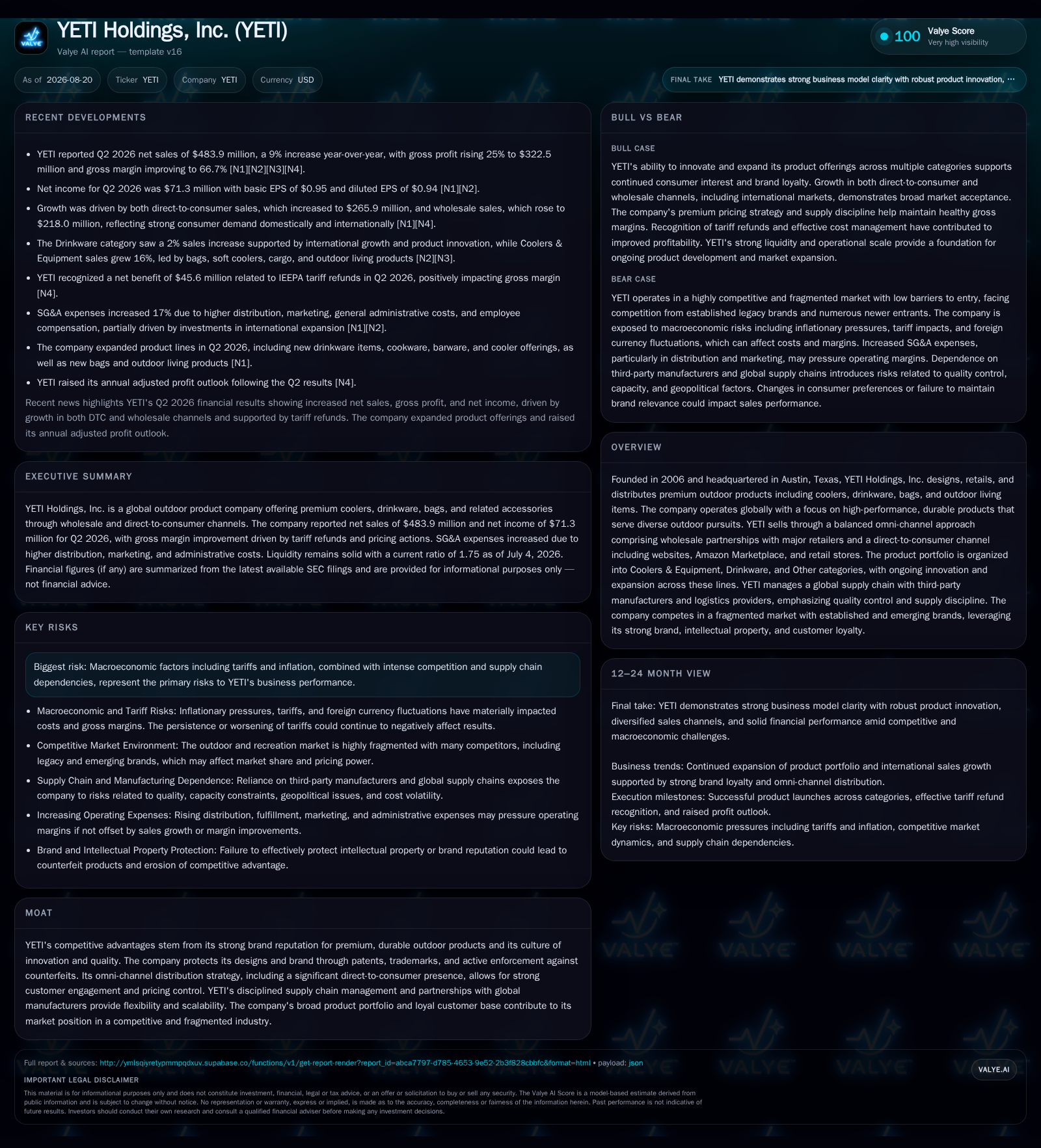
YETI Holdings, Inc. posted solid financial results for Q2 2026, with net sales increasing year-over-year across both direct-to-consumer and wholesale channels. The company achieved gross margin expansion driven by favorable product mix and disciplined supply chain management. These operational strengths supported a raised full-year adjusted profit outlook. YETI's balanced omni-channel distribution and premium product portfolio underpin its structural growth potential amid competitive and macroeconomic challenges.
YETI Holdings, Inc. reported strong financial results for Q2 2026, with net sales increasing and gross margin expanding compared to Q2 2025, leading the company to raise its adjusted profit outlook [S2]. This performance reflects YETI's operational strength and effective management of its brand and supply chain, supporting growth and profitability in the competitive outdoor products market. The company’s revenue growth was driven by broad-based demand across both its direct-to-consumer channel—including sales through company websites, Amazon Marketplace, and retail stores—and its wholesale channel, which includes national and regional retail partners across multiple countries [S2].
Gross margin expanded in Q2 2026, supported by a favorable product mix and disciplined supply chain management [S2]. This margin improvement underpins enhanced operating leverage and profitability.
Its product portfolio is positioned at the premium end of the market, targeting consumers who value durability, functionality, and design quality [S1].
The company’s revenue model relies on a balanced omni-channel distribution platform. Wholesale partnerships with select national and regional retailers—such as Dick's Sporting Goods, REI, and Bass Pro Shops in the U.S., and comparable retailers internationally—complement direct-to-consumer sales through YETI’s own websites, Amazon Marketplace, and branded retail stores [S2]. This diversified channel mix supports revenue resilience and pricing control, as the DTC channel typically offers higher margins while wholesale partnerships expand geographic reach and customer access.
YETI also offers customized corporate sales programs, providing branded products for events and resale, further diversifying revenue streams [S1]. The company’s culture of innovation and product development drives ongoing expansion of its portfolio, which in turn supports sustained customer engagement and brand loyalty.
Financial Position and Liquidity
As of July 4, 2026, YETI reported current assets of approximately $717 million and current liabilities of around $410 million, resulting in a current ratio of 1.75 [F1]. This ratio indicates a moderate liquidity buffer, sufficient to support operational needs and working capital requirements in the near term.
The company’s ability to maintain supply chain discipline and favorable product mix contributes not only to margin expansion but also to effective working capital management. These factors are critical in the consumer outdoor retail sector, where inventory turnover and cost control directly impact profitability.
Risks and Industry Context
YETI operates in a competitive consumer outdoor retail industry characterized by premium pricing, brand loyalty, and product innovation. Key performance indicators include revenue growth by channel, gross margin influenced by product mix, customer acquisition costs, and supply chain efficiency.
While brand loyalty and product innovation provide structural growth drivers, macroeconomic factors such as inflation, tariffs, and consumer discretionary spending shifts introduce cyclical risks. The company’s premium pricing strategy and reliance on discretionary outdoor spending make it sensitive to these external pressures [S1]. Competitive pressures from both established and emerging outdoor brands also present ongoing challenges to maintaining market share and margin levels.
Analytical Conclusions and Scenario Analysis
The broad-based revenue growth across both DTC and wholesale channels in Q2 2026 suggests that YETI’s performance reflects structural strength in brand loyalty and omni-channel distribution rather than a temporary demand spike [S2][S1]. However, this margin improvement could face pressure if macroeconomic factors such as inflation or tariffs worsen, given the company’s exposure to cost inputs and competitive pricing dynamics.
Looking ahead, one possible bull case is that YETI continues to leverage its strong brand equity, omni-channel reach, and product innovation to sustain above-market revenue growth and margin expansion. Confirmation of this scenario would include sustained revenue growth in subsequent quarters, further margin improvement or stability, and positive updates to full-year guidance.
The base case envisions steady growth with modest margin improvements, balancing competitive pressures and macroeconomic headwinds. This would be confirmed by flat to moderate revenue growth, stable margins, and consistent guidance.
Conversely, a bear case could arise if macroeconomic pressures and intensified competition erode demand and margins, leading to revenue stagnation or decline and margin compression. Evidence for this scenario would include declining revenue or market share, margin compression, and downward revisions to guidance.
Watchpoints
Investors and analysts should monitor subsequent quarterly revenue growth by channel to assess whether the broad-based growth trend continues. Gross margin trends and shifts in product mix will be critical to understanding margin sustainability. Supply chain cost pressures and inventory levels should be watched closely given their direct impact on profitability. Finally, updates to full-year guidance and any capital allocation decisions will provide insight into management’s outlook and financial discipline.
In summary, YETI’s Q2 2026 results demonstrate operational strength in a competitive market, supported by a balanced omni-channel distribution approach and disciplined supply chain management. While macroeconomic risks remain, the company’s premium brand and product innovation offer structural advantages that underpin its raised profit outlook.
Disclaimer: This is research-only, informational analysis and not investment advice. It may include AI-generated interpretation and general industry context. Always verify important details using primary sources.

Comments