
Yext, Inc. Clarifies Strategy With Flat Revenue but Expands Publisher Network
Yext reported a pause in revenue growth for Q1 2027 amid intensifying competition but is boosting its market positioning through product enhancements and expanding digital channel integrations.
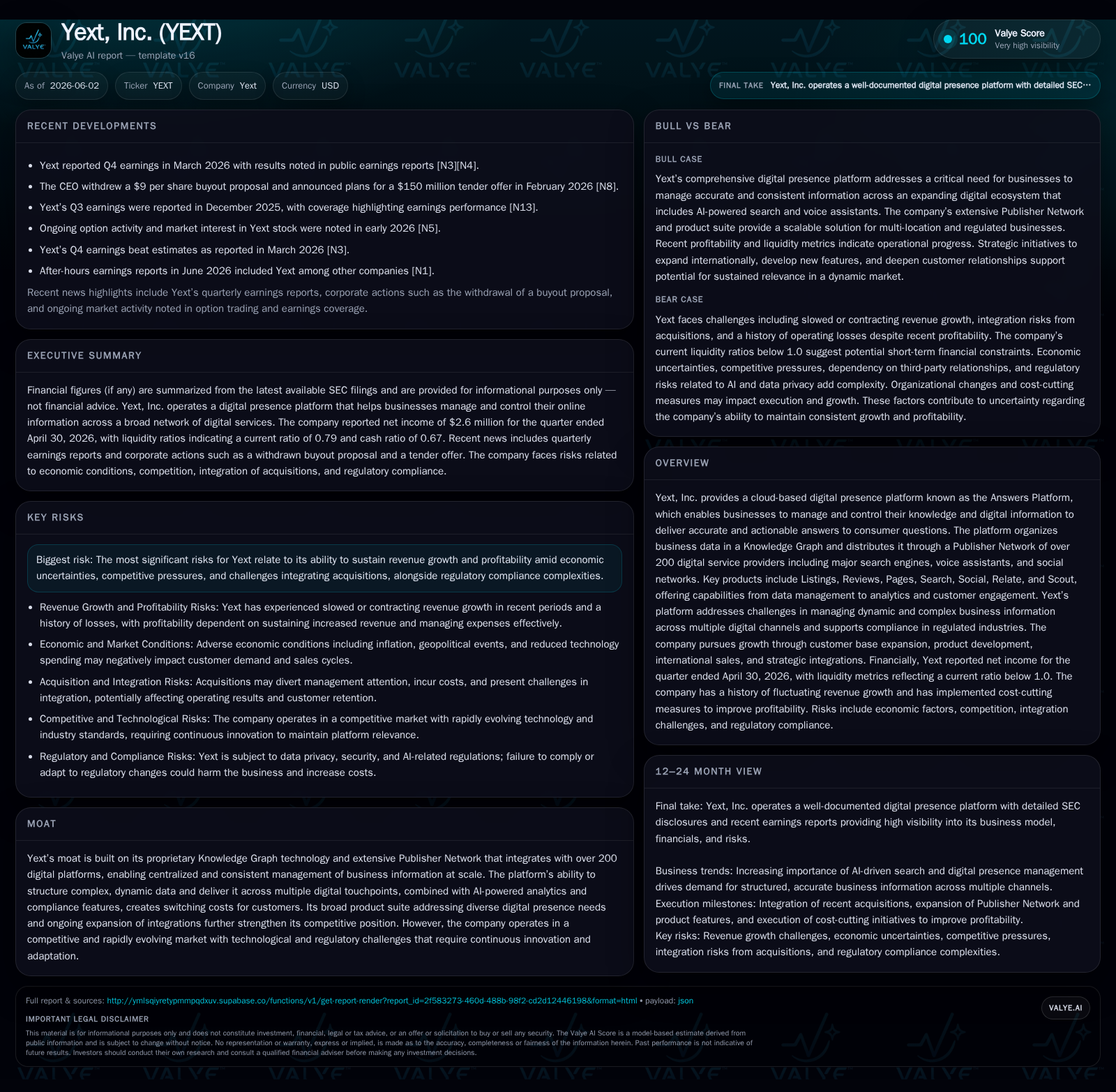
Yext's Q1 2027 results highlight revenue pressures in an increasingly competitive SaaS landscape. The company continues to rely on its proprietary AI-powered Knowledge Graph platform to manage digital business presence across an extensive Publisher Network of over 200 partners. While subscription sales growth is challenged by longer enterprise sales cycles and evolving consumer search behaviors, Yext is driving retention and upsell through product breadth and new AI-driven features. Risks remain over profitability and effective sales execution, but recent initiatives focus on sustaining competitive advantages in a fragmented market transitioning towards AI-powered discovery and engagement.
Recent Quarterly Operating Update Highlights Challenges and Initiatives
Yext’s latest quarterly filing for Q1 2027 (10-Q dated June 2, 2026) reveals a marked slowing in revenue growth with essentially flat top-line performance relative to prior periods [S2]. Management commentary in the accompanying Form 8-K further underscores heightened competitive pressures within the SaaS digital presence ecosystem alongside ongoing macroeconomic uncertainties that have tempered new customer acquisitions and upsell velocity [S3]. Despite the revenue pause, Yext highlights continued strategic investments in its platform capabilities, including accelerated integration of AI functionalities aimed at adapting to evolving consumer search trends that rely more heavily on conversational queries rather than simple keyword searches [S2],[S3].
Notably, the company confirmed progress in expanding its Publisher Network beyond 200 digital service providers — a critical driver for its content distribution strategy — enhancing reach across key channels such as voice assistants (Amazon Alexa), major search engines (Google, Bing), social networks (Facebook), and emerging platforms like OpenAI-powered applications [S1],. This network expansion underpins the ability to deliver consistent and authoritative business information at scale.
The filings also caution that complex enterprise sales cycles continue to delay immediate revenue translation from pipeline opportunities; subscription renewals remain pivotal but show signs of pressure as some customers reassess budgets in light of economic headwinds [S2]. The subscription-recognition accounting approach further masks short-term fluctuations making quarter-to-quarter trends volatile.
Yext’s Business Model Centered on Its AI-Driven Knowledge Graph Platform
At the core of Yext’s business model is its proprietary Knowledge Graph technology — an AI-powered structure organizing dynamic business information such as location data, hours, reviews, products, and services — distributed systematically across an ecosystem of over 200 integrated publishers [S1],. Customers pay recurring subscription fees for access to this cloud-based Answers Platform, which spans products addressing Listings management, Reviews analytics, Pages creation, Search capabilities, Social engagement, audience Relate tools, and Scout monitoring services.
The platform addresses a fundamental challenge for enterprises: controlling fragmented scattered digital footprints across multiple channels to present consumers with accurate answers instantly. This capability creates a form of switching cost as replacing or replicating the extensive integrations and proprietary data structuring would be prohibitively complex for customers. Moreover, Yext’s product breadth enables cross-selling opportunities — existing clients often expand usage from listings management into reviews or search products — thereby supporting net retention despite slower new logo acquisition.
Recurring subscription revenue aligns business incentives toward long-term client engagement but entails an elongated sales cycle reflective of B2B SaaS norms involving technical integration reviews and approval processes within large organizations. Additionally, Yext’s focus on regulated industries like healthcare emphasizes compliance features in the platform which serve as a strategic differentiator but also increase implementation complexity.
Competitive Positioning and Industry Dynamics in Digital Presence Software
Yext operates within a highly fragmented market where multiple players offer overlapping solutions for digital presence management, reputation control, search engine optimization (SEO), and customer interaction analytics. Its moat derives principally from two intertwined assets: (a) the proprietary Knowledge Graph that harmonizes complex datasets at scale using AI techniques; and (b) a broad Publisher Network encompassing over 200 key third-party platforms including dominant online ecosystems and emerging conversational interfaces, [S1]
This integration scale surpasses many regional or niche competitors who often rely on manual updates or single-channel syndication methods. In contrast to legacy data aggregators that supply "best guess" information fraught with inaccuracies due to inconsistent sourcing, Yext’s approach emphasizes direct control over client data models ensuring freshness and factual correctness across all digital touchpoints. Such precision becomes increasingly vital as consumer behavior shifts toward natural language queries processed via large language models embedded within search engines and voice-activated assistants.
However, peers attempting rapid innovation around generative AI-powered knowledge management pose existential competitive threats if they achieve superior accuracy or ease-of-use at lower price points. Furthermore, reliance on maintaining strategic relationships with publisher partners introduces external dependencies that could be vulnerable to changing terms or policies in the underlying platforms.
Growth Drivers: Expanding Publisher Network, Product Offerings, and AI Adoption
Yext’s path to future growth hinges primarily on leveraging organic expansions within its installed base through product seat upsell — enticing existing customers to adopt additional modules like Reviews or Social alongside core Listings subscriptions,[S2]. The extensiveness of its multi-product platform facilitates these cross-sell motions while enabling data-driven analytics that demonstrate tangible ROI by quantifying customer engagement improvements.
International expansion efforts capitalize on the increasing globalization of enterprise client bases seeking centralized brand governance across geographies. Localized data compliance needs paired with an increasing number of digital discovery channels create fertile demand pockets outside North America.
Crucially, the company is embedding advanced AI-driven enhancements into its platform that enable natural language query processing and predictive analytics – responding to a structural shift in consumer search practices toward conversational interfaces powered by models like GPT. This innovation not only enhances the relevance of answers delivered but also encourages wider adoption among clients wanting cutting-edge customer experience solutions.
Despite these levers, sales cycles remain prolonged due to complex procurement processes inherent to large organizations; hence billings growth can lag behind pipeline accumulation. Net retention thus serves as a critical barometer reflecting success in deepening account penetration relative to churn risk from subscription downgrade or cancellations.
Risks Threatening Revenue Momentum and Profitability Improvements
The filings articulate multifaceted risks undermining both top-line acceleration and operating profitability trajectories for Yext [S1],[S2]. Persistently sluggish global IT spending attributable to inflationary pressures constrains enterprise budgets affecting new customer acquisition pipelines.
Competition intensifies notably from established digital marketing incumbents expanding their presence management offerings as well as emergent startups leveraging novel AI approaches potentially diluting Yext’s technological advantage. Customer dependence on subscription renewals presents vulnerability; failure to broaden customer usage or attract sizeable new logos could depress ARR growth below expectations.
Operationally, integration challenges from recent acquisitions may add execution risk without guaranteeing immediate synergies. Managing international compliance complexities while scaling a growing sales force adds organizational strain potentially impacting go-to-market effectiveness. Furthermore, pricing model adjustments necessary for competitive positioning could pressure margins if not carefully calibrated.
The absence of sustained profitability despite operating income improvements signals ongoing investment demands weighing against near-term free cash flow generation ambitions.
What to Watch: Contract Renewals, Customer Expansion, and Market Response
Key milestones include upcoming disclosures around renewal rates which will illuminate customer satisfaction levels amid economic headwinds [S2],[S3]. Management commentary regarding accelerated introduction of AI features within the platform will be instructive in assessing technological leadership claims versus peers.
Additions to the Publisher Network—particularly partnerships with fast-growing or strategically important platforms—could amplify content distribution breadth strengthening competitive moats. Monitoring pipeline health alongside average contract sizes offers insights into sales execution momentum amid lengthening deal cycles.
Tracking changes in gross margin influenced by R&D spend allocations tied to AI development will reflect investment trade-offs between innovation speed versus operating leverage realization.
Brief Financial Synopsis: Liquidity, Leverage, and Profitability Trends
As of April 30, 2026 year-to-date figures exhibit cash & equivalents totaling approximately $92 million alongside total debt near $150 million resulting in net debt around $58 million [F1]. The resultant current ratio stands below unity at approximately 0.79 indicating liquidity tightness when considering current liabilities exceeding current assets slightly [F1].
Operating income improvements documented through fiscal year-end January 31 show some margin progress though net income remains constrained reflecting continued high expenditure levels supporting sales expansion and platform development [F1]. The capital structure suggests moderate leverage requiring prudent cash flow management particularly if macroeconomic conditions worsen or capital markets tighten.
Overall financial positioning necessitates careful balancing of strategic investment pacing against near-term solvency considerations.[S2]
Disclaimer: This analysis is based solely on publicly available SEC filings dated up to June 2, 2026 ([S1], [S2], [S3]) complemented by companyfacts numeric snapshots ([F1]) and relevant news sources ([N1]). It does not constitute investment advice or research views. Investors should perform their own due diligence before taking any financial actions related to Yext Inc.
Disclaimer: This is research-only, informational analysis and not investment advice. It may include AI-generated interpretation and general industry context. Always verify important details using primary sources.

Comments