
York Water’s Steady Expansion and Regulatory Moat Uphold Dividend Strength
York Water Company leverages its exclusive Pennsylvania franchises, historic infrastructure, and regulatory pricing mechanisms to sustain revenue growth and reliable dividends.
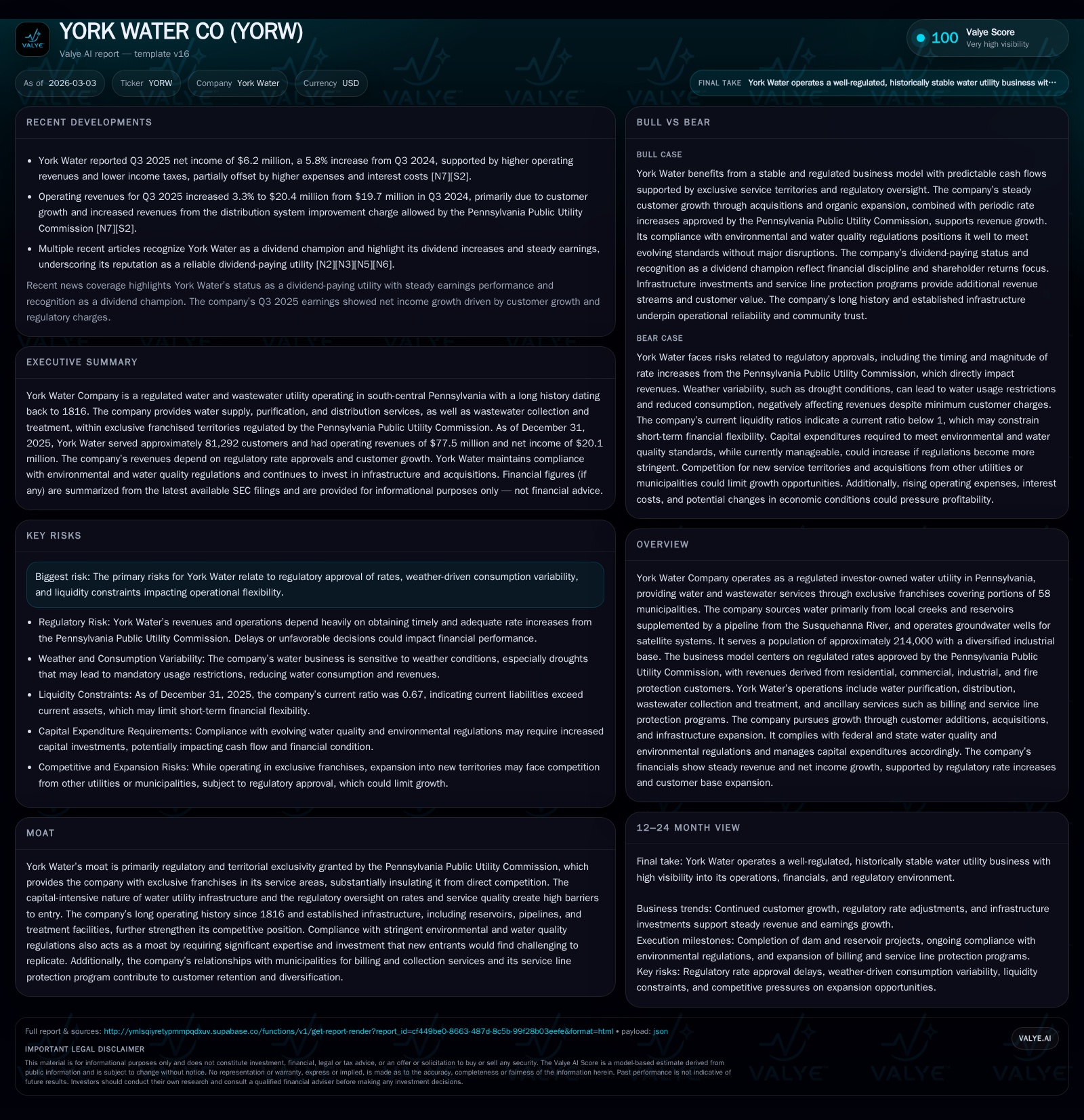
York Water, the oldest investor-owned water utility in the U.S., operates under a strong regulatory framework that grants it territorial exclusivity over 58 municipalities in Pennsylvania. Its historical growth has been driven primarily by customer additions and Distribution System Improvement Charge (DSIC) revenues, which have underpinned a 3.4% top-line increase in FY2025. Despite a slight dip in operating income and net income due to rising costs and interest expenses, the company maintains positive cash flow and prioritizes capital spending on infrastructure maintenance while consistently returning capital through modest dividend increases. Going forward, York Water’s prospects rest on continued rate case approvals by the Pennsylvania Public Utility Commission (PPUC), acquisition opportunities within its franchised territory, and managing weather-driven demand variability.
Historical Growth Drivers Supported by Regulatory Pricing and Customer Additions
York Water Company benefits substantially from its regulated monopoly status granted by the Pennsylvania Public Utility Commission (PPUC), which allows exclusive franchise rights across 58 municipalities within four counties in south-central Pennsylvania [S1][S6]. This exclusivity provides insulation from direct competition, anchoring stable demand within a service territory estimated to cover about 214,000 residents as of FY2025 [S8].
Growth historically hinges on expanding the customer base and obtaining timely rate increases from the PPUC—a vital regulatory lever supporting revenue progression [S5][S6]. In FY2025, the firm reported revenue of approximately $77.5 million representing a 3.4% increase over FY2024's $74.9 million [F1]. This rise was primarily attributable to customer count growth (from circa 79,771 to 81,292 customers) alongside incremental revenues from the Distribution System Improvement Charge (DSIC). The DSIC mechanism enables infrastructure cost recovery between formal rate cases via surcharges on customer bills without extensive filings [S5][S6][S16]. The steady addition of new customers complements organic demand improvement despite some per capita consumption reductions.
The company's diversified industrial base within its service area supports consistent commercial water usage along with residential demand [S1]. DSIC adjustments—comprising investments into pipe replacements and maintenance—drive incremental allowable billings fostering granular revenue pacing.
Revenue and Earnings Trends: Stability Amid Gradual Infrastructure Expansion
Despite the top-line revenue gains, operating income declined slightly by approximately 1.2%, falling from about $28.0 million in FY2024 to $27.7 million in FY2025 [F1]. Similarly, net income edged down by roughly 1.3%, from $20.3 million to $20.1 million over the same interval [F1]. These marginal compressions primarily stemmed from elevated operating expenses—including higher distribution system maintenance costs—and increased interest expense reflecting modest rises in debt servicing costs [S2][S16].
Interest payments rose due to both higher outstanding debt levels and market interest rate increases; however, York Water partially mitigates variable-rate exposure through interest rate swaps converting $12 million of variable-rate debt into fixed rates near 3.16% [S7][S9][S23]. The company also experienced regulatory lag where costs incurred during infrastructure expansion periods precede corresponding tariff recoveries.
This dynamic illustrates a common characteristic among regulated utilities where steady but measured infrastructure investments cause short-term margin pressure that is later balanced as authorized rates catch up.
Growth Prospects Within Pennsylvania Franchises and Acquisition Opportunities
York Water continuously pursues expansion via acquisitions within its franchise areas as well as adjacent opportunities subject to PPUC approval [S5][S6][S17]. The company owns three wastewater collection systems along with twelve wastewater treatment sub-systems supplementing its water utilities coverage, collectively enhancing scale effects.
To bolster diversification beyond core volumetric sales, York Water has introduced ancillary services such as municipal billing agreements and service line protection plans—fixed monthly fees customers pay enabling repairs or replacements of service lines at capped annual costs [S5][S17]. These initiatives represent strategic avenues to generate non-commodity revenue streams adding resilience.
With service territory spread across multiple counties including York, Adams, Franklin, and parts of Lancaster via groundwater wells servicing satellite systems [S1][S8], incremental acquisitions can augment customer density while leveraging existing infrastructure synergies.
Regulatory Environment: The Keystone of York Water’s Competitive Moat
Regulatory exclusivity granted by PPUC forms York Water's central competitive advantage ensuring protection from direct entrants at minimal risk of substitutive competition thanks to capital-intensive water utility infrastructure barriers [S1][S20][S22]. The requirement for comprehensive environmental compliance under federal Safe Drinking Water Act guidelines further raises expertise and cost hurdles deterring new entrants.
Furthermore, contractual obligations surrounding billing practices, terminable payment procedures, dispute resolution processes, specific service territories sanctioned exclusively to York Water create embedded high switching costs deterrent to challengers [S1].[F1] The capital-heavy nature inherent in reservoir maintenance, pipeline upkeep (including reservoirs holding billions of gallons) coupled with network extension reinforces fixed cost profiles justifying stable tariff structures.
Nonetheless, dependence on obtaining PPUC approval for rate changes remains a potential constrain—delayed or insufficient approvals could temper growth especially if infrastructure costs accelerate beyond allowed recoveries.
Capital Allocation Focused on Infrastructure With Modest Dividend Increases
Reflecting a traditional utility stance prioritizing system reliability over aggressive growth CAPEX spending, capital expenditures plunged approximately 31% year-over-year in FY2025 compared with previous years [F1][S19]. This reduction suggests prioritization towards ongoing maintenance programs mandated under environmental regulations rather than costly expansions.
Dividend payments remain a salient feature aligned with cash flows generated via regulated operations; $12.6 million were distributed in FY2025 representing a measured step-up from previous years ($12.1 million in FY2024), consistent with the cash flow stability expected given tariff frameworks [F1][S19].
Recent years show negligible share repurchase activity indicating capital allocation emphasis skewed towards dividends support rather than buybacks—a conservative approach typical for regulated utilities facing steady but modest growth prospects [F1][S10].
Liquidity, Debt Profile, and Interest Rate Risk Management via Swaps
The company’s current ratio was approximately 0.67 at FY2025 year-end owing partly to high working capital demands relative to liquid assets tied up across materials inventories and prepaid expenses necessary for ongoing infrastructure management [F1][S25]. Nonetheless liquidity appears adequate supported by committed credit facilities extended through September 2027 totaling around $37 million untouched as well as long-term bond issues aggregating near $230 million carrying mostly fixed coupon rates prominently maturing into decades ahead supporting staggered refinancing risk limits [S4][S7][S25].
Crucially York Water engages interest rate swaps converting roughly $12 million of variable-rate debt into locked fixed coupons (~3.16%), stabilizing finance expense amid rising interest rate phases helping earnings visibility [S9][S23][S28]. Credit rating affirmed A- with stable outlook reflects financial discipline maintaining investment-grade standing essential for affordable capital access.
Key Metrics Snapshot: Return on Equity, Operating Cash Flow, and Capex Efficiency
Historical performance (annual)
| FY | Rev ($mm) | Net ($mm) | CFO ($mm) | OpInc ($mm) | Rev YoY | Net YoY |
|---|---|---|---|---|---|---|
| 2025 | 77 | 20 | 30 | 28 | +3.4% | -1.3% |
| 2024 | 75 | 20 | 31 | 28 | +5.5% | -14.4% |
| 2023 | 71 | 24 | 32 | 30 | +18.3% | +21.3% |
| 2022 | 60 | 20 | 22 | 24 |
Source: SEC companyfacts cache [F1].
Capital returns and efficiency (annual)
| FY | Div ($mm) | ROE% |
|---|---|---|
| 2025 | 13 | 8.3 |
| 2024 | 12 | 8.8 |
| 2023 | 12 | 10.7 |
| 2022 | 11 | 9.5 |
Source: SEC companyfacts cache [F1].
Return on equity approximated at ~8.3% calculated using latest net income against equity base endorses moderate profitability inline with regulated utility expectations emphasizing risk-mitigated stable earnings rather than high returns [F1]. Free cash flow after capex remains positive around $13 million underscoring operational cash generation effectively covers infrastructure spending despite recent capex pullback [F1].
Outlook Considerations and Potential Challenges to Monitor
While York Water does not provide formal guidance at this time [N2], key forward-looking indicators revolve heavily around PPUC rate case outcomes given prior reliance on distribution system improvement charges for passing through large portions of infrastructure expenses without full-rate case burden filing requirements [N2][N1][S20]. Timeliness and sufficiency of these approvals will directly impact financial performance trajectories.
Operating risks include weather-driven variability affecting seasonal consumption—especially summer irrigation needs—which historically has imposed volatility although mitigated somewhat by minimum customer charges designed to cover fixed operating overhead irrespective of usage fluctuations [S8]. Additionally prudence regarding liquidity management remains important considering capital-intensive asset bases constraining flexibility during periods of irregular cash flows or slower-than-expected customer growth.
Investors should focus attention on upcoming regulatory hearings or filings alongside monitoring any shifts in environmental compliance requirements that might necessitate accelerated capex investment potentially impacting margins or cash flow dynamics.
Disclaimer: This analysis is intended solely for informational purposes reflecting publicly available data as of March 2026 without providing investment advice or recommendations.
Disclaimer: This is research-only, informational analysis and not investment advice. It may include AI-generated interpretation and general industry context. Always verify important details using primary sources.

Comments