
Yum China’s Earnings Surge Amid Operational and Regulatory Dynamics
Yum China posted notable revenue and operating income growth in 2025, driven by brand strength and operational scale while navigating China-specific regulatory challenges.
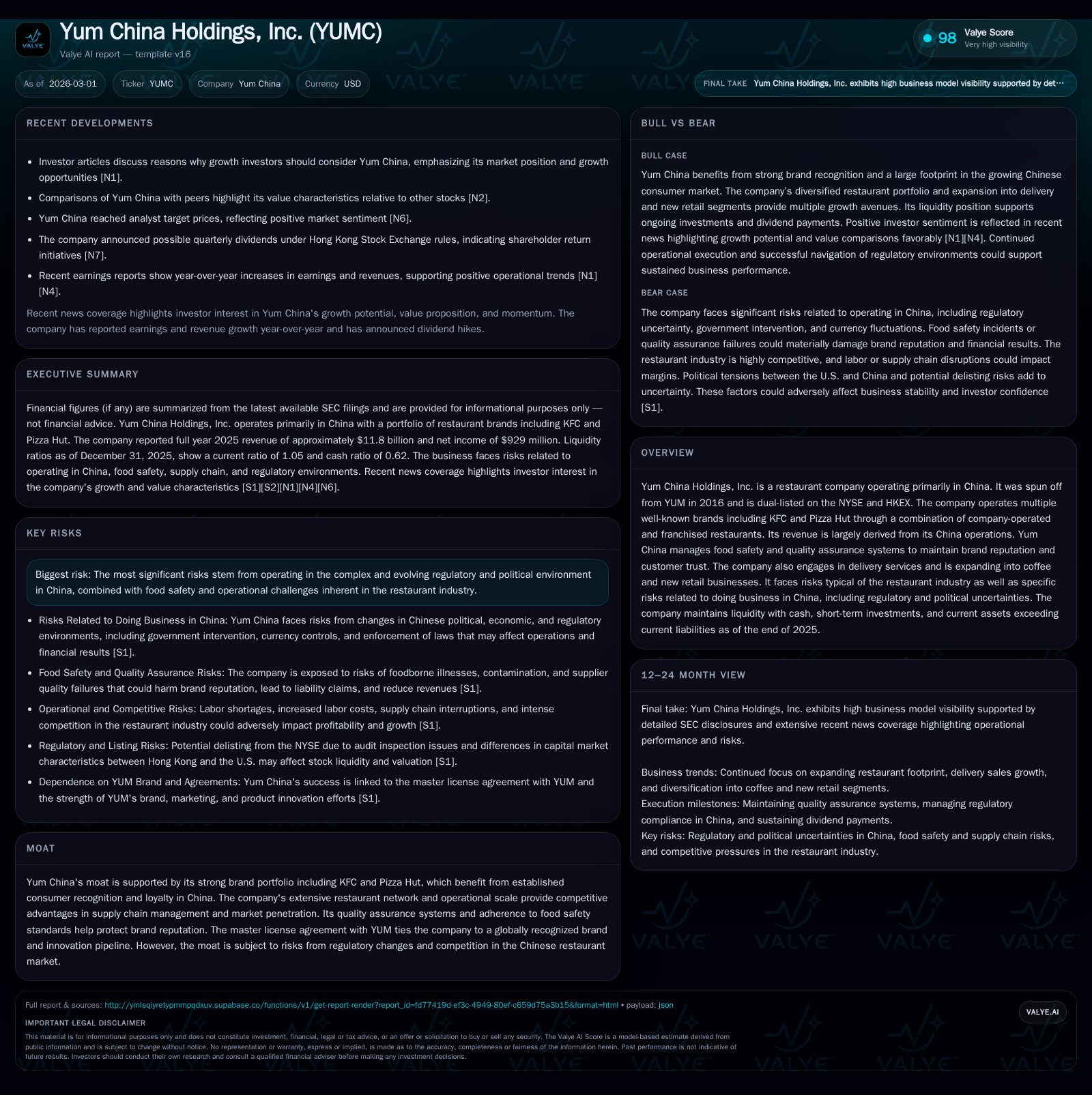
In 2025, Yum China delivered a 4.4% revenue increase and an 11% jump in operating income, underpinned by its strong brand portfolio and extensive restaurant network across China. The company’s disciplined capital allocation supported earnings growth with robust free cash flow and an approximate return on equity of 17.3%. However, regulatory risks inherent to the Chinese market and operational complexities remain significant headwinds. Innovation initiatives, including expansion into coffee retailing and delivery services, offer measured growth avenues worth monitoring.
Historical Growth Trajectory: Revenue and Profit Expansion Since Spin-Off
Since its spin-off from YUM in late 2016, Yum China has demonstrated consistent top-line growth alongside improving profitability metrics, benefiting from its focused presence in the Chinese fast-food market. The latest fiscal year capped a streak of revenue expansion reaching $11.8 billion in 2025, representing a solid 4.4% increase over $11.3 billion recorded in 2024 [F1]. Operating income notably outpaced revenue gains, climbing by approximately 11% to reach $1.29 billion in the same period—highlighting operational leverage as fixed cost absorption improved during sales growth.
Net income advanced more modestly by about 2%, arriving at $929 million for FY25 [F1]. This disparity is consistent with factors such as inflationary pressures or currency fluctuations that can depress net margins relative to operating results.
The following table summarizes key annual financials from FY2022 through FY2025:
Historical performance (annual)
| FY | Rev ($bn) | Net ($mm) | CFO ($mm) | OpInc ($mm) | Rev YoY | Net YoY |
|---|---|---|---|---|---|---|
| 2025 | 11.8 | 929 | 1466 | 1290 | +4.4% | +2.0% |
| 2024 | 11.3 | 911 | 1419 | 1162 | +3.0% | +10.2% |
| 2023 | 11.0 | 827 | 1473 | 1106 | +14.7% | +87.1% |
| 2022 | 9.6 | 442 | 1413 | 629 |
Source: SEC companyfacts cache [F1].
Capital returns and efficiency (annual)
| FY | Div ($mm) | Buybacks ($mm) | FCF ($mm) |
|---|---|---|---|
| 2025 | 353 | 1144 | 840 |
| 2024 | 248 | 1249 | 714 |
| 2023 | 216 | 613 | 763 |
| 2022 | 202 | 466 | 734 |
Source: SEC companyfacts cache [F1].
Table Note: Revenue (Rev), Operating Income (OpInc), Net Income (Net), Operating Cash Flow (CFO), Capital Expenditure (Capex), Dividends Paid (Div), Buybacks/Repurchases sourced from [F1].
Margins benefited from ongoing supply chain efficiencies and disciplined cost control despite inflationary inputs.
Brand Portfolio and Operational Drivers Fueling Past Growth
Yum China’s core competitive advantage stems from its portfolio featuring the legacy brands KFC and Pizza Hut which maintain strong brand penetration in urban and secondary cities across mainland China , [S4]. KFC alone operated approximately over twelve thousand locations as of late-2025 while Pizza Hut accounted for just above four thousand outlets [S22]. This extensive footprint supports scale economies particularly in logistics, raw material sourcing, and talent deployment.
The mix between company-operated stores and franchised units contributes to revenue diversification—franchise fee income supplements direct sales revenues while facilitating faster network expansion without proportionally rising capital intensity [S4]. Moreover, expansion into ancillary concepts such as Huang Ji Huang and Little Sheep complements the main brands albeit on a smaller scale.
Operational rigor around food safety management has remained a critical pillar due to heightened consumer scrutiny in China; Yum China invests substantially in quality assurance systems which underpin brand trust and repeat patronage , [S7]. The company’s delivery segment has grown leveraging partnerships with major platforms like Meituan Dianping aiding sales channel diversification amid shifting consumer habits favoring convenience [S22].
Regulatory Environment Risks Specific to China Market Operations
Operating nearly exclusively within China exposes Yum China to complex regulatory dynamics unique to this jurisdiction , [S1], [S5], [S7]. These include:
- Challenges enforcing foreign legal judgments or conducting investigations within Chinese legal frameworks potentially limiting recourse against adverse events [S1]
- Master license agreement constraints tied to YUM impacting innovation nimbleness given reliance on global branding standards and product pipelines [S7]
- Food safety risks demanding continual investment in compliance systems amid incidents that could damage reputation or invite fines [S7]
- Political-economic shifts affecting currency convertibility, dividend repatriation limitations due to PRC government restrictions on capital flows [S17]
- Fluctuating Chinese regulatory policies with limited forward guidance creating uncertainty on approvals, permits renewals or restrictions on restaurant operations [S16]
While management emphasizes mitigating these exposures via compliance programs and diversified revenue streams, such risks remain material variables impacting business continuity.
Innovation and Expansion Initiatives Mapping Future Growth Potential
Yum China is actively pursuing new growth avenues through innovation beyond traditional quick-service restaurants , [N1], [N8]. Key initiatives include:
- The Lavazza joint venture coffee enterprise extending the company’s footprint into specialty beverages targeting rising middle-class demand for premium coffee experiences [S22]
- Continued ramp-up of delivery services infrastructure catering both system-owned outlets as well as third-party restaurants through Daojia platform integration [S22]
- Exploration of new retail concepts including digital engagement tools and packaged food retail although some e-commerce ventures like Shaofaner were wound down by mid-2024 signaling course corrections [S22]
These initiatives reflect an adaptive strategy designed to capture evolving consumption patterns without overextending capital resources—a balance critical given operational constraints noted earlier.
What Investors Should Monitor: Upcoming Milestones and Catalysts
Explicit forward guidance remains sparse; however, key developments to watch over coming quarters include:
- Quarterly earnings updates revealing trajectory trends especially around same-store sales growth, delivery channel performance, and margin sustainability amid inflationary pressures [N2]
- Progress reports on Lavazza joint venture scale—number of outlets opened, same-store sales growth metrics—as a barometer of success entering premium segments [N1]
- Regulatory policy changes related to licensing or COVID-era restrictions impacting store operations or supply chains within China’s fragmented provincial framework [N4]
- Consumer sentiment shifts relating to discretionary spending post-pandemic impacting ticket sizes within casual dining versus fast food segments
- Digital transformation outcomes including mobile payment adoption rates, GenAI use cases for marketing or operational efficiency indicated indirectly through disclosures or earnings commentary
Capital Allocation Discipline: Dividends, Buybacks, and ROE Trends
Yum China exemplifies prudence balancing shareholder returns with investment needs amid sector volatility and geopolitical complexity:
- Dividend payments rose consistently across recent years reaching $353 million in FY25 up from $248 million in FY24 representing steady yield enhancement matching earnings expansion [F1],
- Share repurchases remain a major capital distribution tool with approximately $1.14 billion allocated in FY25 slightly below prior year’s record levels but substantially above earlier periods reflecting confidence in intrinsic value [F1]
- Return on equity approximated at around 17.3% for FY25 attests to effective use of equity base generating substantial net profits relative to shareholders’ invested capital [F1]
- Free cash flow calculated conservatively as operating cash flow minus capex was about $840 million in FY25 providing ample liquidity support for buybacks/dividends without compromising growth investments [F1]
This balanced approach reinforces the company’s moat by sustaining investor confidence alongside funding operational excellence.
Liquidity Profile and Financial Health Supporting Strategic Flexibility
As of year-end December 31, 2025,[F1] Yum China's liquidity position showed current assets of approximately $2.36 billion against current liabilities near $2.25 billion yielding a current ratio of about 1.05x which is adequate for short-term obligations coverage.[S19],[S20] Cash and equivalents stood at roughly $506 million providing an immediate liquidity buffer.
Additionally, long-term deposits totaled nearly $1 billion backing medium-term financial stability.[S20] Total liabilities hovered around $4.69 billion balanced against equity nearing $5.38 billion demonstrating sound capitalization for further strategic deployment or risk absorption.[F1],[S19],[S20]
Such financial health is especially critical considering potential government restrictions on cross-border fund flows requiring efficient internal liquidity management.
Synthesizing Growth Prospects Against Operational Constraints
Yum China enters a nuanced phase where its entrenched brand power across KFC and Pizza Hut supports sustained organic growth reinforced by incremental omni-channel sales avenues especially delivery services and coffee retail expansions.
Nonetheless, macro-level risks centered around regulatory unpredictability within China’s evolving political-economic landscape temper outlook optimism requiring ongoing diligence.
Operationally, balancing aggressive store development against cannibalization risks remains paramount while food safety vigilance sustains customer trust crucial for recurring revenues.
Capital allocation stands out as a strength with consistent dividend improvements plus sizeable share repurchases underpinning shareholder value creation signaling managerial confidence amidst external headwinds.
Investors should weigh Yum China's demonstrated operational leverage capabilities against the backdrop of volatile regulatory environments when assessing future performance trajectories.
Disclaimer: This analysis is intended solely for informational purposes based on publicly available data as of early March 2026; it does not constitute investment advice or recommendations.
Disclaimer: This is research-only, informational analysis and not investment advice. It may include AI-generated interpretation and general industry context. Always verify important details using primary sources.

Comments