
ZenaTech's Rapid Acquisitions Fuel Drone-as-a-Service Expansion Amid Integration Challenges
ZenaTech leverages acquisitions and proprietary technology to scale DaaS offerings, balancing growth ambitions with operational complexities.
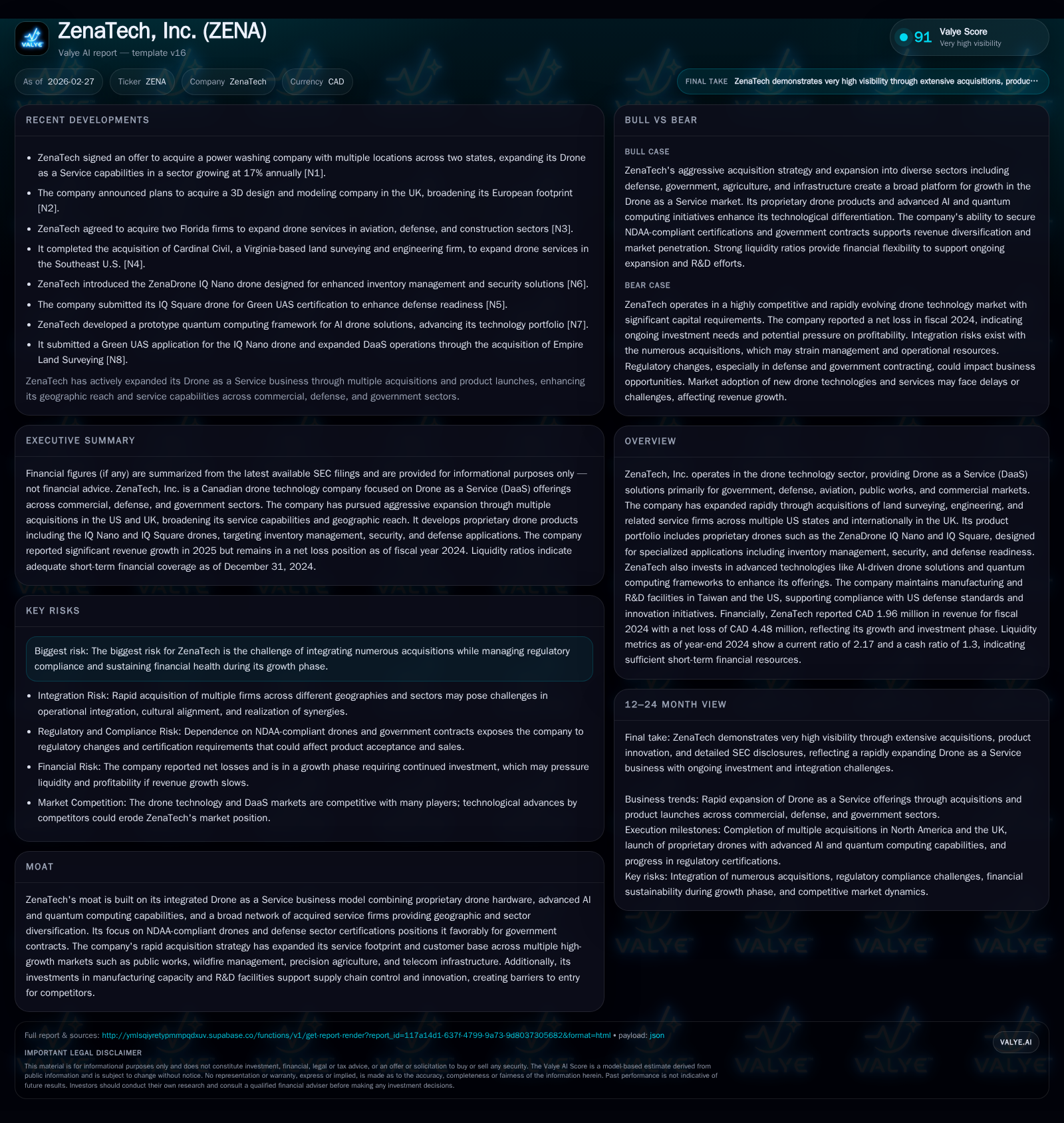
ZenaTech, a drone technology company specializing in Drone as a Service (DaaS), has experienced explosive growth driven by an aggressive acquisition strategy that expanded its geographic footprint and sector reach including government, defense, agriculture, and telecom. Proprietary drones like ZenaDrone IQ Nano and investments in AI and quantum computing underpin its competitive moat, especially for US defense contracts requiring NDAA compliance. Despite CAD 1.96 million revenue in 2024 and expanding manufacturing capacity, the company is unprofitable with negative operating income and free cash flow, reflecting scaling costs and integration risks. Watch for progress in operational leverage, milestone acquisitions completion, and successful integration execution through 2026.
Company Overview
ZenaTech, Inc. operates within the emerging drone technology sector emphasizing a Drone as a Service (DaaS) model. The company’s strategy relies heavily on growth via acquisition, having completed more than 20 purchases of land surveying, engineering, mapping, and related service firms predominantly across North America with recent expansions into the UK telecommunications infrastructure sector as well as Australia [S3][S9]. Its product mix includes proprietary hardware such as the ZenaDrone IQ Nano and IQ Square models designed for specialized uses from inventory tracking to public safety and defense readiness [S10]. Additional strategic pillars include research initiatives in artificial intelligence-powered drones and quantum computing intended to augment advanced defense applications [S13][S14].
ZenaTech maintains manufacturing footprints primarily in Taiwan complemented by R&D facilities within the United States (Baton Rouge), reflecting their dual focus on innovation leadership and adherence to stringent U.S. government regulatory requirements including NDAA compliance [S8][S10].
Historical Performance
The company’s financial narrative reflects a start-up profile marked by rapid top-line expansion offset by substantial operational losses that accompany extensive acquisition activity and investment outlays.
Historical performance (annual)
| FY |
|---|
| 2024 |
Source: SEC companyfacts cache [F1].
*Free cash flow approximated from operating cash flow minus capital expenditures as reported [F1].
Growth catalysts driving this progression included:
- Aggressive acquisition campaigns expanding their DaaS footprint geographically and across sectors such as public works, commercial surveying, agriculture, wildfire management, solar infrastructure, and aviation [S3][S9][S13].
- Product launches tailored to niche uses like golf course surveying and telecom tower design signaling diversification [S2][S9].
- Ramping up proprietary drone testing for defense readiness including swarm capabilities that may unlock incremental government contracts [S2].
However, these efforts have resulted in persistent negative operating income reflecting upfront integration costs and ongoing investment into manufacturing scale-up (notably a new assembly line in Dubai area adding approximately 15,000 sq. ft.) [S6][S8], diluting immediate profitability. The net loss aligns closely with operating results suggesting limited other income or expense impacts during this stage.
Future Growth Prospects
Looking ahead through early 2026 disclosures reveals several avenues for scaling:
Acquisition Strategy: The pipeline includes planned acquisitions targeting precision agriculture, ranching, wildfire management service providers as well as niche infrastructure firms servicing fast-growing verticals such as solar energy installations [S3][S9]. These deals deepen geographic penetration particularly within western U.S., southeastern states (Florida), Northwest regions plus international markets.
Proprietary Technology Deployment: Continued development of NDAA-compliant drones positions ZenaTech advantageously in U.S. federal government tender ecosystems where compliance is critical [S3][S9]. Innovations such as swarm drone testing open differentiated capabilities for military-grade applications [S2].
AI & Quantum Computing: Investments into AI-driven analytics integrated into drone operations along with proprietary quantum computing hardware capable of advancing autonomy or encryption for homeland security use cases represent potential long-term value drivers leveraging DARPA collaborations [S3][S13][S14].
Manufacturing Scaling: Expanded manufacturing footprints improve unit economics reducing per-unit cost basis while enabling fulfillment capacity aligned with projected contract wins particularly within defense channels requiring robust supply chain control [S8][S9].
Risks arise chiefly from execution complexity:
- Integrating diverse acquired businesses effectively while harmonizing systems under one brand.
- Maintaining regulatory compliance amid increasing jurisdictional spread.
- Sustaining liquidity given continuing negative cash flow during growth transition.
Key Milestones & Forecasts to Watch
Near-term milestones include:
- Completion of targeted acquisition count (~25 deals) anticipated by mid-2026 with several pending closings announced across various states plus UK market entry recently completed [S3][S9].
- Commercial rollout plans for new drone models like IQ Quad serving urban planning/public works sectors set for early 2026 implementation phases [S3][S14].
- Demonstration projects addressing U.S. defense customers aiming for pilot contracts deploying NDAA-compliant drones expected during H1 2026 leveraging recent FCC policy shifts [S3][S5].
- Progress reports on the quantum computing hardware platform moving toward prototype or early deployment stage within the year likely impacting innovation narrative [S13][S14].
Stakeholders should monitor quarterly updates particularly operational leverage metrics reflecting margin improvements versus continued revenue ramp along with announced contract wins or large-scale integration completions.
Returns & Capital Allocation
Data confirms an early developmental stage characterized by reinvestment over returns:
- Return on equity was approximately negative 20.5% reflecting net losses relative to shareholder equity base in the latest fiscal year [F1].
- Operating cash flows are negative primarily due to acquisition-related outlays plus capex relating to manufacturing/R&D expansions; free cash flow remains subdued around -10 million CAD annually indicating ongoing financing needs despite improving top-line dynamics [F1][S11].
- There are no indications of dividend distributions or share repurchase programs; capital allocation prioritizes deployment into growth initiatives via M&A and internal development rather than returning capital at this point .
- Liquidity appears adequate given a current ratio above two times with over three million CAD cash available at year-end 2024 alongside current assets exceeding current liabilities which bodes well given continued investment requirements but underscores need for sustained capital access over time [F1][S11].
Disclaimer: This is research-only, informational analysis and not investment advice. It may include AI-generated interpretation and general industry context. Always verify important details using primary sources.

Comments