
Applied Optoelectronics’ Financial Turnaround and Vertical Integration Power New Growth Strategy
AAOI leverages its integrated manufacturing and strategic shifts to narrow losses and tap growth across fiber-optic markets.
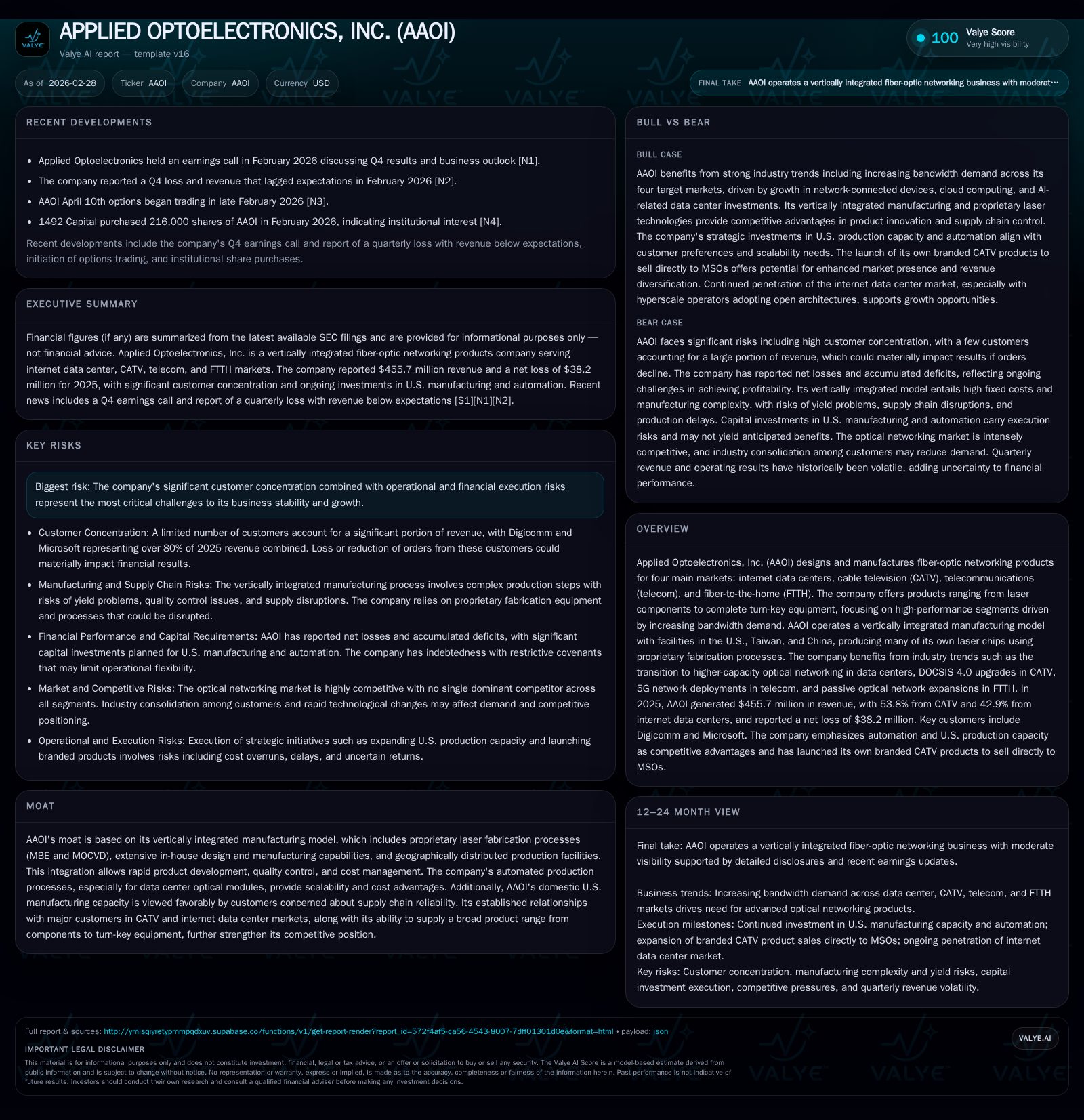
Applied Optoelectronics, Inc. (AAOI) is executing a financial turnaround amid sustained industry demand driven by bandwidth growth in CATV, data centers, telecom, and FTTH markets. Its vertically integrated manufacturing model—anchored by proprietary laser fabrication techniques and geographically distributed facilities—is a core competitive advantage enabling agility and cost management. Despite losses persisting through 2025, the company has narrowed operating deficits by 23% year over year while heavily investing in production capacity, especially in the U.S., signaling commitment to scale and innovation. Customer concentration risk alongside capital intensity represent key challenges to monitor as AAOI seeks growth from DOCSIS 4.0 upgrades, 5G rollouts, and expanding optical networking requirements.
From Losses to Leaner Operations: Tracking AAOI’s Recent Profitability Trends
Applied Optoelectronics has embarked on a gradual financial recovery trajectory marked by shrinking operating losses and net deficits through 2025. The company recorded an operating loss of $54.6 million for fiscal 2025, improving approximately 23% compared to a $70.9 million loss in the prior year [F1]. Net losses similarly contracted steeply by nearly 80%, falling from $186.7 million in 2024 to $38.2 million in 2025 [F1]. This progression reflects actions taken toward operational efficiencies amid an intensifying market backdrop demanding faster connectivity.
Notwithstanding this trend, cash flow generation remains pressured due largely to aggressive capital spending programs — operating cash flow declined from negative $69.5 million in 2024 to negative $174.4 million in 2025 as capex ballooned [F1]. The significant widening of free cash flow deficit underscores the company’s investment phase aimed at expanding capacity and automation.
Vertical Integration as Competitive Moat: Manufacturing and Design Advantages Explained
Central to AAOI’s competitiveness is its vertically integrated manufacturing approach that spans design through component fabrication to assembly of turnkey optical equipment [S1], [S5]. Proprietary molecular beam epitaxy (MBE) alongside metal organic chemical vapor deposition (MOCVD) processes form the technical backbone for laser chip creation within its Sugar Land, Texas facility—an asset cited by customers preferring domestic sourcing for critical components [S16].
Complementing U.S.-based laser fabs are facilities in Taiwan and China that collectively enable geographically distributed production for responsiveness and IP security [S5]. Automation investments particularly target data center optical modules where scalable manufacture meets hyperscale AI-driven bandwidth surges [S17]. Such integration supports rapid new product development cycles while facilitating cost control advantages uncommon among less vertically integrated peers.
Market Focus Shifts: How Data Center and CATV Demand Reshape Revenue Mix
AAOI’s revenue composition shifted with cable television (CATV) accounting for 53.8% of revenues in 2025 versus 35.2% in 2024, while internet data center revenue declined from 59.5% to 42.9% over the same period [S7]. The CATV segment benefits from multiple system operators (MSOs) upgrading networks for DOCSIS 4.0 compatibility—a protocol aimed at enhancing both forward- and return-path bandwidth flexibility [S18].
In response, AAOI launched its Quantum Bandwidth™ brand in 2023 targeting direct sales to MSOs rather than solely supplying vendors [S21]. This strategic repositioning aligns with MSOs’ complex upgrade cycles that necessitate accelerated innovation delivery timelines.
Meanwhile, data center optics remain important albeit facing more modest growth from shifting spending patterns among hyperscale customers like Microsoft [S7]. Module offerings leverage AAOI’s light engine expertise combining lasers, photodiodes, and signal electronics optimized for very high-speed interconnects—800 Gbps-plus transmission—meeting AI-scale networking demands [S14], [S19].
Growth Drivers and Constraints: Navigating Bandwidth Expansion, 5G, and DOCSIS 4.0 Upgrades
The principal growth tailwinds arise from explosive bandwidth consumption fueled by cloud computing proliferation, streaming video traffic increases, social media connectivity, and AI compute needs [S1], [N1]. Telecom segment contributions stem largely from advancing high-speed fiber rollouts supporting nascent but growing 5G network deployments which require sophisticated lasers and transceivers embedded in metro-scale fiber infrastructure.
Simultaneously, DOCSIS 4.0 adoption by North American MSOs has triggered substantial CAPEX cycles for upgraded cable headend equipment capable of digital return-paths enhancing upstream throughput per subscriber [S18]. Concurrent expansion of passive optical networks (PON) under FTTH initiatives adds incremental volume albeit currently minor relative to total revenues [S1], [S15].
Key constraints include concentrated revenue exposure to top customers such as Digicomm (>50% CATV) and Microsoft (~29%) creating dependence risks if order patterns or industry consolidation affect buying behavior [S24], [S7]. Supply chain complexity combined with fixed-cost intensity also challenges margin stability during demand fluctuations [S27].
Capital Spending Surge: Evaluating the Impact of Capex on Cash Flows and Scalability
Capital expenditure surged over threefold from roughly $43 million in fiscal 2024 to $179 million in fiscal 2025 [F1]. These investments mainly target expanding automated U.S.-based production capacity for data center optical modules responding to hyperscale demand for advanced optical interconnects [S20], [S8]. Automation efforts aim not only scalability but also cost reduction leveraging robotics and precision assembly technology common among leading original design manufacturers (ODMs).
This intense capital outlay pressures short-term liquidity metrics as operating cash flows have turned deeply negative (-$174 million) due partly to upfront fixed costs associated with capacity build-out ahead of anticipated volume ramp-ups [F1]. The tradeoff entails foregoing near-term positive free cash flow for enhanced long-term cost efficiencies and resilience amid volatile demand cycles.
Customer Concentration Risks and the Push for Diversification
AAOI faces significant customer concentration risk with its top ten customers comprising over 96% of revenue as of 2025; Digicomm accounted for approximately 53% of overall revenues while Microsoft contributed nearly 29% [S7], [S6]. Such dependency exposes margins and growth prospects to shifts in purchasing patterns or customer consolidations within these firms.
To mitigate this concentration risk, AAOI has increased staffing focused on sales expansion efforts targeting broader customer segments within its four verticals along with cultivating new ODM partnerships across geographies aiming at diversifying its client base beyond existing accounts [S6], [S7]. These initiatives reflect management’s acknowledgment that sustaining long-term growth requires widening the revenue foundation against cyclical headwinds or volume contractions associated with large single projects or customer budget adjustments.
Liquidity Profile and Capital Structure: Assessing Financial Flexibility Amid Investments
At year-end 2025, AAOI reported a robust current ratio near 2.63 driven by $206 million cash reserves against current liabilities approximating $257 million indicating sound short term liquidity buffers despite large ongoing capital deployment commitments [F1], [S8]. However, debt covenants linked to existing credit agreements impose operational restrictions limiting freedom for additional borrowing or restructuring if needed.
Total consolidated indebtedness stood near $164 million posing moderate leverage that constrains financial maneuverability especially under volatile industry capex cycles requiring carefully balanced capital stewardship between funding growth initiatives vs maintaining liquidity cushions against market disruptions or competitive shocks [S8], [F1]. Continued adherence to covenant terms will be critical to avoid triggering adverse consequences ranging from accelerated repayments to restriction on business activities.
What to Watch: Upcoming Milestones, Market Signals, and Strategic Initiatives
Looking forward into early 2026, key indicators include execution progress against planned US-based laser fab expansions intended to boost proprietary laser output capacity underpinning advanced optical product launches cited on recent earnings calls ([N1]). Close monitoring of incremental penetration gains within CATV via direct MSO sales under Quantum Bandwidth™ will shed light on product-market fit amid network upgrade cycles ([N1],[N11]).
Additionally, upstream supply chain stability post-Lunar New Year shutdown concerns plus ongoing automation integration effectiveness are market signals investors will track closely given historical seasonal disruptions ([N13]). Analyst upgrades such as B.Riley Securities’ recent lift ([N11]) alongside elevated institutional buying volumes ([N13]) suggest growing confidence yet underscore importance of tangible milestones delivery amidst residual uncertainty common in capital-intensive technology deployments.
Financial Performance Summary FY2022-FY2025
Historical performance (annual)
| FY | Net ($mm) | CFO ($mm) | OpInc ($mm) | Capex ($mm) | Net YoY |
|---|---|---|---|---|---|
| 2025 | -38 | -174 | -55 | 179 | +79.5% |
| 2024 | -187 | -70 | -71 | 43 | -233.2% |
| 2023 | -56 | -8 | -41 | 9 | +15.6% |
| 2022 | -66 | -14 | -59 | 3 |
Source: SEC companyfacts cache [F1].
Capital returns and efficiency (annual)
| FY | FCF ($mm) | ROE% |
|---|---|---|
| 2025 | -354 | -5.2 |
| 2024 | -113 | -81.5 |
| 2023 | -17 | -26.1 |
| 2022 | -17 | -36.0 |
Source: SEC companyfacts cache [F1]. Note: Revenue data partial earlier years; figures drawn directly from latest filing extract where available.
This analysis synthesizes material disclosures from Applied Optoelectronics’ SEC filings dated February 26-27, 2026 ([S1]-[S29]), related Nasdaq earnings reports ([N1]-[N13]), alongside structured financials ([F1]). The company is navigating a challenging yet promising inflection characterized by heavy reinvestment funded through strong liquidity amid ongoing operational refinements supported by deep vertical integration.
Liquidity dynamics paired with customer concentration remain watch points even as execution on automation-enabled scaling unfolds within high-growth fiber-optic networking end-markets fundamentally driven by secular bandwidth expansion trends globally.
Disclaimer: This report does not provide investment advice or recommendations but intends informed contextual understanding grounded strictly on disclosed evidence without speculative projections or unverifiable assertions.
Disclaimer: This is research-only, informational analysis and not investment advice. It may include AI-generated interpretation and general industry context. Always verify important details using primary sources.

Comments