
Abeona Therapeutics Q2 2026: Manufacturing Challenges Delay ZEVASKYN® Commercial Launch Despite Strong Liquidity
Abeona Therapeutics faces ongoing production setbacks with its FDA-approved gene therapy ZEVASKYN®, delaying revenue despite a solid cash position.
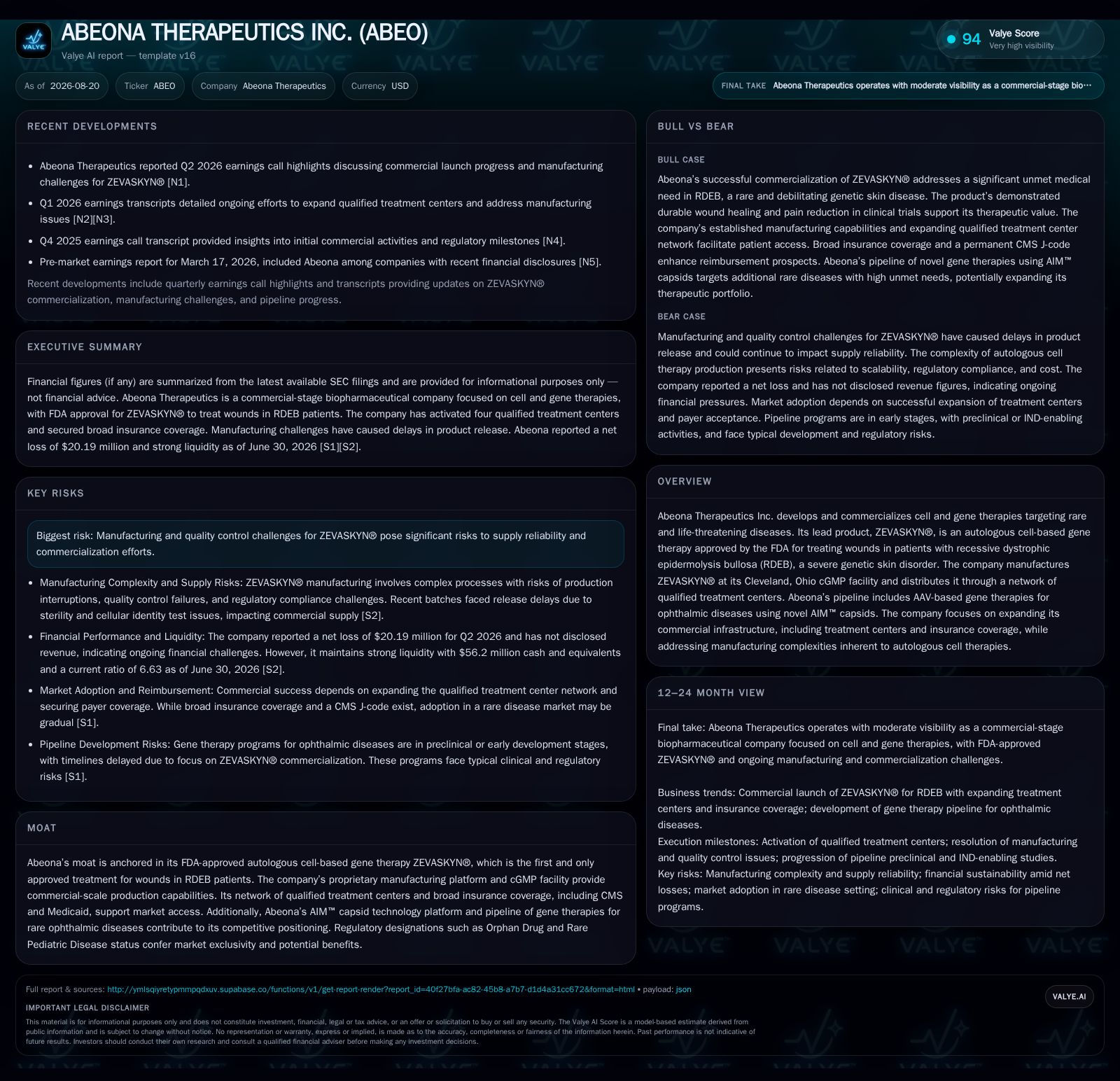
Abeona Therapeutics reported persistent manufacturing and quality control issues with its autologous cell-based gene therapy ZEVASKYN® during Q2 2026, resulting in delayed commercial launch and limited revenue generation. The company experienced batch release failures due to sterility and cellular identity test problems, with the FDA authorizing only single-patient IND use for recent batches. Despite these operational hurdles, Abeona maintains a strong liquidity position with $56.2 million in cash and a current ratio of 6.63 as of June 30, 2026, providing financial flexibility to address manufacturing challenges and support commercialization efforts.
Q2 2026 Operating Update: Manufacturing Challenges and Commercialization Progress
Abeona Therapeutics Inc. continues to face significant manufacturing and quality control challenges with its autologous cell-based gene therapy, ZEVASKYN®, during the second quarter of 2026 [S1][S2]. ZEVASKYN®, which received FDA approval in April 2025 as the first and only autologous cell-based gene therapy for treating wounds in patients with recessive dystrophic epidermolysis bullosa (RDEB), remains constrained in commercial availability due to production setbacks.
The complex manufacturing process for ZEVASKYN® has resulted in repeated batch release failures. In August 2025, a batch was rejected due to a false positive result in a rapid sterility assay mandated by the FDA [S2]. More recently, in July 2026, another batch failed release because a cellular identity test was out of specification. Although the FDA authorized this July 2026 batch for use under a single-patient Investigational New Drug (IND) application, it did not approve the batch for commercial release, highlighting ongoing regulatory and manufacturing hurdles [S2].
These production interruptions directly impede Abeona's ability to generate meaningful revenue from ZEVASKYN®, its sole FDA-approved product. The delays in batch releases have postponed the commercial launch and limited the supply available to qualified treatment centers, which are essential for administering the therapy to patients [S2]. The company reported cash and cash equivalents of $56.2 million against total debt of $14.4 million, resulting in a net cash position of approximately $41.8 million [F1]. Current assets stood at $164.6 million with current liabilities of $24.8 million, yielding a current ratio of 6.63, which indicates substantial short-term liquidity to support ongoing operations and manufacturing optimization efforts [F1][S2].
Business Model and Competitive Positioning
Abeona’s business model centers on commercializing ZEVASKYN®, an autologous cell-based gene therapy delivered via a single surgical application to treat wounds in both adult and pediatric RDEB patients. Revenue is generated through sales of ZEVASKYN® to qualified treatment centers, which administer the therapy and seek reimbursement from insurers, including government payers like CMS and Medicaid [S1][S2]. The company’s competitive advantage lies in ZEVASKYN®’s status as the first FDA-approved autologous cell therapy for RDEB wounds, coupled with proprietary manufacturing processes and an expanding network of qualified treatment centers. However, the complexity of manufacturing autologous cell therapies presents significant constraints, including stringent regulatory compliance, quality control challenges, and difficulties scaling production [S1][S2]. These factors currently limit Abeona’s ability to fully capitalize on its market exclusivity and commercial readiness.
Scenario Analysis: Pathways for Commercial Success or Continued Challenges
One possible positive scenario is that Abeona successfully resolves the manufacturing and regulatory testing issues. The FDA’s authorization of single-patient IND releases suggests regulatory flexibility, and Abeona’s proprietary manufacturing platform and expertise could enable process optimization. If the FDA accepts revised cellular identity test specifications and batch release rates improve without quality failures, Abeona could accelerate commercial supply of ZEVASKYN®, leading to revenue ramp and margin improvement [S1][S2]. Expansion of qualified treatment centers and payer coverage would further support commercialization growth.
Conversely, persistent manufacturing and regulatory hurdles could continue to delay or limit ZEVASKYN®’s commercialization. The complexity of autologous cell therapy manufacturing and stringent FDA release requirements have already caused multiple batch failures and launch delays [S2]. Failure to gain FDA acceptance of revised test specifications or ongoing production interruptions could force Abeona to seek strategic partnerships or additional financing under unfavorable terms. Such outcomes would be confirmed by further batch rejections, negative cash flow trends, and liquidity deterioration.
Watchpoints
Key factors to monitor include the FDA’s acceptance of revised cellular identity and sterility test specifications, which are critical to batch release approvals. The pace and success rate of commercial batch releases and shipments of ZEVASKYN® will indicate progress in overcoming manufacturing bottlenecks. Additionally, the expansion rate of qualified treatment centers and trends in quarterly revenue and margins will provide insight into Abeona’s commercialization trajectory. Finally, tracking cash burn rate and liquidity position in upcoming filings will reveal the company’s financial resilience amid ongoing operational challenges.
In summary, Abeona Therapeutics faces structural manufacturing and regulatory challenges that currently impede the commercial launch of its flagship gene therapy, ZEVASKYN®. The company’s liquidity position may provide a financial buffer to address these issues. The ultimate investment outcome could depend on Abeona’s ability to resolve production issues and scale commercialization in a highly specialized and complex therapeutic area.
Disclaimer: This is research-only, informational analysis and not investment advice. It may include AI-generated interpretation and general industry context. Always verify important details using primary sources.

Comments