
AMBEV S.A.'s Fiscal Trajectory: Revenue Ebb and Profit Resilience in Brazil’s Beverage Sector
AMBEV navigates minor revenue contraction with strong net income gains amid operational scale and commodity cost management.
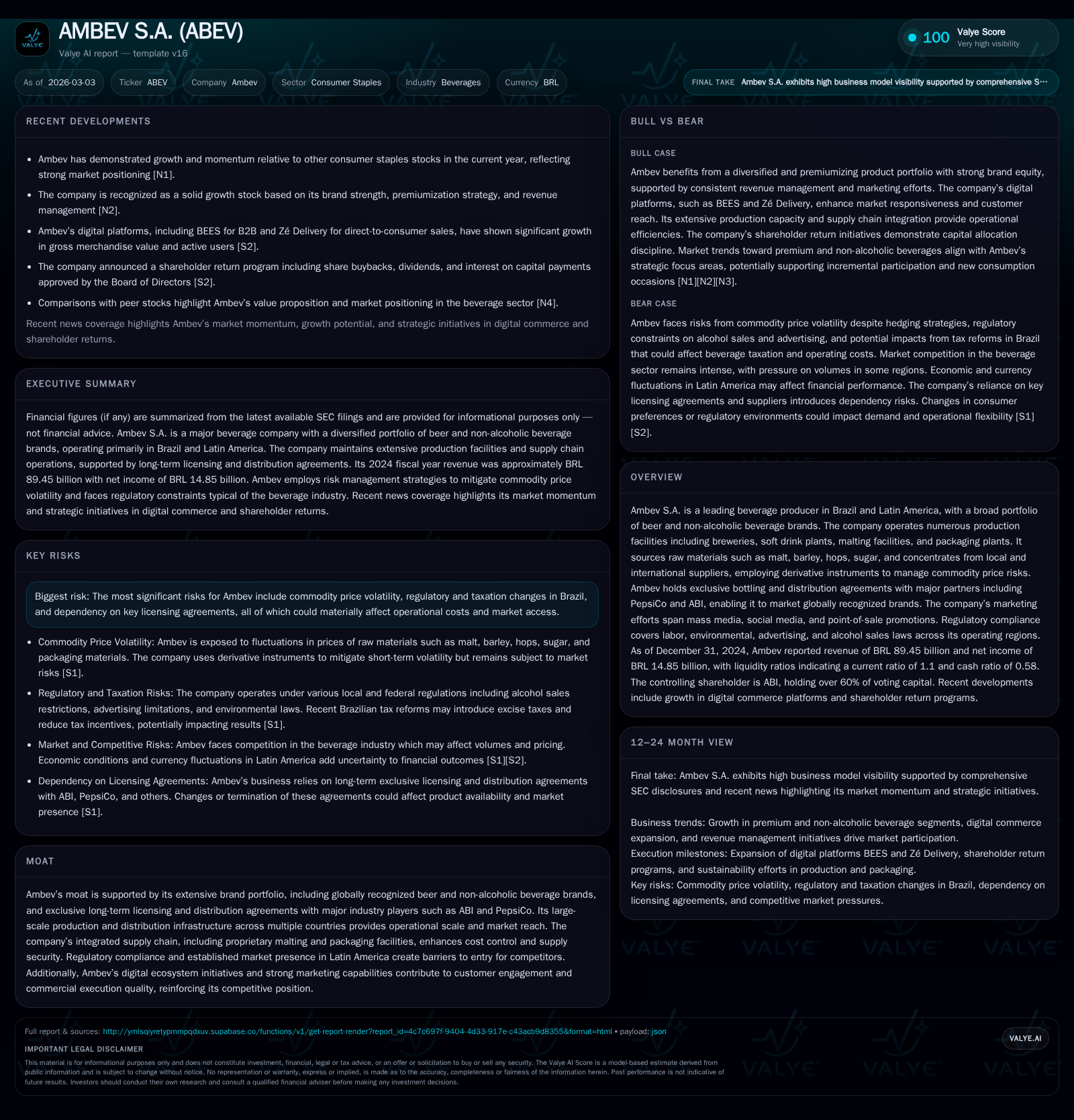
In 2025, AMBEV reported a slight decline in revenue contrasted by an increase in net income, reflecting disciplined cost control amidst challenging commodity prices and market softness. The company's extensive brand portfolio, exclusive licensing agreements, and integrated supply chain underpin its resilient market position. Capital allocation remains conservative yet shareholder-friendly, supported by solid cash flows and manageable debt maturities. Going forward, regulatory changes in tax benefits and commodity price volatility present both challenges and areas to monitor for sustained growth.
A Legacy of Growth: Tracking AMBEV’s Financial Evolution
AMBEV's trajectory through FY2022 to FY2025 reflects resilience amid moderate top-line pressures while expanding profitability. Revenue held steady between FY2022 (BRL 79.71 billion) and FY2023 (BRL 79.74 billion), surged sharply in FY2024 to BRL 89.45 billion before dipping slightly by 1.4% in FY2025 to BRL 88.24 billion [F1]. Despite this minor revenue contraction, net income rose from BRL 14.85 billion in FY2024 to BRL 15.99 billion in FY2025—an increase of nearly 8%, underscoring effective cost management amid challenging inputs.
Historical performance (annual)
| FY | Rev ($bn) | Net ($bn) | Rev YoY | Net YoY |
|---|---|---|---|---|
| 2025 | 88.2 | 16.0 | -1.4% | +7.7% |
| 2024 | 89.5 | 14.8 | +12.2% | -0.8% |
| 2023 | 79.7 | 15.0 | +0.0% | +0.5% |
| 2022 | 79.7 | 14.9 |
Source: SEC companyfacts cache [F1].
Capital returns and efficiency (annual)
| FY | Div ($mm) | ROE% |
|---|---|---|
| 2025 | 18.0 | |
| 2024 | 14.9 | |
| 2023 | 544 | 18.7 |
| 2022 | 357 | 17.9 |
Source: SEC companyfacts cache [F1].
Equity expanded notably in FY2024 before contracting somewhat in FY2025, possibly reflecting dividends or share buybacks alongside retained earnings [F1]. The approximate ROE of 18% for FY2025 indicates efficient capital deployment within prudent financial management.
Drivers Behind Revenue Trends: Market Dynamics and Operational Decisions
AMBEV's market strength stems from its broad product portfolio encompassing beer—including premium brands under long-term licensing with ABI—and non-alcoholic beverages produced under exclusive bottling rights from PepsiCo covering products such as Pepsi, Gatorade, and Lipton Iced Tea across Latin America [S6][S9]. These arrangements provide significant brand equity and distribution control.
Operational scale is supported by an integrated supply chain featuring breweries, six malting plants supplying about 70% of malt needs internally across Brazil, Argentina, and Uruguay, packaging facilities, and proprietary concentrate production like Guaraná Antarctica [S1][S20]. This vertical integration aids cost control and supply security amid volatile raw material prices.
Marketing efforts combine traditional media with digital platforms including the BEES marketplace—whose gross merchandise value grew over 70%, driven by third-party partnerships—and the Zé Delivery direct-to-consumer platform boasting approximately 27 million active users [S5][S19], boosting engagement particularly among younger consumers.
Commodity Volatility and Regulatory Environment: Impacts on Growth Prospects
Raw material costs remain a key challenge due to reliance on commodities such as barley, hops (imported mainly from the US and Europe), sugar, aluminum cans, and corn—all subject to global price swings [S1][S17]. AMBEV mitigates these risks through financial instruments including futures contracts and derivatives to hedge currency exposure (notably USD/BRL) as well as commodity price volatility [S15][S17].
Brazil's ICMS tax reform preserves existing benefits until around 2032 but phases them out progressively starting in 2029 with potential compensation mechanisms pending regulatory clarification [S1][S11]. Some Brazilian states increased ICMS rates on soft drinks ahead of implementation periods beginning early-2025 or early-2026, which could pressure margins further [S10]. These developments represent important factors requiring investor attention.
Capital Allocation Framework: Dividends, Debt Profile, and Return on Equity
Capital allocation remains disciplined with stable equity levels complemented by steady dividend payments while maintaining capacity for reinvestment and capex estimated near R$5 billion annually targeting capacity expansion and sustainability initiatives [F1][S16][S19]. Recent announcements include R$13.2 billion dividends plus R$4.2 billion interest on capital distributions along with a R$2.5 billion share buyback program authorized post-2025 [S19].
The debt profile is diversified across currencies and instruments: local currency fixed-rate leases at near double-digit yields (11.73%), floating-rate debt tied to Brazil’s TJLP benchmark (9-10%), US dollar-denominated liabilities hedged via derivatives totaling roughly R$953 million foreign currency exposure at end-2025, plus Canadian dollar borrowings averaging ~5.4% fixed rate [S4][S8][S13]. Maturities extend beyond short-term horizons affording refinancing flexibility supported by cash reserves near BRL18.6 billion at fiscal year-end [F1].
Risk Management Practices: Navigating Exchange Controls and Supply Chain Exposures
Beyond commodity hedging, AMBEV maintains robust cybersecurity governance led by experienced executives: the Technology Operations Director holds over fourteen years’ cybersecurity expertise with advanced certifications; the Information Technology VP brings nearly two decades’ experience; both are supported by a Privacy & Cybersecurity Committee chaired by the Legal & Compliance VP Officer integrating cross-functional experts overseeing data protection, compliance, digital ethics, AI governance aligned with board-level oversight through the Governance Committee [S1].
Brazilian exchange controls impact dividend repatriation and proceeds remittance for foreign investors governed under Central Bank policies requiring registrations under Foreign Direct Investment or Portfolio Investment regimes potentially causing delays or restrictions on converting payments abroad [S1][S11].
Innovation, Sustainability, and Digital Initiatives as Growth Catalysts
Innovation efforts include sustainability projects such as opening energy-efficient glass manufacturing plants powered by renewable electricity achieving up to 80% recycled glass input reducing environmental impact within packaging supply chains [S12][S20]. Water consumption efficiency per hectoliter also continues improving via advanced treatment technologies.
Digital transformation accelerates commercial execution through data-driven platforms like BEES enhancing sell-out performance via benchmarking best-in-class points-of-sale; concurrently Zé Delivery's GMV expanded +13%, enriching customer insights enabling agile response to evolving consumer preferences among digitally native cohorts supporting growth opportunities [S5][S19].
Monitoring Milestones Ahead: Key Metrics for Investors
While explicit official guidance is limited beyond general outlooks projecting higher Cash COGS per hectoliter due mainly to FX rate assumptions (~BRL/USD hedge near R$5.50) plus inflationary commodity impacts for Brazil beer operations in calendar year-2026 [S16], investors should track:
- Post-2025 revenue trends amid macroeconomic shifts given volume softness late-2025;
- Clarity on ICMS tax benefit phase-out schedules alongside regulatory decisions on compensation funds;
- Global commodity price movements affecting input costs including barley, hops, sugar;
- Execution of capex programs linked to sustainability targets and capacity expansion;
- Stability of exclusive licensing agreements amid competitive or renegotiation dynamics;
- Monetization effectiveness of digital ecosystems translating into margin gains. Recent analyst upgrades highlight AMBEV’s positioning benefiting from demographic trends favoring premiumization coupled with growing out-of-home consumption occasions fueling selective category growth within Latin America's beverage landscape [N1][N2][N3].
Disclaimer: This analysis is based solely on disclosed filings as referenced; it is intended for informational purposes without providing investment advice.
Disclaimer: This is research-only, informational analysis and not investment advice. It may include AI-generated interpretation and general industry context. Always verify important details using primary sources.

Comments