
Adient’s Strategic Levers: Operational Efficiency, Global OEM Integration, and the Realities of Automotive Cyclicality
Adient’s 2026 net loss and increased share repurchase authorization highlight a company at a crossroads—balancing industry headwinds, global scale, and deep OEM integration with the relentless pressures of automotive cyclicality, commodity costs, and execution complexity.
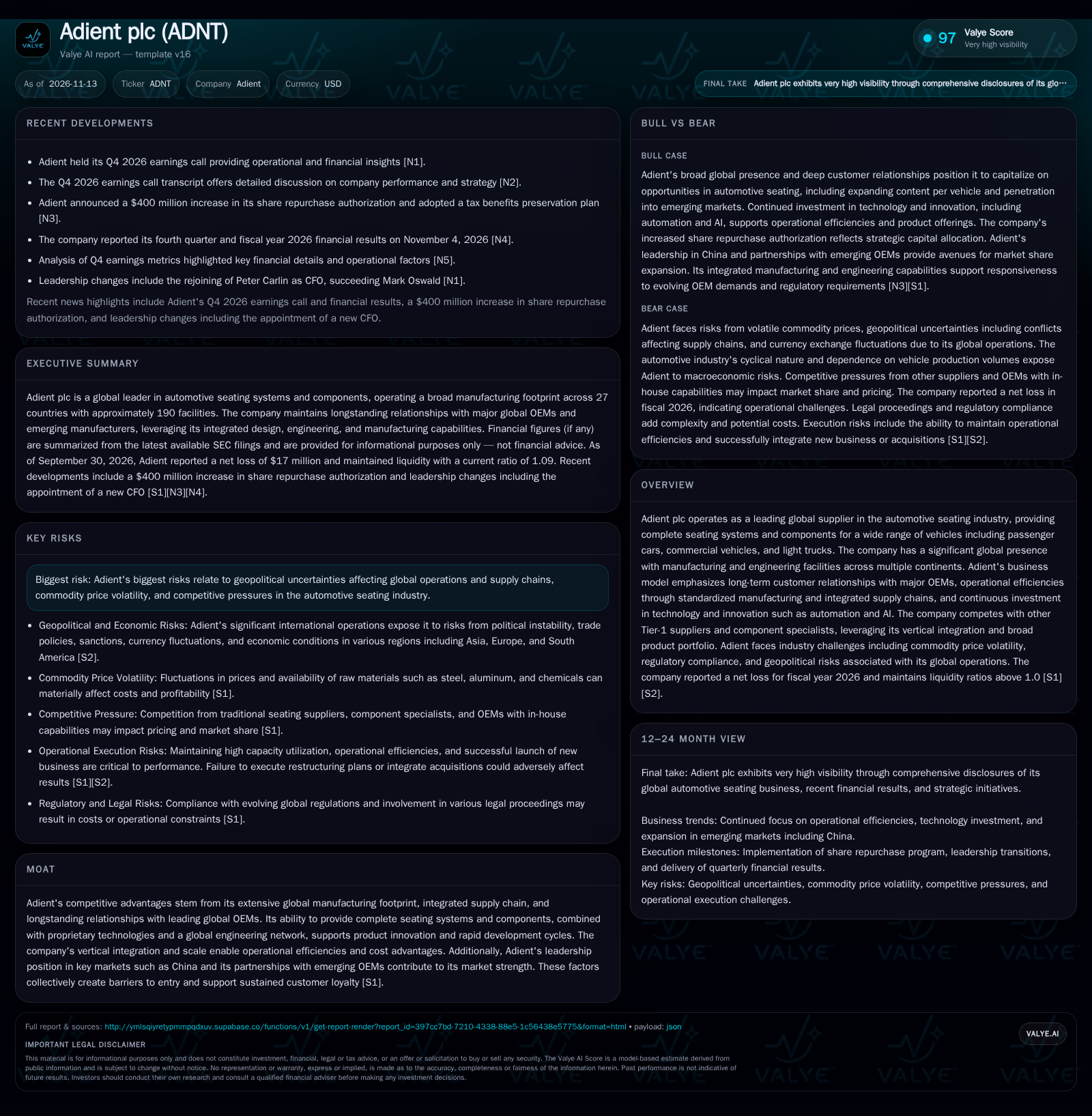
Adient remains a global leader in automotive seating, serving both established and emerging OEMs across 27 countries. Despite reporting a net loss for fiscal 2026, the company’s broad manufacturing footprint, deep customer relationships, and ongoing investments in automation and AI underpin its operational strategy. Recent moves, including a $400 million boost to share repurchases and a CFO transition, suggest efforts to balance capital allocation with the need for strategic renewal amid persistent industry and macroeconomic headwinds. [S1] [N3] [N4]
Adient plc, the world’s largest independent automotive seating supplier, enters fiscal 2027 navigating a demanding landscape: a modest net loss, persistent industry cyclicality, and the need to reconcile global operational scale with cost and innovation pressures. The company’s recent $400 million increase in share repurchase authorization and CFO transition reflect a sharpened focus on capital discipline and leadership continuity. Yet, with over 190 facilities in 27 countries and a customer roster spanning both legacy automotive giants and emerging EV players, Adient’s ability to translate operational investments and OEM integration into sustainable margins remains the central question for investors and industry observers alike. [S1] [N3] [N4]
Recent Results and Strategic Moves Reshape Adient’s 2026 Narrative
Adient closed fiscal 2026 with a net loss of $17 million and basic/diluted EPS of -$0.22, underscoring ongoing profitability pressures despite its role as a global automotive seating leader. The company reported $924 million in cash and equivalents, a current ratio of 1.09, and a cash ratio of 0.25 at September 30, 2026. These balance-sheet metrics suggest Adient is meeting its short-term obligations but do not independently confirm resilience or excess capacity for major investment. [S1]
A notable recent development is the $400 million increase in share repurchase authorization, coupled with the adoption of a tax benefits preservation plan. This signals a renewed focus on shareholder returns and capital structure, even as net income remains negative. Leadership changes, highlighted by Peter Carlin’s return as CFO, further suggest an emphasis on operational execution and financial stewardship. [N3] [N1] [N4]
How Adient’s Business Model Converts Scale and Complexity into (Potential) Earnings Power
Adient’s core economic engine is the design, engineering, and just-in-time delivery of complete seating systems and components for a global roster of automotive OEMs. Revenue is fundamentally volume-driven, tied to new vehicle production and platform launches, with pricing power partially constrained by the concentrated, negotiating leverage of major OEM customers. Margins are structurally thin, reflecting the highly competitive, cost-focused nature of automotive supply.
To mitigate this, Adient leverages extensive vertical integration, global engineering centers, and a manufacturing footprint that enables both cost arbitrage and local supply for major OEM programs. Investment in automation and AI is intended to reduce labor intensity and improve quality, targeting incremental margin expansion through lower variable costs and fewer production defects. However, the fixed cost base—comprising facilities, engineering, and compliance infrastructure—is substantial, so sustainable margin improvement depends on high plant utilization and disciplined cost control.
Raw material inputs, especially steel, aluminum, and polyurethane, are significant cost drivers, making Adient’s earnings sensitive to commodity price swings. The company’s capital needs are ongoing: retooling for new vehicle platforms, regulatory compliance, and technology upgrades all require persistent reinvestment, limiting free cash flow if operating leverage is not realized through higher volumes or improved pricing terms.
OEM Integration, Global Reach, and the Dual-Edged Sword of Diversification
Adient’s primary competitive advantage lies in its deep, multi-decade relationships with virtually every major global OEM—spanning BMW, Toyota, Ford, Volkswagen, and new entrants such as BYD, NIO, and Rivian. This breadth supports platform access, volume stability, and early involvement in vehicle design cycles, making Adient a strategic partner rather than a commodity supplier. The company’s seven joint ventures in China and 40 manufacturing sites across 24 Chinese cities position it as a preferred supplier in the world’s largest auto market, particularly as domestic EV makers gain share. [S1]
However, this diversification comes with complexity. Each OEM relationship requires tailored engineering, compliance, and logistics, constraining economies of scale. Competition remains intense: Tier-1 rivals like Lear, Forvia, Magna, Yanfeng, and Toyota Boshoku are equally global and often compete head-to-head on both price and innovation. Component specialists and OEM insourcing initiatives add further margin pressure. In this context, Adient’s ability to deliver cost, quality, and innovation simultaneously is critical to defending share and margin.
Potential substitutes—such as emerging lightweight or modular seating technologies, or vertically integrated EV platforms—could erode supplier content per vehicle or shift value to new entrants, especially if digital or autonomous vehicle architectures change interior design paradigms.
What a Virtuous Cycle of Volume, Efficiency, and Content Growth Would Look Like
The most favorable outlook for Adient is predicated on a synchronized recovery in global vehicle production, particularly in high-growth markets and premium/luxury segments where content per vehicle is greatest. If Adient’s investments in automation and AI translate into measurable cost reductions and quality gains, and if the company successfully capitalizes on emerging OEM relationships (especially Chinese EV makers), operating leverage could drive a return to sustained profitability—even in the face of modest pricing pressure.
Confirmation of this scenario would come from a shift to positive net income and EPS, expanding gross and operating margins, and evidence of rising content per vehicle or new platform wins with high-volume OEMs. Additional signs would include a positive trajectory in free cash flow, ongoing share repurchases without increased leverage, and public disclosure of major, multi-year supply agreements with leading EV brands.
This scenario would be falsified by continued or worsening net losses, stagnant or declining margins despite efficiency investments, or loss of share with key global OEMs—especially in the Chinese and EV segments.
Sustained Complexity, Tight Margins, and Incremental Progress Amid Macro Volatility
The most plausible near-term outcome is a continuation of Adient’s current operating environment: modest volume growth in select markets, incremental recovery in global vehicle production, and ongoing margin pressure from input costs and competitive dynamics. Operational improvements—automation, supply chain integration, and engineering efficiency—yield some cost offsets, but are largely absorbed by OEM pricing demands and commodity volatility.
Under this scenario, Adient may oscillate between small profits and losses, with reported results heavily influenced by near-term macro conditions such as global interest rates, consumer demand for new vehicles, and commodity price trends. Share repurchase activity continues, but at a measured pace, and capital allocation remains cautious given the need to fund future platform launches and regulatory compliance.
This scenario would be confirmed by stable or slightly improving liquidity metrics, modest sequential improvement in operating margins, and continued strong presence in both legacy and emerging OEM programs. It would be falsified by a material deterioration in free cash flow, loss of major platform contracts, or an inability to recover margins despite cost initiatives.
A Downturn in Auto Production or Raw Material Spike Exposes Structural Vulnerabilities
In a negative scenario, global vehicle production contracts—due to macro shocks, credit tightening, or persistent consumer weakness—leading to lower volumes and underutilization of Adient’s fixed manufacturing base. Simultaneously, a spike in steel, aluminum, or chemical input costs could squeeze gross margins, especially if OEMs resist price pass-through. Execution missteps, such as failed launches of new vehicle platforms or quality issues, would amplify the impact.
In this environment, Adient could see a widening of net losses, negative free cash flow, and potential pressure on liquidity—even if current ratios remain above technical thresholds. The company might be forced to curtail capital investments, delay product innovation, or renegotiate debt covenants. A reduction or suspension of share repurchases and a focus on defensive cash conservation would likely follow.
Confirmation would come from a sharp drop in reported revenues, a significant decline in plant utilization rates (if disclosed), and negative trends in balance-sheet liquidity. Falsification would require resilience in volumes and margins despite macro or commodity shocks, and the maintenance of investment pace in innovation and platform launches.
Milestones That Will Reveal Whether Adient Can Convert Scale Into Sustainable Value
Quarterly net income/EPS trajectory: Is Adient able to return to and sustain profitability, or do losses persist even as volumes recover?
Gross and operating margin trends: Are efficiency initiatives and automation translating into higher margins, or are gains being offset by input costs and OEM pricing?
Free cash flow generation: Does Adient consistently generate positive free cash flow after capital expenditures and share repurchases?
Major OEM platform wins and contract disclosures (if disclosed): Is Adient securing new, high-volume supply agreements, particularly with emerging EV manufacturers?
Plant utilization rates and capacity metrics (if disclosed): Are facilities running at efficient levels, or is excess capacity dragging on margins?
Commodity cost pass-through effectiveness: Can Adient offset raw material volatility through pricing or hedging, or do spikes flow directly to the bottom line?
Pace and scale of share repurchases: Is capital being returned to shareholders without impairing investment capacity or balance-sheet stability?
Leadership execution and strategic continuity: Does the new CFO and management team deliver on operational and financial targets, particularly amid macro volatility?
Disclaimer: This is research-only, informational analysis and not investment advice. It may include AI-generated interpretation and general industry context. Always verify important details using primary sources.

Comments