
ECA Marcellus Trust I: Finite Royalty Streams, Depleting Reserves, and the Countdown to Liquidation
With all wells drilled and a fixed royalty interest portfolio, ECA Marcellus Trust I offers a transparent, self-liquidating income stream tied to Marcellus Shale gas production—yet faces inexorable decline as reserves are drawn down and the 2030 sunset approaches.
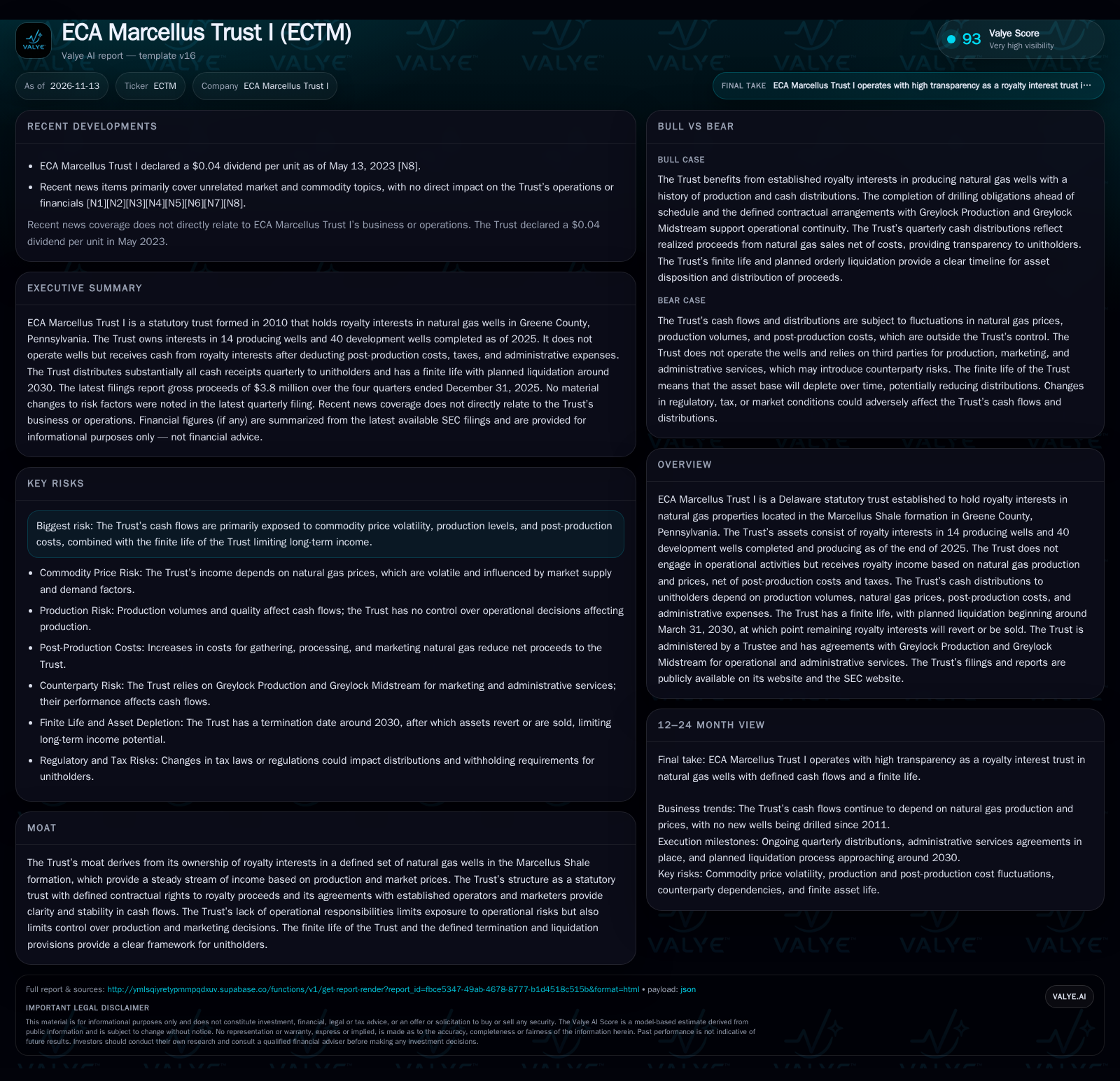
ECA Marcellus Trust I is a royalty trust holding interests in natural gas wells in Pennsylvania’s Marcellus Shale. All drilling was completed by 2011, so the Trust’s cash flows now depend entirely on the output and realized prices from 54 wells, subject to post-production costs and taxes. Gross proceeds for the twelve months ending December 2025 were $3.8 million. The Trust distributes substantially all net cash quarterly and is slated to begin liquidation around March 31, 2030, at which point its royalty interests will revert or be sold. With no further drilling, distributions will decline as reserves deplete, and all risk rests on commodity prices, production rates, and cost management. [S1] [S2]
ECA Marcellus Trust I is an archetype of the finite-life US royalty trust: it owns passive interests in a defined set of Marcellus Shale gas wells, distributes nearly all net cash to unitholders, and faces a predetermined end date in 2030. With drilling obligations fulfilled over a decade ago, the Trust’s destiny is now bound to the output and realized prices of its maturing well portfolio, minus steadily accruing post-production costs and routine administrative fees. For investors, the thesis is straightforward but unforgiving: distributions will shrink as wells deplete and commodity cycles play out, and when the clock runs out, so do the cash flows.
2025 Operating Results and the Looming 2030 Endgame
The most consequential current facts are that ECA Marcellus Trust I holds royalty interests in 14 producing wells and 40 development wells, with all drilling completed by 2011 and no additional wells planned. As of December 31, 2025, all wells are producing, and the Trust reported gross proceeds of $3.8 million for the preceding four quarters. Cash distributions to unitholders are made quarterly and reflect substantially all net receipts after post-production costs and administrative expenses. The Trust is expected to begin liquidation on or about March 31, 2030, at which point remaining royalty interests will revert or be sold. Post-production costs averaged $0.67 per MMBtu in 2025, up from $0.61 in 2024, highlighting the impact of non-operating costs on distributable income. [S1] [S2]
How the Trust Converts Gas Royalties into Distributions
ECA Marcellus Trust I’s economics are fundamentally simple: it receives a contractually fixed percentage of gross proceeds from the sale of natural gas produced by its wells, net of post-production costs and taxes. The Trust bears no operating or capital costs related to drilling or maintaining the wells; instead, it is exposed to the realized price of natural gas, volumetric production declines, and variable post-production expenses. Administrative fees, such as the $60,000 annual payment to Greylock Production, are minor relative to overall gross proceeds. There is no internal reinvestment or growth capex; all available cash is distributed quarterly, with no retention for future investment or reserves.
Because the Trust has a static asset base and a finite life, its economic profile is that of a depleting annuity: distributions will trend down as well production declines, offset or amplified by swings in commodity prices and post-production cost inflation. Operating leverage is limited—higher gas prices flow through to distributions, but no new drilling or scale efficiencies are possible. The Trust’s funding needs are minimal, and there is no debt; capital allocation is entirely mechanical, with no optionality for expansion or diversification.
Royalty Trust Structure: Durable Income or Diminishing Moat?
The Trust’s competitive position is rooted in its royalty interests in a defined set of Marcellus Shale wells—among the most prolific US natural gas plays. This provides a degree of geographic and operational quality, but the moat is inherently self-liquidating: as production from the wells declines due to reservoir depletion, the Trust’s income stream shrinks. Unlike operators or mineral aggregators, the Trust cannot pursue new acreage, optimize production, or improve cost structure. Its only source of differentiation is the quality and decline profile of its initial well set.
Relevant peer groups include other finite-life royalty trusts, such as those with interests in mature shale plays. Substitute vehicles for income-oriented investors include public E&P companies, MLPs, and perpetual mineral/royalty companies, which may offer growth, diversification, or longer asset lives. The Trust’s lack of operational control and inability to reinvest are double-edged: they buffer against operational missteps but also preclude any response to changing market or regulatory conditions. As the 2030 sunset nears, the Trust’s competitive relevance will further erode relative to perpetual yield vehicles.
Commodity Price Rally and Slow Declines Could Extend the Trust’s Final Act
The most favorable scenario for ECA Marcellus Trust I is a sustained, above-expectation rally in natural gas prices, combined with slower-than-modeled production declines from the well portfolio. If the Marcellus Shale experiences stronger demand or regional price differentials narrow (for example, due to expanded pipeline takeaway capacity or LNG export growth), realized prices could materially exceed recent averages. Additionally, if well decline rates moderate due to improved reservoir management or favorable geology, total recoverable volumes and thus royalty income could surprise to the upside.
Confirmation of this scenario would come from quarterly reports showing higher-than-expected distributions, stable or rising production volumes, and post-production costs not eroding the benefits of price gains. Conversely, if distributions fail to respond to a rising commodity price environment, or if post-production costs absorb the upside, the bullish case would be weakened.
Predictable Decline: Distributions Track Production and Market Prices
The most plausible outcome is that ECA Marcellus Trust I’s distributions will gradually decline in line with the natural depletion of its wells, punctuated by the volatility of natural gas prices and incremental changes in post-production costs. Cash flows will be largely mechanical: as reservoir pressure drops and cumulative production rises, output will fall, and each well’s contribution to gross proceeds will shrink. Swings in natural gas pricing will cause quarter-to-quarter variability, but the underlying trend will be downward.
This scenario would be confirmed by a consistent pattern of declining distributions, modest variation in post-production costs, and no material changes in the Trust’s administrative structure or contractual relationships. A significant deviation—such as an unexpected surge in production, a structural change in gas prices, or a major regulatory disruption—would challenge this base expectation.
Accelerated Decline: Weak Gas Prices, Rising Costs, and Counterparty Risks
Adverse outcomes for the Trust would be driven by a combination of unexpectedly rapid well declines, sustained low natural gas prices, and/or rising post-production costs that erode distributable income. If the Marcellus region faces oversupply, infrastructure bottlenecks, or regulatory headwinds, realized prices could underperform national benchmarks. In parallel, if gathering, processing, or marketing costs rise—whether due to inflation, new regulations, or contractual changes—the Trust’s net proceeds could be squeezed further.
A further risk is counterparty performance: the Trust relies on Greylock Production and Greylock Midstream for production, marketing, and administrative functions. Any operational issues, disputes, or financial distress at these entities could disrupt cash flows or increase costs. This scenario would be evident in sharply lower or erratic distributions, abrupt increases in reported costs, or any disclosed counterparty or regulatory problems.
Testing the ECA Marcellus Trust I Thesis as Liquidation Approaches
Quarterly cash distributions per unit: Persistent declines, stabilization, or positive surprises would directly reflect realized economics.
Reported production volumes (if disclosed): Tracking the pace of reservoir depletion and comparing against modeled decline curves would clarify the underlying asset trajectory.
Realized average natural gas price per MMBtu: Movements relative to regional and national benchmarks will indicate the Trust’s price exposure and market risk.
Post-production cost per MMBtu: Increases or decreases will alter distributable cash and may signal cost inflation or operational changes.
Administrative expense levels: Any material changes, especially as the Trust winds down, could affect net distributions.
Counterparty disclosures or changes to Greylock Production/Midstream agreements: New risks or disruptions here could impact income stability.
Regulatory or tax changes affecting trust structure or unitholder distributions: Monitoring for legislative or IRS developments is critical as the Trust approaches liquidation.
Updates on the planned liquidation process, including valuation or sale of residual royalty interests as 2030 nears, would help clarify end-of-life economics.
Disclaimer: This is research-only, informational analysis and not investment advice. It may include AI-generated interpretation and general industry context. Always verify important details using primary sources.

Comments