
Transportation & Logistics Systems, Inc.: From Insolvent Shell to Nanotechnology Platform—A High-Risk Restructuring Gambit
After ceasing logistics operations and entering insolvency, TLSS has executed a reverse merger for a majority stake in PGS, pivoting toward safety and security technologies underpinned by nanotech glass patents. With minimal cash, unresolved liabilities, and extreme dilution risk, the company’s future hinges on integration, capital access, and the commercial viability of its new direction.
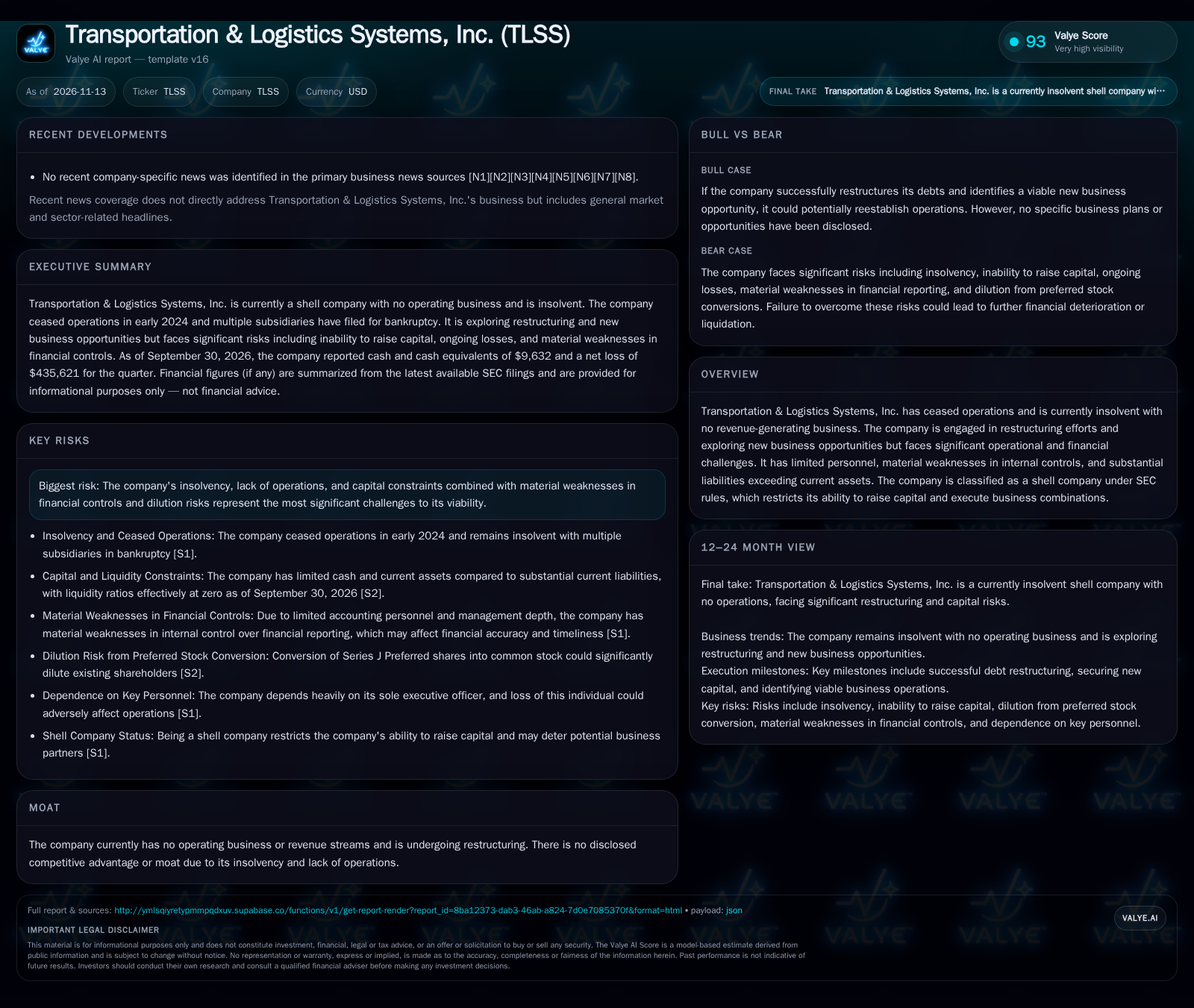
TLSS, having ceased logistics operations and become a shell company, has acquired an 80% stake in PGS—a nanotechnology-focused business—via a reverse merger. Despite this pivot, the company remains deeply insolvent, with negligible cash and overwhelming liabilities, and faces serious dilution risk from preferred stock. The ability to realize value from the PGS platform, restructure debts, and attract capital will determine whether TLSS can escape its shell status or succumb to financial collapse. [S1] [S2]
Transportation & Logistics Systems, Inc. (TLSS) provides a stark case study in distress-driven reinvention. After ceasing all logistics operations and being rendered insolvent, TLSS has pivoted through a reverse merger, acquiring an 80% stake in PGS—a business centered on nanotechnology for glass and security applications. This bold move, executed with almost no reported cash balance and under the looming threat of massive dilution, transforms TLSS from a broken logistics operator into a speculative technology platform. Whether this reset can deliver operational traction or merely delays an inevitable collapse now depends on the integration of PGS, realization of the acquired intellectual property’s value, and the company’s ability to attract fresh capital against daunting odds. [S1] [S2]
Reverse Merger with PGS Signals a Strategic Pivot Amid Extreme Financial Distress
As of September 30, 2026, TLSS remained insolvent, with just $9,632 in cash and current assets of $13,632 set against $9.87 million in current liabilities, resulting in a current ratio and cash ratio near zero. The company reported a quarterly net loss of $435,621 and has not generated any operating revenue since ceasing logistics operations in early 2024. [S2]
The most consequential development is the November 2026 acquisition of an 80% membership interest in PGS, a company holding four U.S. patents related to nanotechnology for strengthening glass. TLSS executed this reverse triangular merger by issuing 47,500 shares of Series J Preferred Stock (aggregate stated value $4.75 million), with PGS’s founder retaining a 20% minority interest. The transaction aims to establish a new operating platform focused on safety and security technologies, but the commercial value and integration risks are yet undetermined. [S2]
Outstanding Series J Preferred Stock expanded to 161,442 shares post-merger, with a liquidation preference of $19.37 million—far above TLSS’s asset base—creating immediate and severe dilution risk for existing common shareholders. [S2]
Assessing the Economics of a Nanotechnology Platform Built on Glass-Strengthening IP
TLSS’s pre-merger business model is now obsolete; future economics depend entirely on the commercial viability of PGS’s technology. The value chain for nanotechnology-enabled glass products typically spans patent licensing, direct product sales (e.g., glass treatments or additives), or co-development with manufacturers in automotive, construction, or security sectors.
Revenue generation may involve licensing fees, royalties, or product sales, each with distinct margin structures: licensing can offer high margins but requires proof of IP relevance and enforceability, while product sales are capital- and distribution-intensive, often requiring upfront investment in manufacturing, inventory, and marketing.
The merger consideration—preferred stock with substantial liquidation preference—means any future cash flows must first address preferred redemption and deferred compensation liabilities before benefiting common shareholders. With negligible cash, TLSS will likely need to raise external capital for product development, sales, or manufacturing partnerships. The extent to which PGS’s IP can command premium pricing, secure distribution, and scale volume will determine whether the new platform can achieve operating leverage or remains mired in fixed-cost overhead and continued losses.
Material weaknesses in financial controls and the reliance on a single executive officer further complicate the economics, as they may hinder both capital-raising and the execution of commercial agreements. [S1] [S2]
No Moat Yet: Technology Validation, IP Protection, and Industry Partnerships Will Define Relative Position
TLSS currently lacks a demonstrated moat in its new nanotechnology vertical. While four U.S. patents offer a theoretical foundation for differentiation, commercial traction will depend on the patents’ enforceability, technical superiority, and relevance to real-world applications. In glass-strengthening and safety/security markets, competition spans established chemical companies, specialty materials firms, and vertically integrated glass manufacturers.
Barriers to entry for IP-driven platforms are typically moderate unless the technology is demonstrably superior or able to secure exclusive supply contracts. Without evidence of current customer adoption, pilot programs, or licensing partners, TLSS’s competitive position is purely potential at this stage.
The company’s shell status, insolvency, and internal control weaknesses are likely to deter partners or acquirers. In contrast, successful demonstration of the technology’s value—via third-party validation, industry partnerships, or initial commercial sales—would be necessary to establish any defensible position against incumbent material science and specialty glass providers.
How a Successful Technology Commercialization Could Unlock Value—If Execution and Capital Follow
A favorable scenario would see TLSS quickly validate PGS’s nanotechnology through successful pilot deployments or licensing deals with glass manufacturers, construction companies, or security integrators. Independent third-party validation or safety certifications could accelerate market adoption, enabling the company to negotiate licensing or distribution agreements that generate recurring, high-margin revenue streams.
Access to new capital—potentially via PIPE investments or strategic partnerships—would allow TLSS to fund product development, marketing, and further patent prosecution. If the technology demonstrates a tangible performance or cost advantage, the company could scale rapidly without the need for capital-intensive manufacturing, instead monetizing its IP through industry partners.
Confirmation of this scenario would require disclosure of signed commercial agreements, revenue generation from IP, or major strategic partnerships. Falsification would occur if the patents prove commercially irrelevant, do not attract interest, or if the company fails to raise capital for productization and go-to-market execution.
Speculative Platform Treads Water: Limited Traction, Dilution, and Ongoing Losses
The most plausible near-term pathway is that TLSS, despite the PGS acquisition, remains a speculative shell with ongoing financial distress. Integration of PGS could be delayed by lack of capital, unresolved liabilities, and continued material weaknesses in internal controls. The patents may require additional validation, and with no disclosed customer pipeline or revenue, commercialization is likely to be slow.
Dilution from Series J Preferred Stock conversion could overwhelm any incremental equity value created, as new investors would likely demand steep discounts to compensate for risk and legacy liabilities. The company may continue to operate with minimal personnel and negative operating cash flow, seeking but struggling to secure meaningful strategic or financial partnerships.
This scenario would be confirmed by continued absence of revenue, failure to attract new investment, or further shareholder dilution. Signs of improvement would include hiring for business development, disclosure of pilot projects, or early-stage licensing revenue.
Failure to Restructure or Commercialize Leads to Liquidation or Asset Sale
In an adverse scenario, TLSS is unable to realize commercial value from the PGS acquisition. The company fails to raise capital, cannot satisfy deferred compensation or preferred redemption obligations, and faces creditor or legal action. Material weaknesses in controls persist, further eroding any remaining confidence from potential partners or investors.
Regulatory risks associated with shell company status, combined with overwhelming dilution and insolvency, could force TLSS to liquidate its remaining assets—including the recently acquired patents—at distressed valuations. Common shareholders would likely be wiped out, with preferred holders and creditors absorbing any residual value.
Evidence of this scenario would include legal proceedings, bankruptcy filings, or asset sales at values far below stated preferences. Confirmation would also come from ongoing absence of commercial traction and inability to remediate internal control weaknesses.
Milestones and Developments That Will Reveal Whether TLSS’s Reinvention Can Succeed
Disclosure of initial commercial agreements, pilot projects, or licensing deals for PGS’s nanotechnology IP would help test whether the technology has real market demand.
Updates on external capital raises (PIPEs, equity placements, or strategic investments) are essential, as current resources are insufficient to fund operations or scale new business lines.
Progress on resolving or restructuring legacy liabilities, including deferred compensation and preferred stock redemption obligations, will indicate whether the balance sheet can support a viable business.
Remediation of material weaknesses in internal controls and expansion of management depth would signal improved execution capacity and credibility with investors.
Filing of pro forma financials or detailed purchase price allocation for the PGS transaction would clarify the true asset base, goodwill, and noncontrolling interest stakes.
Evidence of third-party validation, certifications, or endorsements for the acquired glass-strengthening technology would help establish its competitive relevance.
If disclosed, metrics on customer pipeline, contracted revenue, or initial order volume would provide tangible evidence of commercialization progress.
Any legal proceedings, creditor actions, or regulatory developments related to shell company status or insolvency would be crucial to monitor for downside risk.
Disclaimer: This is research-only, informational analysis and not investment advice. It may include AI-generated interpretation and general industry context. Always verify important details using primary sources.

Comments