
Green Planet Bio Engineering: Public Shell Status, Structural Challenges, and the Mechanics of a Potential Reversal
With no active operations, zero cash, and mounting compliance costs, Green Planet Bio Engineering exists as a public shell seeking a viable acquisition or merger. The company's path forward depends entirely on sourcing external capital and a suitable business opportunity—both of which face substantial practical and regulatory hurdles.
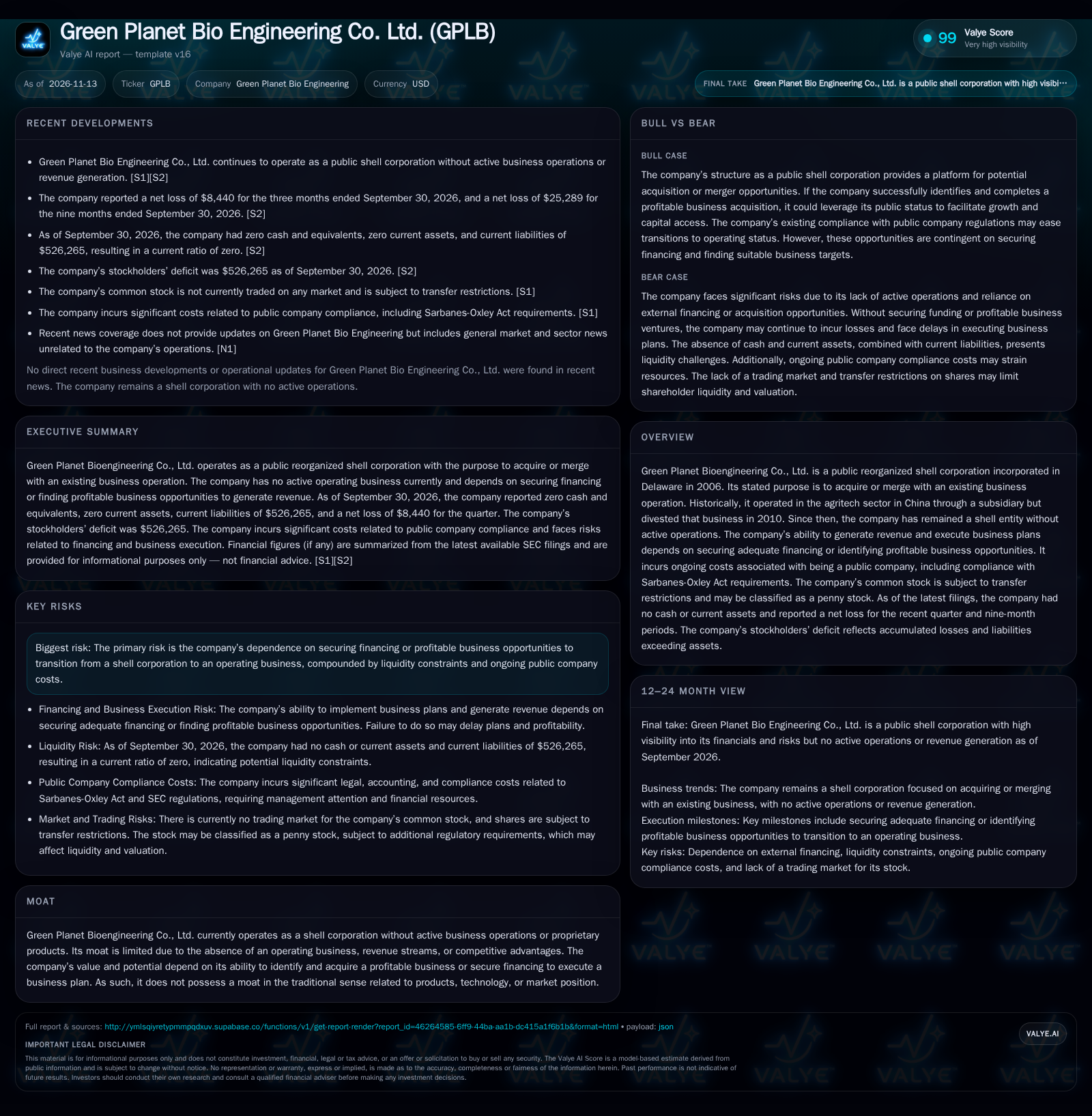
Green Planet Bio Engineering is a Delaware-incorporated public shell corporation with no current operations, assets, or revenue. As of September 30, 2026, it reported zero cash, $526,265 in current liabilities, and ongoing operating losses. The company’s only path to value creation is through acquisition or merger, but success is contingent on securing external financing and finding an attractive target—while simultaneously bearing the persistent costs of public company compliance. [S1] [S2]
Green Planet Bio Engineering Co. Ltd. embodies the classic public shell: a legal entity with no operating business, no assets, and substantial liabilities, whose stated purpose is to acquire or merge with an existing company. Its only tangible asset is its public listing, which theoretically offers a shortcut for private businesses seeking to go public. However, the company’s precarious financial position—zero cash, mounting liabilities, and persistent operating costs—creates formidable obstacles to executing any business plan. For investors and potential acquirers alike, the real questions are whether Green Planet can attract the capital needed to facilitate a deal, and whether its shell structure actually offers meaningful value given regulatory, financial, and reputational frictions. [S1] [S2]
Financial Deficit and Shell Status Define Immediate Reality
As of September 30, 2026, Green Planet Bio Engineering reported zero cash, zero current assets, and current liabilities totaling $526,265. The company posted a net loss of $8,440 for the quarter and $25,289 for the nine months ended September 30, 2026. Its stockholders’ deficit stands at $526,265, and there is no trading market for its shares, which are further constrained by transfer restrictions. The company has no operating business and is focused solely on seeking an acquisition or merger partner. These facts underscore a business with no intrinsic operating value, negative net worth, and no immediate liquidity, making its continued existence dependent on external intervention or a successful transaction. [S2]
How Shell Companies Create (or Lose) Value
The economics of a public shell like Green Planet hinge entirely on its potential to serve as a vehicle for a private company to access public markets via a reverse merger or acquisition. In this scenario, the shell’s value is derived from its public listing status, which can save a target company time and regulatory complexity compared to a traditional IPO. However, the absence of assets or operating revenues means fixed costs—primarily legal, audit, and compliance expenses—are a constant drain. There is no revenue unless and until an acquisition is consummated. The company’s negative equity and lack of liquidity mean it cannot self-fund a transaction or cover even basic obligations, making any potential deal contingent on external capital, often in the form of a simultaneous financing or backstopping by a sponsor.
If a merger occurs, the economics for existing shell shareholders are highly sensitive to the transaction terms, dilution from new capital, and the reputation and financial health of the incoming target. In many cases, legacy shell shareholders retain a small fraction of the post-deal equity. If no deal occurs, the shell continues to accrue losses from ongoing compliance costs, eroding any residual value.
Shell Market Saturation and Regulatory Friction Limit Differentiation
Green Planet faces a crowded and undifferentiated field of public shells, many of which also promise a shortcut to public markets for private businesses. The competitive landscape is defined less by traditional business advantages and more by regulatory cleanliness, cost structure, and the absence of legacy liabilities or legal complications. In this context, Green Planet’s negative equity and lack of cash are significant disadvantages: a shell with a cleaner balance sheet or recent transaction history is typically more attractive to merger targets.
Further, heightened regulatory scrutiny (e.g., SEC focus on shell-company abuses and penny-stock rules) increases the compliance burden and may deter high-quality target companies. The illiquidity and transfer restrictions on Green Planet’s shares further reduce its appeal compared to shells with more active trading volumes or established investor bases. The company’s only potential advantage is its continued SEC reporting compliance, which may reduce the time and expense for a merger partner to achieve public reporting status—but this alone is unlikely to offset its financial and structural weaknesses.
A Successful Reverse Merger Could Unlock Value—If Capital and Target Align
The most favorable outcome for Green Planet would be the identification of a credible private business seeking a public listing, coupled with investors willing to fund the transaction and cover the shell’s liabilities. In this case, Green Planet’s public status and SEC reporting compliance could facilitate a relatively rapid reverse merger, allowing the new business to access public capital markets. Existing shell shareholders might retain a modest equity stake in the combined entity, which could become valuable if the new business performs well post-merger.
Evidence that would confirm this scenario includes the announcement of a binding merger agreement, disclosure of a committed financing package sufficient to cover existing liabilities and public company costs, and regulatory filings outlining the terms of the transaction and post-deal capitalization. A successful merger with a high-quality, growth-oriented operating business would likely be accompanied by increased trading activity, new capital inflows, and possibly the removal of transfer restrictions.
Ongoing Stasis and Value Erosion from Compliance Drag
The most probable near-term scenario is continued stasis: Green Planet remains a public shell, incurring compliance and reporting costs while searching for a viable merger or acquisition candidate. With no cash and no operating assets, the company is unable to initiate any business activities independently or invest in making itself a more attractive target. Over time, fixed costs further erode the company’s net worth, and the stock remains illiquid and constrained by regulatory rules.
Evidence for this scenario includes continued zero cash balances, negative equity, and the absence of any announced transaction or financing. Ongoing net losses and the lack of change to the company’s status in SEC filings would further confirm a continuation of the current trajectory.
Escalating Liabilities and Regulatory Sanctions Threaten Survival
The primary adverse scenario is that Green Planet’s persistent inability to secure a merger partner or new capital leads to compounding liabilities, potential regulatory non-compliance, and the eventual risk of delisting or dissolution. If the company is unable to pay for mandatory audits, legal filings, and other public company costs, it could fall out of SEC compliance, triggering administrative actions or involuntary termination of its public registration. This would effectively eliminate any remaining value for shareholders and close the door to future transactions.
Confirmation of this scenario would include missed SEC filing deadlines, auditor resignations or adverse audit opinions, legal proceedings related to unpaid obligations, or formal SEC actions against the company. A further deterioration in the company’s financial disclosures—such as growing liabilities or contingent legal risks—would also support this downside path.
Milestones and Disclosures That Will Clarify Green Planet’s Prospects
Any public announcement of a binding letter of intent, merger agreement, or acquisition target would be a pivotal development.
Disclosure of external financing commitments or capital raises, if announced, would signal potential viability for a transaction.
Changes in the company’s SEC filing status—such as missed deadlines, restatements, or auditor changes—would indicate rising compliance or solvency risk.
Updates to the balance sheet, including any new cash infusions or material changes in liabilities, would help assess short-term survivability.
The emergence of a liquid trading market for the company’s shares, or regulatory filings lifting transfer restrictions, would test potential value realization for shareholders.
A useful metric would be the size and terms of any proposed equity or debt financing in connection with a business combination.
If disclosed, the identity and operating profile of any proposed merger target would clarify the quality of the potential transaction and future prospects.
Disclaimer: This is research-only, informational analysis and not investment advice. It may include AI-generated interpretation and general industry context. Always verify important details using primary sources.

Comments