
Applied Energetics: Directed Energy Ambitions Confront Financial and Funding Realities
The company's future now hinges on securing additional funding and converting R&D into sustainable revenues amid persistent operational headwinds.
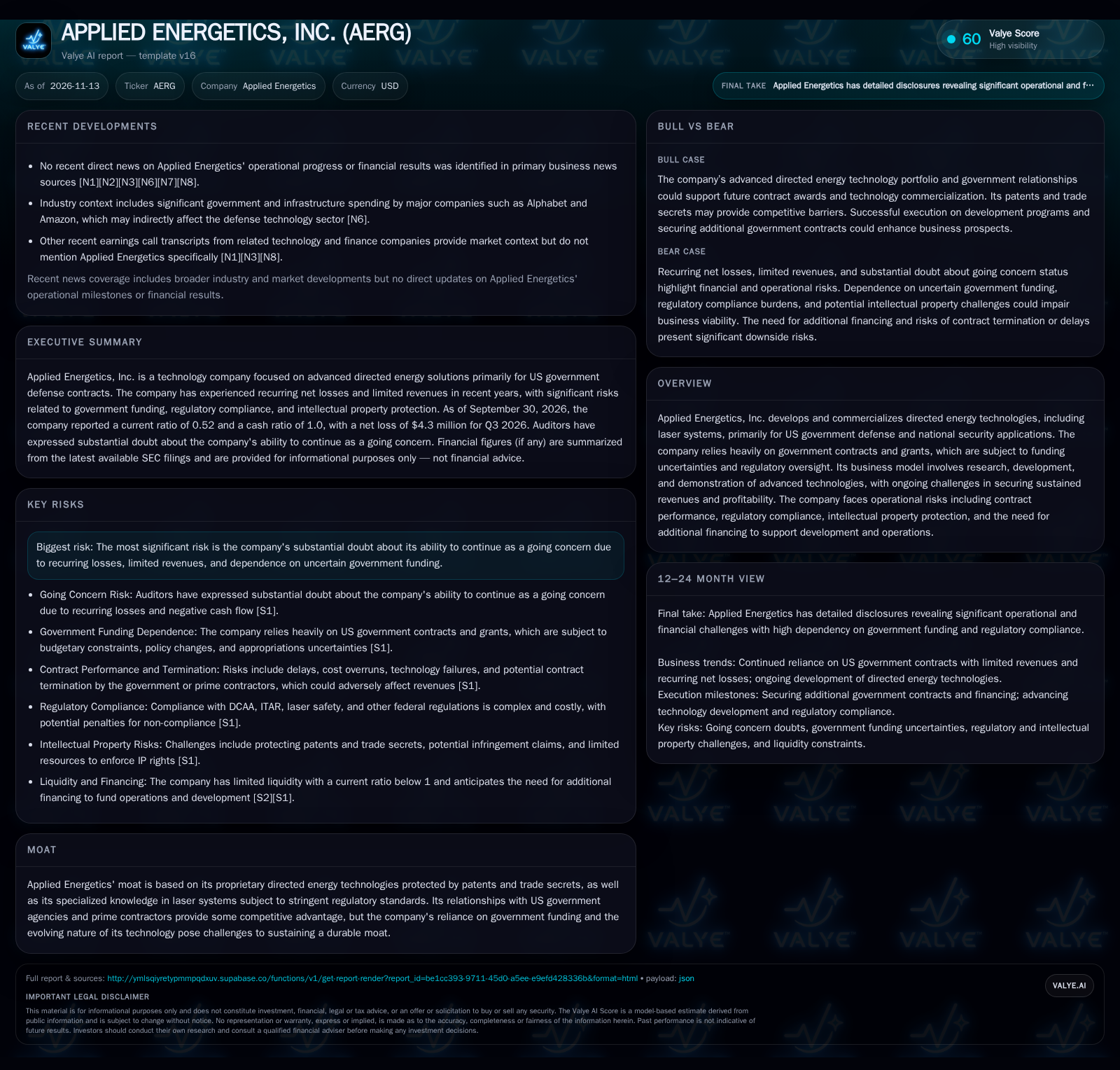
With auditors expressing doubt about its ability to continue operations, the company's prospects depend on new contract wins, additional financing, and successful technology development [S2].
Applied Energetics, Inc. exemplifies both the technological promise and operational fragility inherent to early-stage defense innovators. Specializing in directed energy and advanced laser systems for US government and defense customers, the company operates in a market where long development cycles, regulatory complexity, and funding volatility are the norm. Despite a portfolio of proprietary technologies and government relationships, Applied Energetics remains in a precarious financial position, with recurring losses, reported liquidity position, and auditors raising substantial doubt about its ability to continue as a going concern. The company’s path forward will be determined by its ability to secure additional contracts and financing while navigating the inherent risks of government-dependent R&D.
Acute Liquidity Strain and Auditor Doubt Define Near-Term Outlook
As of September 30, 2026, Applied Energetics reported a net loss of $4.3 million for Q3 and a current ratio of just 0.52, reflecting acute liquidity pressure [S2]. The company’s cash ratio stands at 1.0, which, while covering immediate obligations, does not provide a cushion for ongoing R&D or operational investment. Auditors have formally expressed substantial doubt about Applied Energetics' ability to continue as a going concern, citing recurring net losses and limited revenues [S1]. These facts underscore existential financial risks and shape every aspect of business strategy and execution for the foreseeable future.
How Government-Driven R&D Shapes Revenue Potential and Cost Structure
Applied Energetics’ business model is fundamentally tied to the US government procurement cycle, with revenues driven by competitive awards for R&D, demonstration, and potential deployment of directed energy solutions. This structure creates high revenue volatility: contract wins can produce meaningful cash inflows, but periods between awards can leave the company with little to no revenue. The cost base is dominated by R&D and compliance, both of which are largely fixed over short periods and difficult to scale down without impairing technical progress.
Gross margins, if and when products or prototypes transition to limited production, could be attractive due to the high-value, specialized nature of defense technology. However, until sustained production contracts materialize, the company is likely to remain in a negative operating leverage position—where incremental revenue does not cover fixed personnel, regulatory, and infrastructure costs. The need for ongoing investment in intellectual property protection and regulatory compliance further amplifies capital requirements. Without additional financing or a step-change in contract awards, recurring net losses are likely to persist.
The timing and scale of government contract awards are inherently uncertain, often influenced by shifting defense priorities, budget appropriations, and geopolitical developments. This unpredictability complicates financial planning and resource allocation for Applied Energetics. Moreover, the company’s reliance on government funding introduces a lag between expenditure and revenue recognition, as contracts typically require milestone achievements before payments are disbursed. This creates a working capital strain that necessitates access to bridge financing or reserves. Additionally, cost overruns or delays in meeting technical milestones can jeopardize contract continuation, amplifying financial risk. Therefore, the company’s ability to manage project execution efficiently and align its R&D pipeline with government procurement cycles is critical to stabilizing its cost structure and revenue streams.
Moat Mechanisms: Technology Barriers, Relationships, and Their Limitations
Applied Energetics’ primary competitive assets are its proprietary directed energy technologies, protected by a combination of patents and trade secrets. These barriers can be meaningful in defense, where regulatory standards and export controls (such as ITAR) restrict market entry and provide some insulation from commercial competitors. The company’s relationships with US government agencies and prime contractors can also be a source of repeat business, provided technical milestones are met and funding persists.
However, these advantages are tempered by several structural vulnerabilities. Large defense primes and well-capitalized technology firms can invest more heavily in advanced R&D and have greater resources to navigate regulatory and contracting complexity. Additionally, the company’s limited ability to enforce its IP in the face of infringement, due to resource constraints, leaves it exposed to competitive encroachment or loss of proprietary advantage. Finally, the evolving nature of directed energy technology means that today’s patents may not guarantee future relevance if alternative solutions or next-generation architectures gain favor.
The company’s competitive moat is further influenced by the complexity and specialization of directed energy technologies, which require highly skilled personnel and sophisticated manufacturing capabilities. While these factors raise barriers to entry, they also increase operational risks, including talent retention challenges and supply chain dependencies. Furthermore, the defense sector’s preference for established suppliers means that Applied Energetics must continuously demonstrate technological superiority and reliability to maintain and grow its government relationships. The company’s limited scale compared to large primes may restrict its ability to absorb development setbacks or invest in parallel technology pathways, potentially narrowing its strategic options. Hence, sustaining innovation while managing operational constraints is essential to preserving its competitive position.
Breakthrough Award or Technology Validation Could Transform Prospects
A favorable scenario would see Applied Energetics secure a major government contract for development or limited deployment of its directed energy systems, potentially catalyzing follow-on awards and positioning the company as a core supplier for next-generation defense needs. Such a breakthrough might be triggered by successful demonstration of technical milestones, validation by a key agency, or inclusion in a prime contractor’s integrated solution.
Confirmation of this scenario would include public announcements of material contract wins, significant increases in backlog, or evidence of expanded R&D partnerships with major defense entities. Additional signs would be successful capital raises at favorable terms, allowing the company to scale R&D and address working capital needs. Falsification would come from continued absence of new awards, inability to raise capital, or technical setbacks that delay or disqualify the company from procurement competitions.
Financial Pressure Persists as Development Continues Under Funding Constraints
The most plausible trajectory is one of continued struggle for financial sustainability, with sporadic minor contracts or grants supporting ongoing R&D but not closing the gap to profitability. The company may achieve incremental technical progress and maintain a foothold in government R&D programs, but recurring net losses and reported liquidity position persist, forcing periodic fundraising efforts and constraining the pace of development.
Evidence for this scenario would be modest contract announcements, continued negative operating results, and repeated auditor emphasis on going concern risk. A move away from this path could be signaled by either a transformative contract win or a failure to secure bridge financing, pushing the company toward restructuring or wind-down.
Failure to Secure Funding or Awards Accelerates Operational Crisis
In a negative scenario, Applied Energetics fails to obtain needed financing and/or is unable to win new contracts in a timely manner, leading to a liquidity crisis. This could force the company to halt R&D activities, downsize personnel, or seek strategic alternatives under distressed conditions. In the worst case, insolvency or liquidation becomes a real possibility.
Confirmation would be evidenced by missed payroll, defaults on obligations, or public disclosures of restructuring advisors or bankruptcy considerations. Near-term warning signs would be an inability to close planned financings, negative working capital trends, or regulatory actions for compliance lapses due to resource constraints.
Milestones and External Factors That Will Determine Applied Energetics’ Trajectory
Announcements of new material government contract awards, especially those signaling transition from R&D to deployment phases.
Evidence of successful capital raises, including terms, dilution, and use of proceeds.
Quarterly cash burn and changes in working capital, if disclosed, to gauge the pace at which liquidity is being consumed.
Updates on auditor opinions regarding going concern status and any changes in financial statement disclosures.
Progress on key technical milestones or demonstration events recognized by government agencies or prime contractors.
Intellectual property developments—new patents granted, material IP litigation, or evidence of IP enforcement or infringement risk.
Regulatory compliance updates, including any reported issues with DCAA, ITAR, or laser safety requirements.
Disclaimer: This is research-only, informational analysis and not investment advice. It may include AI-generated interpretation and general industry context. Always verify important details using primary sources.

Comments