
Data I/O’s Strategic Overhaul: Recurring Revenue Aspirations Confront Profitability and Integration Pressures
Data I/O Corporation is executing a high-stakes transformation—shifting from hardware-centric capital equipment to recurring, software-driven data provisioning and Edge AI services.
Data I/O is moving aggressively to diversify away from cyclical capital equipment sales into software, services, and consumables, targeting higher stability and a larger addressable market. Acquisitions and AI-driven cost reductions support this pivot, but widening losses, declining bookings, and integration risks signal that successful execution is far from assured. The next year will test whether the company’s transformation can deliver sustainable growth and margin expansion, or whether structural headwinds in its core end-markets will dominate.
Data I/O Corporation stands at a crossroads, executing a strategic overhaul designed to reshape its business model for a world where recurring, software-enabled revenue streams are prized over lumpy, cyclical hardware sales. Recent acquisitions, a reported liquidity position, and a renewed focus on data provisioning and Edge AI signal ambition and adaptability. Yet, persistent losses, declining bookings, and the formidable challenge of integrating new assets and commercial models mean that the company’s transformation is fraught with both promise and peril. The coming quarters will reveal whether Data I/O can turn its operational and portfolio moves into lasting competitive advantage—or whether legacy headwinds will persist.
Recent Acquisitions and Losses Shape Strategic Trajectory
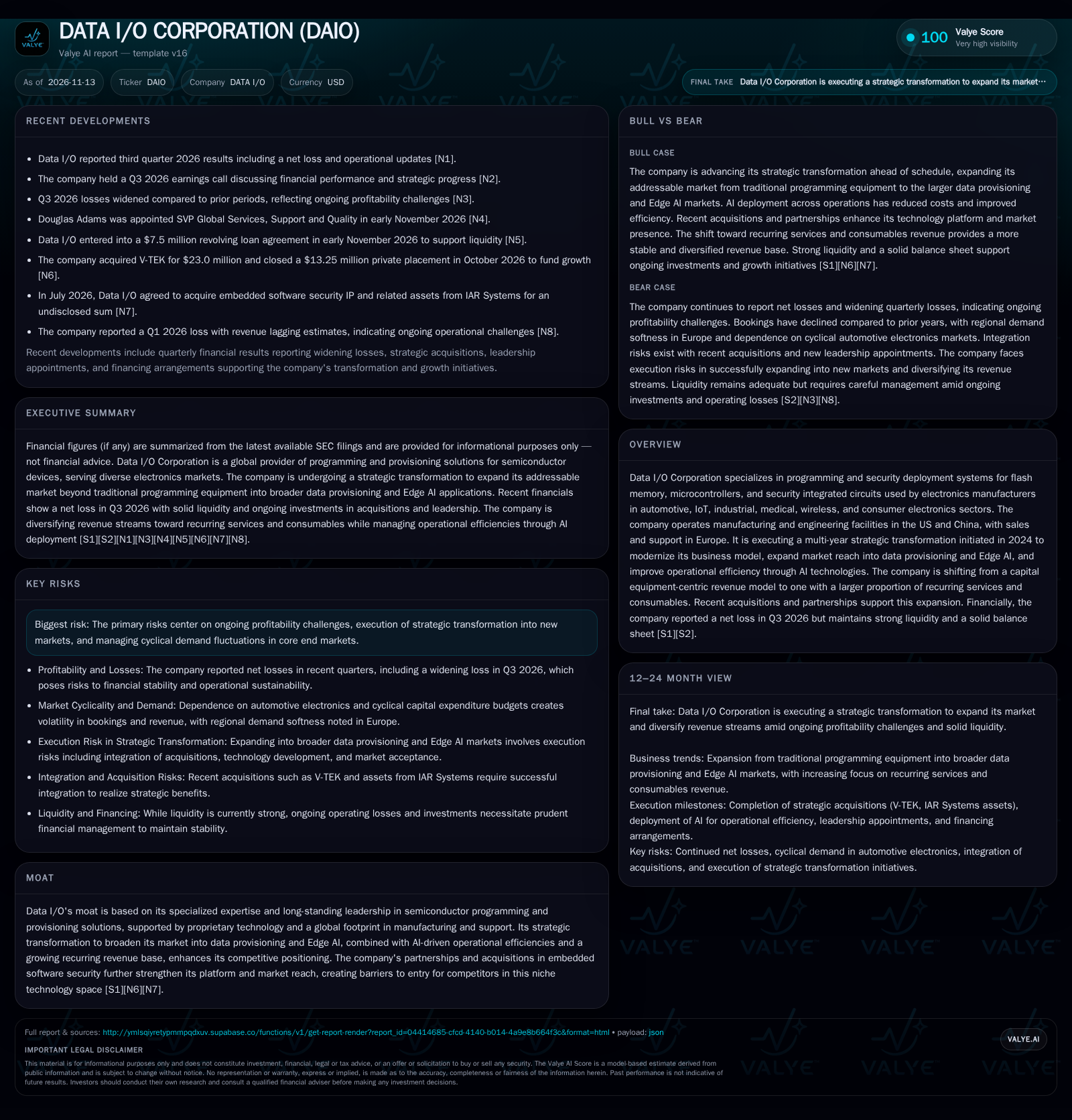
Data I/O reported a net loss of $2.7 million for Q3 2026, continuing a trend of widening losses as the company invests heavily in transformation initiatives. The reported balance sheet position, with $9.4 million in cash and no debt as of September 30, 2026 [S2]. To support its evolving strategy and fund acquisitions, Data I/O closed a $13.25 million private placement and acquired V-TEK for $23 million in October 2026, and separately entered a $7.5 million revolving loan agreement in early November [N5] [N6]. The company also agreed to acquire embedded software security IP from IAR Systems in July 2026 [N7]. These moves broaden the company’s technology stack and recurring revenue potential, but simultaneously raise integration and execution risks, all against a backdrop of continued operating losses.
Recurring Revenue Ambitions Meet Hardware Legacy
Data I/O’s traditional business model relied on capital equipment sales—high-ticket, cyclical, and heavily exposed to customer capex cycles, particularly in automotive and industrial electronics. This model offers high gross margins on hardware, but results in volatile revenue and limited customer lock-in. The company is actively shifting toward a mixed model where recurring services, software, and consumables (like adapters and programming-at-test solutions) now represent 58% of revenue as of 2025 [S1]. This transition is critical: recurring streams typically command higher multiples, offer greater revenue visibility, and can improve customer retention if switching costs or integration depth are meaningful.
The economics of this shift depend on execution—recurring offerings must be woven into customer workflows, priced for value, and scaled globally. The cost structure is also in flux: AI-enabled operational improvements have reduced recurring operating expenses by 7% in 2025, with more savings targeted for 2026 [S1]. However, the company remains loss-making, suggesting that either the gross margin on new offerings, or the pace of cost reduction, is not yet sufficient to offset the drag from legacy operations and transformation costs. The integration of V-TEK and IAR assets could add new revenue streams and cross-selling opportunities, but may also increase short-term costs and complexity.
Positioning in a Crowded and Evolving Data Provisioning Landscape
Data I/O operates in a niche but technologically demanding segment—programming and security provisioning for flash, microcontrollers, and security ICs, serving markets ranging from automotive and IoT to industrial and medical devices. This space is characterized by entrenched legacy competitors, rapid technological change (e.g., shift to Edge AI), and increasing security demands as devices proliferate.
The company’s long-standing expertise, global support footprint, and proprietary technology offer some barriers to entry, especially for large customers requiring validated solutions and global support. However, competitive pressure is intensifying: new entrants and established players alike are pushing more integrated, software-driven, and cloud-enabled provisioning solutions. The move into Edge AI and embedded software security (supported by recent acquisitions) could create differentiation if Data I/O can deliver seamless, secure, and scalable solutions. The challenge is that hardware commoditization, customer price sensitivity, and the need for ongoing R&D investment can erode any advantage absent continuous innovation and deep customer integration.
If Recurring Services Scale and Acquisitions Integrate Smoothly
A favorable outcome for Data I/O would see the company successfully integrating V-TEK and IAR’s embedded security IP, rapidly expanding its suite of recurring services and software offerings. This could lead to a higher mix of recurring revenue, improved gross margins as services and software outpace hardware, and stickier customer relationships due to deeper integration and higher switching costs.
The bull case depends on evidence that recurring revenue continues to grow as a share of total sales (surpassing 60%+), that gross margin improves as new offerings scale, and that integration costs are contained. Signs of customer wins in Edge AI and IoT security, particularly among Tier 1 electronics manufacturers, would further validate the strategy. If AI-driven operational savings compound and new acquisitions contribute positively within 12-18 months, Data I/O could return to profitability, support further innovation, and command a higher valuation multiple. Confirmation would come from sequential improvement in operating margins, sustained bookings growth (especially in Asia and North America), and successful cross-selling of acquired technologies.
Transformation Progresses but Profitability Remains Elusive
The most plausible scenario is one of continued but uneven progress. Data I/O likely continues to grow its recurring revenue base, but not fast enough to offset persistent headwinds from legacy hardware volatility and the costs of transformation. Integration of V-TEK and IAR assets may proceed, but synergies take longer to materialize, and near-term margin improvement is muted by ongoing R&D, sales, and integration costs.
Bookings may stabilize or recover modestly in Asia and North America, but European weakness persists due to automotive sector softness. Operating losses continue, though perhaps at a reduced rate as AI-enabled efficiencies and recurring revenue mix improve. The company’s liquidity position remains adequate in the near term, but additional capital may be needed if losses persist or integration proves more expensive than planned. Evidence for this scenario includes continued net losses, incremental improvement in recurring revenue mix, and muted or uneven gross margin trends.
Integration Missteps and Market Cyclicality Derail the Pivot
The risk case for Data I/O centers on failed or delayed integration of recent acquisitions, with operational distractions, customer churn, or cultural misalignment undermining the expected benefits. If recurring services fail to scale or face competitive pricing pressure, the company remains overexposed to hardware cyclicality and faces continued revenue and margin pressure.
If cost savings from AI and process optimization stall, and if acquisition synergies do not materialize, Data I/O may be forced to raise additional capital on unfavorable terms, cut strategic investment, or retrench to core hardware offerings. Evidence would include continued or worsening operating losses, declining recurring revenue as a share of total, missed integration milestones, and negative cash flow trends.
Milestones That Will Define Data I/O’s Transformation Outcome
Quarterly recurring revenue as a percentage of total sales—an increase above 60% would signal successful business model transition; a stall or decline would raise concerns.
Gross margin trends, especially on new services and software versus legacy hardware—improvement would support the thesis that recurring offerings are higher value.
Bookings growth by region, with a focus on recovery or expansion in Europe and sustained strength in Asia—if disclosed.
Integration milestones for V-TEK and IAR Systems assets, including new product launches or customer wins leveraging these acquisitions.
Operating margin and expense ratio trends, particularly reflecting the impact of AI-driven cost reductions—continued improvement would validate the operational efficiency narrative.
Cash flow from operations and capital expenditure levels, especially in the context of ongoing net losses and integration spend.
Customer concentration and retention rates—greater diversification or stickiness would help offset end-market cyclicality, if disclosed.
New contract wins or strategic partnerships in Edge AI and IoT security, demonstrating traction in targeted expansion markets.
Disclaimer: This is research-only, informational analysis and not investment advice. It may include AI-generated interpretation and general industry context. Always verify important details using primary sources.

Comments