
Central Bancompany: Regulatory Demands, Product Innovation, and the Realities of Regional Concentration
Central Bancompany, Inc. demonstrates sequential profit growth and new product launches, but its fortunes remain tightly linked to regulatory requirements and the economic health of its core markets. The interplay of compliance, operational risk from new business lines, and geographic concentration will define its risk-reward profile over the next several years.
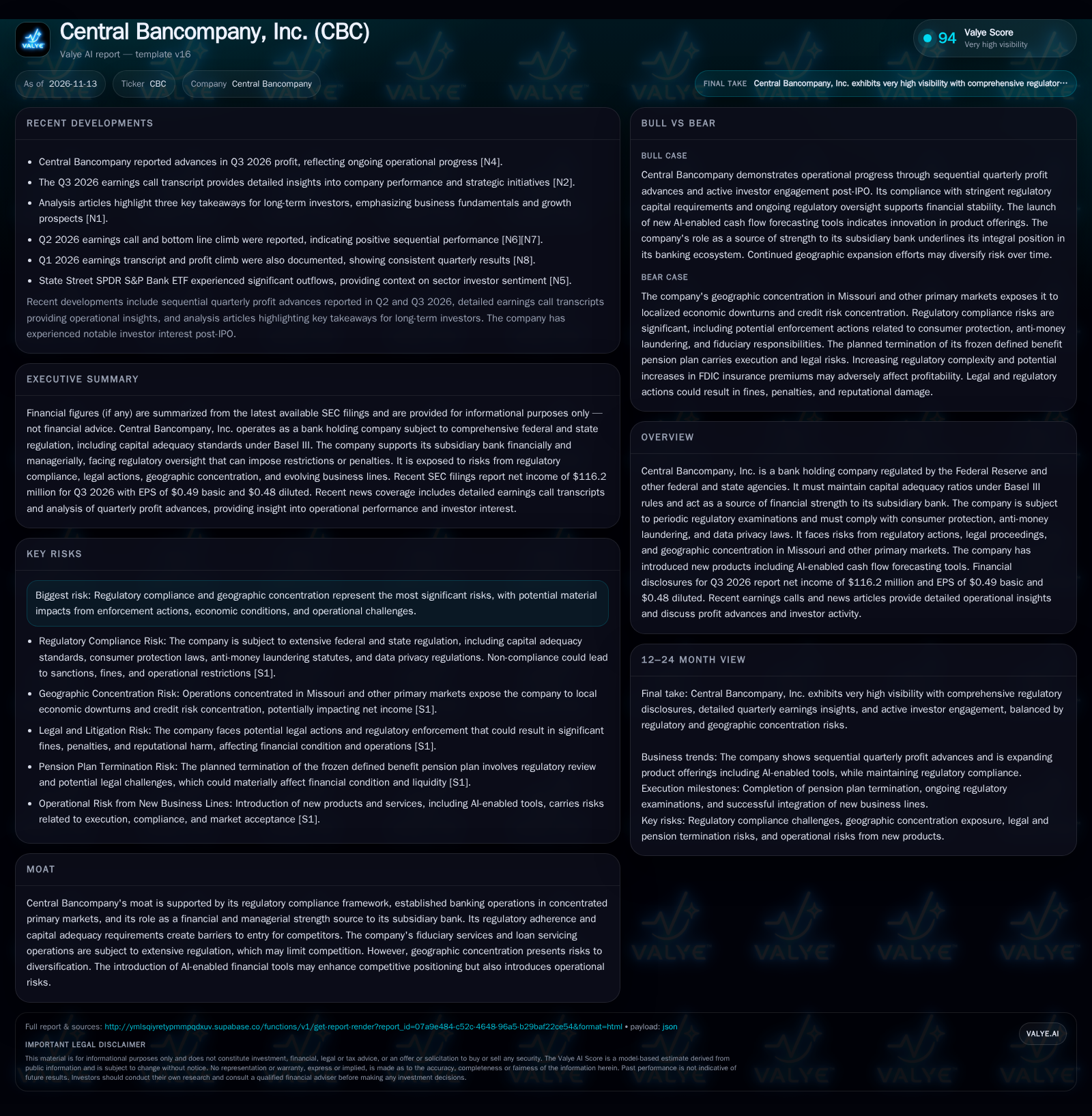
Central Bancompany posted Q3 2026 net income of $116.2 million and continues to advance quarterly profits, supported by new AI-enabled tools and active investor engagement. However, its business is fundamentally shaped by stringent regulatory requirements and a concentration in Missouri and nearby markets, which introduces both operational risk and vulnerability to localized downturns. The company's future hinges on its ability to manage regulatory, legal, and operational risks while leveraging innovation for growth. [S2] [N1] [N4]
Central Bancompany, Inc. stands at the intersection of traditional regional banking and emerging fintech innovation, reporting consistent profit advances and unveiling new AI-driven tools for its clients. While its operational progress and investor engagement draw attention, the company’s business model is fundamentally shaped by regulatory discipline and a concentrated geographic footprint. The coming quarters will test whether the company can balance compliance and innovation against the ever-present risks of legal actions, operational missteps, and local economic swings.
Recent Profit Gains and Expanding Product Suite Anchor the Current Narrative
Central Bancompany reported net income of $116.2 million for Q3 2026, with basic and diluted EPS of $0.49 and $0.48 respectively, marking another period of sequential profit growth. This result follows a pattern of consistent quarterly profit advances throughout 2026, as highlighted in recent earnings call transcripts and news coverage. The company has also launched AI-enabled cash flow forecasting tools, signaling a push into technology-enabled services beyond traditional banking. However, Central Bancompany remains subject to rigorous regulatory supervision, including Basel III capital requirements and periodic examinations, and is actively managing the planned termination of a frozen defined benefit pension plan—an event that carries both regulatory and legal risk. These factors collectively define the company’s near-term operating context and shape its risk profile. [S2] [N2] [N4] [S1]
How Regulatory Capital, Fee Innovation, and Local Credit Cycles Shape Profitability
Central Bancompany’s revenue streams are likely anchored in net interest income from lending and deposit-taking, supplemented by fee-based income from services such as loan servicing and fiduciary activities. The recent introduction of AI-enabled cash flow forecasting tools reflects an effort to capture higher-margin, non-interest income, but the extent of adoption and monetization remains to be seen. Operating leverage in banking is typically driven by the ability to grow assets and fees faster than fixed overhead and regulatory compliance costs, but this leverage is capped by capital adequacy constraints under Basel III. These rules require the company to maintain minimum CET1, Tier 1, total capital, and leverage ratios, effectively limiting outsized balance sheet expansion and requiring constant capital management. Geographic concentration introduces volatility in credit quality and loan growth, as local economic downturns can rapidly translate into higher provisions and lower net interest margins. The pending pension plan termination adds a layer of contingent liability and regulatory complexity that could influence both expenses and capital ratios.
Market Share Defenses and the Limits of Regional Scale
Central Bancompany’s competitive position is anchored by its established presence in Missouri and select primary markets, where longstanding relationships and regulatory compliance may serve as modest barriers to entry. The complexity of regulatory requirements, including capital adequacy and consumer protection laws, raises the cost of entry for new or smaller competitors. However, the company’s regional focus exposes it to competition from both entrenched local banks with similar relationships and national or super-regional banks that can leverage technology, scale, and diversified funding. The launch of new AI-driven tools may help Central Bancompany differentiate itself, but technology adoption in banking is often rapidly commoditized unless paired with unique data, superior integration, or network effects. Regulatory oversight acts as both a moat and a constraint, insulating incumbents from some forms of disruption but also limiting strategic agility.
If Tech-Driven Fee Growth and Geographic Diversification Outpace Regulatory Headwinds
A favorable scenario for Central Bancompany involves successful adoption and monetization of its AI-enabled cash flow forecasting tools, driving incremental fee income and strengthening client relationships. If management can leverage technology to deliver differentiated value—such as improved customer retention, cross-sell, or lower credit losses—the company could achieve higher returns on regulatory capital. Gradual geographic expansion beyond Missouri or penetration into new verticals could reduce risk concentration, smoothing out credit cycles and supporting sustainable growth. Upside would be confirmed by accelerating non-interest income, improved efficiency ratios, evidence of customer migration to new digital services, and regulatory filings showing stable or improved capital ratios despite growth. Evidence refuting this scenario would be stagnant fee income, weak adoption of new products, or regulatory findings constraining expansion.
Profit Advances Continue, But Growth Constrained by Regulation and Local Market Dynamics
The most plausible trajectory for Central Bancompany is continued moderate profit growth, primarily reflecting steady net interest margins and incremental fee income from new tools. Regulatory capital requirements will continue to limit aggressive balance sheet expansion, enforcing prudent risk management. The company’s geographic concentration means that local economic conditions—such as employment, real estate, and industry health—will remain the primary drivers of credit quality and loan demand. Operational risks from new product rollouts are likely manageable but will require ongoing investment in compliance and IT. Confirmation of this scenario would come from sequential profit advances, stable or improving asset quality metrics, and regulatory filings without material enforcement actions. Falsification would involve a local economic downturn, a spike in credit losses, or regulatory or legal actions that materially impact profitability or capital.
How Localized Shocks or Regulatory Penalties Could Disrupt the Profit Engine
A negative scenario could unfold if Missouri or other core markets experience a sharp economic downturn, leading to rising credit losses and eroding net interest margins. Central Bancompany’s regional concentration means such shocks would disproportionately affect its loan book and earnings. Regulatory risk is another acute threat: adverse findings from examinations, enforcement actions related to consumer protection or anti-money laundering, or unexpected increases in FDIC premiums could all compress margins or force costly remedial actions. The planned pension plan termination introduces additional uncertainty; regulatory or legal complications could result in unexpected charges or capital impacts. Downside confirmation would come from sudden increases in loan loss provisions, material regulatory filings or fines, or negative revisions to capital guidance. Evidence against this scenario would be continued solid asset quality, absence of regulatory pressure, and stable capital ratios.
What Will Determine Whether Central Bancompany Can Balance Growth and Risk?
Quarterly trends in non-interest income, particularly from new AI-enabled products, if disclosed, would help test the thesis that innovation can drive fee growth.
Updates on the regulatory and legal process for the pension plan termination, including costs, timing, and any required capital adjustments.
Loan loss provisions and asset quality metrics, especially if local economic conditions deteriorate or sector-specific risk emerges.
Efficiency ratio and expense trends, indicating whether new compliance and technology investments are yielding operating leverage.
Regulatory capital ratios (CET1, Tier 1, total capital, leverage) from SEC filings, as evidence of ongoing capital management and regulatory headroom.
Market share data or deposit/lending growth by geography, if disclosed, to assess progress on diversification or concentration risk.
Any reported enforcement actions, penalties, or consent orders from federal or state regulators, as these could materially impact strategy and profitability.
Customer adoption rates and feedback for new AI-enabled tools, if disclosed, to gauge the commercial impact of innovation.
Disclaimer: This is research-only, informational analysis and not investment advice. It may include AI-generated interpretation and general industry context. Always verify important details using primary sources.

Comments