
Franklin Solana Trust: Passive Solana Exposure Meets ETF Structure and Regulatory Crosscurrents
Franklin Solana Trust delivers a regulated, passive ETF structure for Solana and its staking rewards, combining institutional-grade custody with cost efficiency. While the model removes friction for mainstream investors, its fortunes are tied to Solana’s volatility, regulatory shifts, and the operational discretion of the Sponsor.
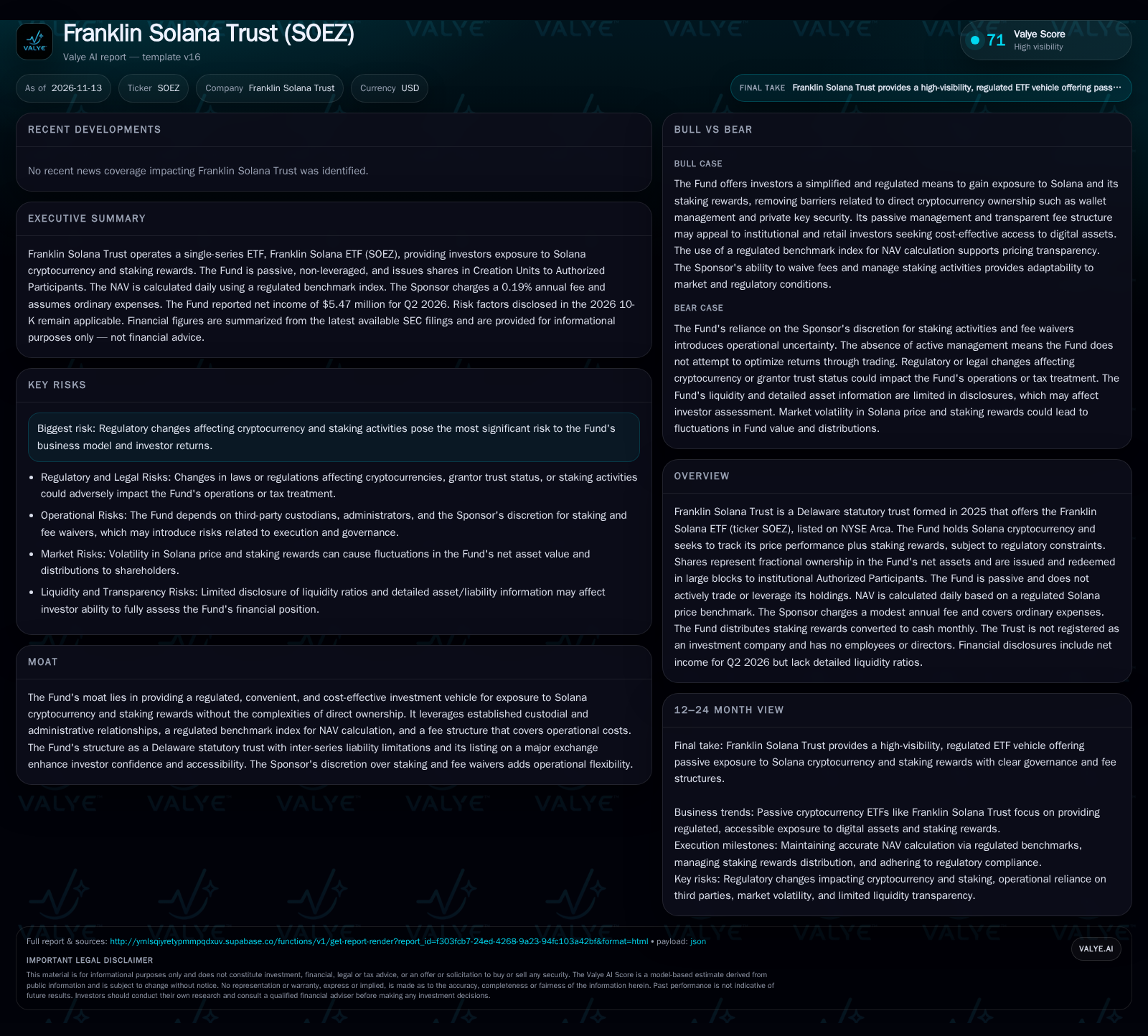
Franklin Solana Trust (SOEZ) offers investors a passive, regulated ETF for Solana exposure and staking rewards, with a low annual fee and institutional-grade custody. The Fund’s Q3 2026 net income of $5.47 million underscores its scale, but its performance and investor appeal hinge on Solana price dynamics, regulatory clarity, and the Sponsor’s management of fee waivers and staking policies. [S1] [S2]
Franklin Solana Trust (SOEZ) positions itself as a gateway for both institutional and retail investors seeking exposure to Solana and its staking rewards—without the operational headaches and security risks of direct crypto ownership. The ETF’s passive structure, low fee, and institutional custody model are designed to appeal to investors wary of the complexities and risks in the digital asset ecosystem. However, the Fund’s dependence on Solana’s market trajectory, evolving regulatory frameworks, and the Sponsor’s operational discretion introduces a mix of opportunity and uncertainty.
SOEZ’s Q3 Earnings, Fee Waivers, and Product Structure: Recent Highlights
Franklin Solana Trust reported net income of $5,474,141 for the quarter ended September 30, 2026, providing a tangible signal of scale and operational activity. The Fund’s annual sponsor fee is set at 0.19% of daily NAV, with an explicit waiver on the first $5 billion of assets in place through May 31, 2026. Shares are issued and redeemed in blocks of 50,000 to Authorized Participants, and the Fund’s NAV is marked daily to the CME CF Solana-Dollar Reference Rate. Notably, the Fund distributes staking rewards monthly (lagged by three months) and does not employ leverage or derivatives, reinforcing its passive, regulated posture. The company reported cash and liquidity metrics for the period; these figures do not by themselves establish operating runway, investment capacity, financial flexibility, or financing capacity. [S1] [S2]
How SOEZ Earns: Passive Crypto Exposure, Fee Structure, and Staking Yield
SOEZ’s economics are fundamentally tied to two components: the price performance of Solana itself and the accrual/distribution of staking rewards. The Fund operates as a pass-through vehicle, holding Solana in custody and issuing ETF shares that represent fractional beneficial ownership. The Sponsor’s 0.19% annual fee, calculated on daily NAV, is the primary revenue stream supporting operational costs, with the potential for scale if assets under management (AUM) grow. The Sponsor has temporarily waived this fee for the first $5 billion in AUM, likely as a competitive tool to attract flows and build market share.
Staking rewards earned on held Solana are converted to cash and distributed to shareholders monthly after a three-month lag, adding a yield component distinct from price appreciation. The Fund’s passive mandate means it does not actively trade Solana or seek to optimize returns beyond staking—so tracking error and performance slippage are minimal, but upside is capped at the underlying asset’s returns. Operating leverage could be favorable if AUM scales, as fixed costs (custody, administration, trustee, etc.) may not rise proportionally. However, transaction costs, including Solana network fees for staking or asset sales, are borne by the Fund or Authorized Participants as applicable, which could erode returns during periods of high activity.
ETF Structure as Differentiator—But Moat Depth Hinges on Regulation and Execution
SOEZ’s core competitive advantage is the provision of regulated, exchange-listed exposure to Solana and its staking rewards, eliminating operational barriers like wallet custody, private key management, and direct staking complexity for end investors. This structure may appeal to both risk-averse retail investors and institutions restricted from direct crypto holdings. The use of a regulated benchmark index for NAV calculation, institutional-grade custody (Coinbase Custody), and the ability to waive fees further enhance its marketability.
However, this moat is not unassailable. Competing Solana or multi-asset crypto ETFs could emerge, potentially undercutting on fees or offering additional features such as active management or alternative yield strategies. Substitution risk from direct crypto exchanges, DeFi platforms, or future regulatory changes—such as broader ETF approval for other assets or staking models—could erode SOEZ’s differentiation. The Fund’s reliance on third-party partners for custody and administration also exposes it to operational and reputational risks outside the Sponsor’s direct control.
Asset Flows Accelerate and Regulatory Tailwinds Drive AUM Expansion
The most favorable outcome for SOEZ would be a sustained influx of assets driven by rising institutional and retail demand for regulated crypto exposure, particularly if Solana’s price and staking yields remain attractive relative to other digital assets. If regulators continue to provide clarity or expand ETF approvals, investor confidence and addressable market could increase. The Sponsor’s fee waiver on the first $5 billion of assets could catalyze early AUM accumulation, creating network effects and fixed-cost leverage as operational expenses become a smaller share of total assets.
Evidence confirming this scenario would include rapid AUM growth, broadening distribution partnerships, and industry data showing increased ETF usage for crypto allocation. Staking rewards remaining robust and regulatory frameworks supporting continued staking activities would further reinforce the thesis. Falsification would occur if inflows stall despite favorable Solana performance, or if regulatory headwinds limit the Fund’s ability to operate or scale.
Mainstream Adoption Counterbalanced by Solana Volatility and Regulatory Flux
The most plausible trajectory is that SOEZ maintains steady but measured AUM growth, reflecting a gradual shift of mainstream investors toward regulated crypto vehicles. Solana’s price and staking rewards are likely to remain volatile, driving swings in NAV and income, but the Fund’s passive structure ensures it closely tracks underlying performance. The expiration of the fee waiver may test the Fund’s pricing competitiveness, potentially slowing new inflows or prompting fee reductions if rivals undercut costs.
Confirmation would come from moderate, consistent AUM increases, stable operational expense ratios, and distribution of staking rewards at expected intervals. Evidence against this scenario would include abrupt Solana price declines, regulatory interventions that restrict staking or ETF operations, or operational hiccups stemming from third-party partners.
Regulatory Disruption or Solana-Specific Shocks Undermine Investor Confidence
The most adverse scenario involves regulatory changes that restrict or prohibit crypto staking in ETF vehicles, alter the Fund’s grantor trust status, or otherwise increase compliance burdens. Such changes could force the Fund to suspend staking, reduce distributions, or even unwind holdings. Alternatively, a sharp decline in Solana price or a security/custody incident could trigger redemptions and erode NAV, undermining investor confidence in the ETF wrapper for digital assets.
This scenario would be confirmed by negative regulatory actions, legal proceedings affecting crypto ETFs or staking, or publicized operational failures at custodians or administrators. Falsification would require evidence of resilient inflows, stable operations, and benign regulatory developments despite broader market volatility.
What Will Shape SOEZ’s Role in the Crypto ETF Landscape?
AUM growth rates and total assets under management, especially as the fee waiver period ends—if disclosed.
Monthly staking reward distribution rates and any changes in the underlying Solana staking yield.
Sponsor fee levels and waivers after May 2026, and whether further competitive pricing actions are announced.
Any changes to regulatory or legal status for crypto ETFs or staking activity in the U.S. or major markets.
Operational disclosures regarding custody, security incidents, or changes in third-party administrator relationships.
NAV tracking accuracy relative to the CME CF Solana-Dollar Reference Rate, especially during periods of high Solana volatility.
Liquidity and redemption activity by Authorized Participants, including any signs of stress or premium/discount to NAV—if disclosed.
Disclaimer: This is research-only, informational analysis and not investment advice. It may include AI-generated interpretation and general industry context. Always verify important details using primary sources.

Comments