
Cannaisseur Group: Financial Strain and Regulatory Uncertainty Cloud CBD and Wellness Expansion
With a majority stake in Atlanta CBD but no revenue and near-zero liquidity as of Q3 2026, Cannaisseur Group faces acute financial and regulatory headwinds despite ambitions to broaden its health and wellness footprint.
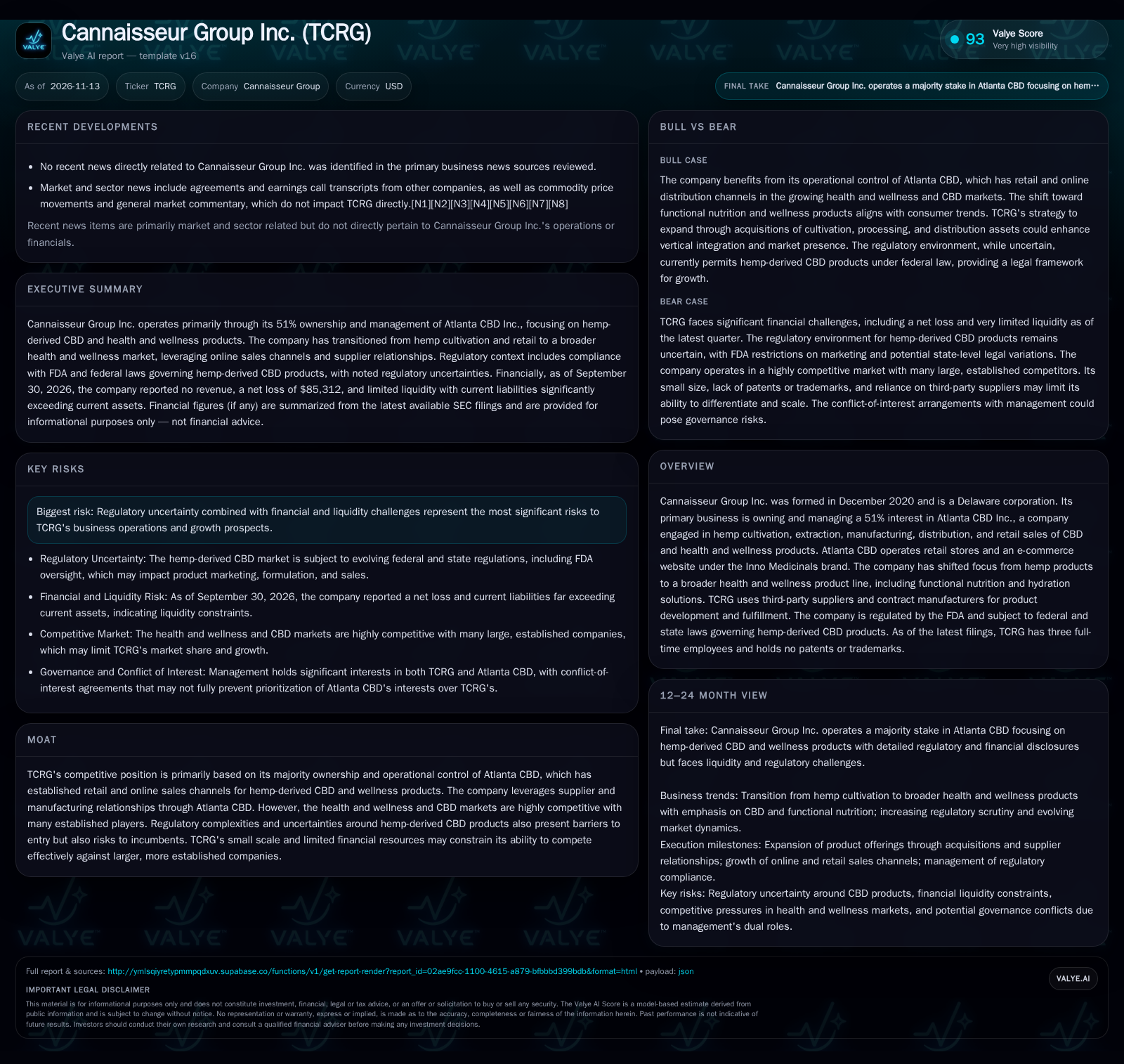
Cannaisseur Group (TCRG) manages Atlanta CBD, targeting the expanding CBD and wellness markets through retail and online channels. However, as of Q3 2026, the company reported no revenue, a significant net loss, and a near-zero cash position. TCRG’s growth strategy hinges on supplier relationships and potential acquisitions but is constrained by acute liquidity shortfalls and regulatory uncertainty, raising questions about its ability to execute in a competitive sector. [S2]
Cannaisseur Group Inc. (TCRG) controls Atlanta CBD, aiming to scale in the competitive CBD and broader wellness markets by leveraging retail and online channels as well as third-party supplier partnerships. Yet, as of Q3 2026, the company stands at a financial crossroads: it reported no revenue, a significant net loss, and a cash position so minimal as to leave it functionally illiquid. These acute financial constraints, combined with persistent regulatory ambiguity around hemp-derived CBD products, challenge TCRG’s ability to capitalize on health and wellness sector growth trends. The company’s future now depends on its capacity to secure funding, navigate regulation, and differentiate in a crowded market landscape. [S2]
Acutely Constrained Liquidity and Absence of Revenue Define Current State
As of September 30, 2026, Cannaisseur Group reported no revenue and a net loss of $85,312. The company’s cash and equivalents totaled just $20, while current liabilities stood at $406,051, resulting in both current and cash ratios effectively at zero. TCRG’s operational structure is anchored in its 51% ownership and management of Atlanta CBD, which sells CBD and wellness products through retail and online channels. However, the absence of reported revenue and the severity of its liquidity deficit are immediate existential concerns: without a material cash infusion or rapid revenue generation, the company’s ability to continue operations is in question. [S2]
Revenue Model and Cost Structure: Dependency on External Suppliers and Online Sales
TCRG’s business model is to monetize its majority stake in Atlanta CBD, focusing on hemp-derived CBD and broader wellness products distributed via both physical retail and direct-to-consumer e-commerce. The company outsources product research, development, manufacturing, and packaging to commercial suppliers and contract manufacturers, which reduces fixed overhead but exposes TCRG to variable costs and potential supply chain disruptions.
With no reported revenue as of Q3 2026, it is unclear whether TCRG’s current product mix, pricing, or marketing strategy can generate sufficient gross margins to cover operating expenses. The reliance on online channels could offer higher margins and lower customer acquisition costs if executed at scale, but the absence of revenue suggests that either volume, pricing, or market traction is lacking. The company’s stated ambition to expand via acquisitions and grow its product portfolio would require significant capital, which is currently unavailable. Thus, unless TCRG secures external funding or dramatically improves cash conversion, its fixed obligations could quickly overwhelm any future incremental margin gains.
The dependency on third-party suppliers and contract manufacturers introduces significant operational risk factors that warrant deeper consideration. Supply chain disruptions, whether due to raw material shortages, regulatory compliance issues, or logistical bottlenecks, could materially impact product availability and cost structure. In an industry where product quality and consistency are critical to brand reputation, TCRG’s lack of direct control over manufacturing processes may hinder its ability to respond swiftly to market demands or quality concerns. Additionally, variable costs tied to outsourced production can fluctuate with supplier pricing power, potentially compressing margins if the company cannot pass these costs onto consumers through pricing adjustments.
Competitive Pressures and Structural Disadvantages in CBD and Wellness Markets
The market for CBD and wellness products is intensely competitive, populated by both established consumer health giants and aggressive digitally native brands. TCRG’s main asset is operational control of Atlanta CBD’s brand, retail presence, and e-commerce site. However, the company has no patents, trademarks, or proprietary technology, limiting defensibility and pricing power. Its use of third-party suppliers means it lacks vertical integration benefits that larger rivals may possess.
Moreover, the regulatory ambiguity around CBD—especially concerning FDA policy on marketing and labeling—creates a moving target for compliance and marketing. Without substantial resources or unique intellectual property, TCRG is exposed to both margin compression and brand dilution. While its local retail and online channels could foster customer loyalty, scaling these advantages is capital-intensive and slow relative to the pace of market consolidation and regulatory change.
TCRG’s absence of proprietary intellectual property and reliance on third-party manufacturing also limits its ability to create sustainable competitive moats. In a sector where product differentiation often depends on unique formulations, patented delivery mechanisms, or exclusive sourcing agreements, TCRG’s model may struggle to build lasting customer loyalty beyond price or convenience. Furthermore, larger competitors with vertically integrated operations can better control costs and innovation cycles, allowing them to respond more nimbly to regulatory changes or consumer trends. This structural disadvantage may force TCRG to compete primarily on promotional activities or discounting, which is challenging without robust capital reserves.
Regulatory uncertainty compounds these competitive challenges by increasing operational complexity and compliance costs. Shifting FDA guidance on permissible health claims and labeling requirements can necessitate frequent product reformulations or marketing adjustments, which are resource-intensive for a company with constrained capital and operational bandwidth. Moreover, state-level regulatory fragmentation means TCRG must navigate a patchwork of rules that can limit market access or create uneven competitive conditions. Without substantial legal and regulatory expertise or potential financial flexibility, the company risks non-compliance penalties or lost sales opportunities, further eroding its competitive position.
Path to Viability: Funding, Regulatory Clarity, and Acquisition-Driven Growth
A plausible upside for TCRG would entail securing a meaningful capital infusion—through equity, debt, or strategic partnership—that enables the company to address its immediate liquidity crisis and invest in customer acquisition and inventory. If regulatory clarity emerges (for example, FDA guidance allowing more explicit CBD health claims or broader retail distribution), TCRG could leverage Atlanta CBD’s channels to capture share in both CBD and functional wellness categories.
Acquisitions of additional cultivation, processing, or distribution assets could enhance vertical integration and margins, provided the company can execute and differentiate its product line. Early signs confirming this scenario would include new financing announcements, a return to positive revenue growth, and expansion into new product categories or markets. Conversely, continued absence of revenue or failure to secure funding would quickly falsify this scenario.
Operational Survival Hinges on Cost Cuts and Minimal Growth Absent New Capital
The most probable short-term outcome is that TCRG remains in a holding pattern, managing minimal operations while seeking external funding or strategic alternatives. The company may attempt to cut costs further, delay payables, or negotiate with creditors to buy time. Incremental revenue from existing e-commerce and retail channels could provide marginal relief but is unlikely to offset the acute cash deficit or fund meaningful growth.
Confirmation of this scenario would come from continued low or zero reported revenue, persistent liquidity pressures, and no material expansion in product lines or markets. Any evidence of creditor forbearance or bridge financing would suggest management is prioritizing operational survival over growth. Falsification would require a transformative event—such as a major capital raise, acquisition, or regulatory breakthrough—that changes the company’s financial trajectory.
Acute Liquidity Crisis Forces Insolvency or Asset Liquidation
If TCRG fails to secure new funding or rapidly generate revenue, the risk of insolvency or forced asset liquidation becomes acute. In this scenario, TCRG may default on obligations, lose operational control of Atlanta CBD, or be compelled to sell assets at distressed prices to satisfy creditors.
Evidence supporting this scenario would include further deterioration in liquidity ratios, legal filings for bankruptcy or restructuring, and the cessation of retail or online operations. Any public disclosure of missed payments to suppliers or employees would also be an early warning. The downside is further exacerbated by the lack of proprietary assets or intellectual property, limiting the recoverable value in a liquidation event.
Signals That Will Determine Cannaisseur Group’s Strategic and Financial Fate
Any disclosure of new financing, whether in the form of equity, debt, or strategic partnership, as this would materially alter the company’s liquidity outlook and capacity to invest in growth.
Quarterly or intra-quarter revenue figures, if disclosed, to determine whether e-commerce or retail channels are gaining traction or remain stagnant.
Updates on regulatory developments—especially FDA guidance or state-level rule changes—that could expand or restrict TCRG’s addressable market.
Evidence of new product launches or category expansion in functional wellness and nutrition, which would indicate execution on diversification strategy.
Announcements of acquisitions or vertical integration moves, and the terms/financing structure of such deals, as these would signal both ambition and risk tolerance.
Supplier relationship updates or changes in contract manufacturing arrangements, which could affect cost structure and supply chain resilience.
Any management disclosures regarding operational cutbacks, creditor negotiations, or going-concern warnings, which would foreshadow acute distress or restructuring.
Disclaimer: This is research-only, informational analysis and not investment advice. It may include AI-generated interpretation and general industry context. Always verify important details using primary sources.

Comments