
TriMas: Global Industrial Manufacturing Scale Meets Cyclical and Execution Risks
The company’s strategic flexibility is evident in its acquisition activity and capital return programs, yet its ability to outpace industry headwinds will depend on operational execution and adaptability.
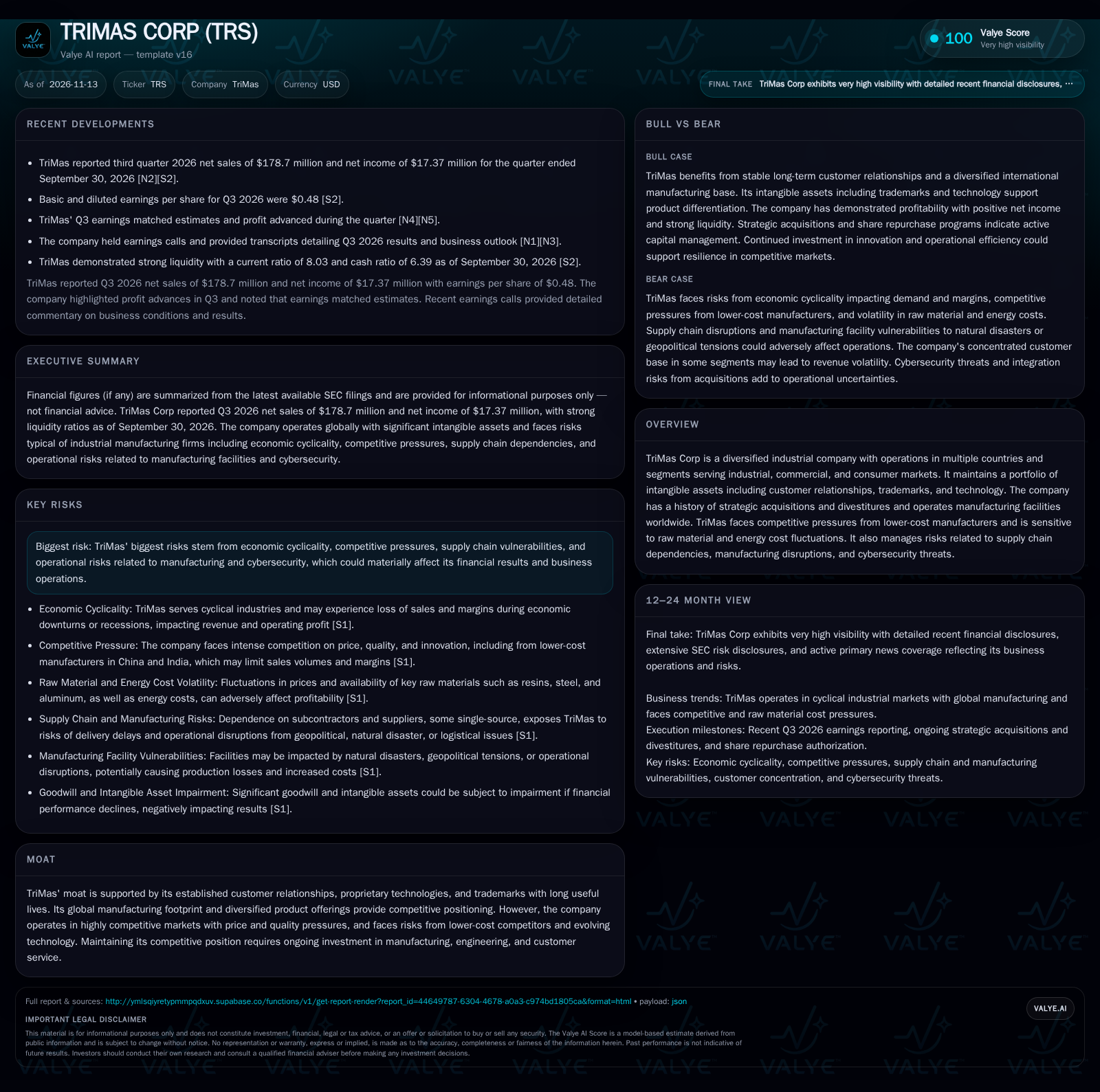
TriMas reported Q3 2026 net sales of $178.7 million and net income of $17.37 million, maintaining a strong cash balance and reported current ratio. The company’s global manufacturing presence and portfolio of intangible assets offer competitive positioning, but exposure to cyclical demand, raw material volatility, and concentrated customers heightens execution risk. Strategic moves—including acquisitions and share repurchases—may drive value if integration and operational discipline are sustained.
TriMas Corp, a diversified industrial manufacturer with a global reach, continues to post steady financial results and maintain a reported liquidity position cushion, as reflected in its Q3 2026 report. The company’s wide-ranging manufacturing base and intangible asset portfolio underpin its ability to serve industrial, commercial, and consumer markets across continents. However, TriMas’ exposure to cyclical demand, cost volatility, and customer concentration highlights the persistent balancing act between operational stability and external risk. The company’s strategic capital allocation, including acquisitions and share repurchases, signals both confidence and the need for ongoing adaptation in a competitive landscape.
Q3 2026 Snapshot: Profits, Liquidity, and Geographic Reach
TriMas reported net sales of $178.7 million and net income of $17.37 million for the third quarter of 2026, translating to earnings per share of $0.48 [N2] [S2]. This performance reflects continuity in profitability, with profit advancing during the period [N5].As of September 30, 2026, TriMas held $1.16 billion in cash and cash equivalents, supporting an reported current ratio of 8.03 and a cash ratio of 6.39 [S2]. The company reported cash and liquidity metrics for the period; these figures do not by themselves establish operating runway, investment capacity, financial flexibility, or financing capacity. Approximately 36.8% of 2025 net sales were generated internationally, with nearly half of long-lived assets located outside the US [S1], reinforcing TriMas’ global manufacturing footprint and exposure to both international opportunity and risk.
How TriMas Generates Returns: Manufacturing Leverage and Cost Pressures
TriMas’ revenue model is rooted in the manufacture and sale of industrial, commercial, and consumer products, with operations spanning multiple continents [S1]. Revenue is likely driven by both volume and mix across segments, with pricing power constrained by competition from lower-cost overseas manufacturers. Given the industrial nature of its business, fixed costs—such as plant operations, equipment, and labor—tend to be high, creating operating leverage: incremental volumes can materially improve margins, but downturns can quickly erode profitability.
Raw material and energy costs are significant variables. TriMas sources key inputs like resins, steel, and aluminum, exposing it to input price swings that may not be fully passed through to customers, especially in commoditized product lines [S1]. This cost volatility can compress margins in periods of inflation or supply disruption. International operations add complexity, including currency risk and varying regulatory environments, but can also provide diversification and access to growth markets.
Capital needs are twofold: maintaining and upgrading a dispersed manufacturing base, and funding acquisitions or integration efforts as TriMas continues to reshape its portfolio. The degree to which TriMas can drive margin expansion will depend on its ability to manage input costs, optimize production, and differentiate offerings through technology or customer relationships.
Balancing Global Scale Against Cost-Driven Rivals
TriMas’ competitive position is anchored by its established customer relationships, portfolio of proprietary technologies and trademarks, and a global manufacturing footprint that enables it to serve diverse markets [S1]. These factors can reinforce customer stickiness and support product differentiation, particularly where technical specifications or certifications are valued. However, in many product lines, competition is intense and often price-driven, with lower-cost manufacturers—especially those based in China and India—pressuring margins and limiting pricing power.
Switching costs may be modest in highly commoditized segments, but higher for products tied to long-term customer relationships or with specialized engineering content. The company’s exposure to customer concentration in some segments can be a double-edged sword: it enables scale and relationship depth but increases revenue volatility if large customers change suppliers or reduce orders. Technology substitution risk is present if TriMas’ products face replacement by alternative materials or manufacturing methods. Ongoing investment in innovation, operational efficiency, and customer service will be needed to sustain any competitive edge.
Margin Expansion Through Operational Discipline and Strategic Execution
A favorable outcome for TriMas could emerge if the company leverages its liquidity and international scale to drive operational efficiencies, successfully integrates acquisitions, and continues to deepen customer relationships. If management can mitigate raw material and energy cost volatility—whether through supply chain diversification, hedging, or contractual pass-throughs—margin stability could improve. The successful rollout of higher-value engineered products, leveraging its proprietary technology and trademarks, could also support pricing and differentiation.
Confirmation of this scenario would require evidence of sustained gross and operating margin improvement in subsequent quarters, successful integration of acquired businesses with minimal disruption, and growth in revenue from new product introductions or expanded customer relationships. Announcements of new long-term contracts, customer wins in growth regions, or demonstrable cost-out programs would further strengthen the upside case. Conversely, persistent margin pressure or failed integrations would undermine this thesis.
Navigating Industrial Cyclicality with a Defensive Balance Sheet
The most plausible trajectory for TriMas is steady performance in line with broader industrial market cycles. The company’s diversified end markets and geographies provide some insulation, but macroeconomic downturns or sector-specific slowdowns would still weigh on demand and margins.
In this scenario, revenue and profitability would trend with the underlying cycles of industrial, commercial, and consumer demand. Periodic margin compression from input cost inflation or competitive pricing could be offset by cost management and incremental portfolio optimization. Major swings in financial results would likely track external variables rather than internal failures or breakthroughs. Evidence supporting this base case would include relatively stable quarterly revenue and margin trends, ongoing but measured capital allocation to acquisitions or share buybacks, and absence of major operational or integration disruptions.
Vulnerability to Demand Shocks, Cost Spikes, and Customer Losses
The adverse scenario centers on the convergence of macroeconomic contraction, persistent raw material and energy cost spikes, and the loss of major customers in concentrated segments. In this environment, TriMas’ operating leverage could backfire—fixed costs would weigh heavily as volumes decline, while input cost inflation compresses margins that cannot be passed through to customers. Supply chain disruptions, whether from geopolitical tensions, natural disasters, or logistics breakdowns, could further exacerbate production and financial instability.
This scenario could be confirmed by sharp declines in quarterly revenue, sequential margin erosion, or impairment charges on intangible assets if financial performance deteriorates. The loss of a top customer or a failed acquisition—evidenced by restructuring charges or underperformance of acquired units—would also substantiate downside risk.
Testing TriMas’ Resilience: Factors That Could Shift the Narrative
Gross and operating margin trends by segment—if disclosed—would provide insight into the company’s ability to manage input costs and pricing pressure.
Quarterly revenue growth or contraction, especially in international markets, would help gauge exposure to regional economic cycles and competitive dynamics.
Customer concentration metrics: disclosure of customers representing over 10% of segment revenues would clarify volatility risk.
Evidence of successful acquisition integration, including realized cost synergies and retention of key customers or personnel.
Supply chain stability indicators, such as lead times, raw material availability, or the impact of geopolitical events on sourcing.
Capex and R&D spending levels, indicating ongoing investment in manufacturing capability and product innovation.
Intangible asset impairment charges or goodwill write-downs, which would signal underperformance or shifting market conditions.
Cybersecurity breach disclosures or information system disruptions, given reliance on integrated and third-party digital platforms.
Disclaimer: This is research-only, informational analysis and not investment advice. It may include AI-generated interpretation and general industry context. Always verify important details using primary sources.

Comments