
Utah Medical Products: Engineering-Driven Differentiation Amid Customer and Margin Volatility
UTMD leverages specialized engineering to develop safety-focused medical devices, distributing through direct and partner channels worldwide.
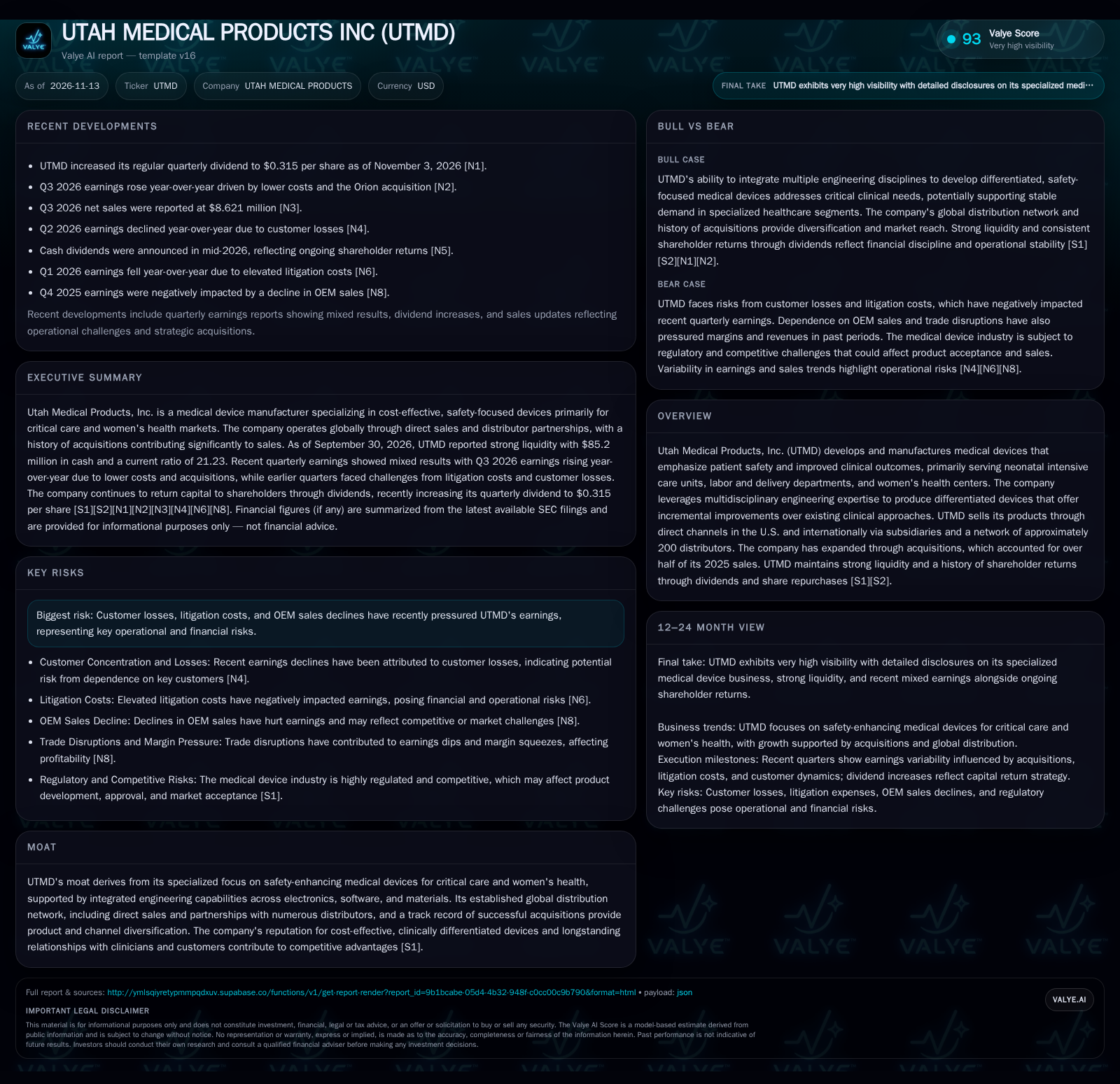
UTMD leverages specialized engineering to develop safety-focused medical devices, distributing through direct and partner channels worldwide. The company’s 2025 sales were majority acquisition-driven, and its substantial cash reserves underscore financial stability. However, recent earnings swings—driven by customer attrition, litigation, and variable OEM sales—expose risks to demand resilience and margin predictability, even as shareholder returns remain robust. Sustainable growth likely hinges on maintaining differentiated product relevance and managing customer concentration.
Utah Medical Products (UTMD) stands out for its engineering-led approach to specialized medical device development, targeting safety and efficacy improvements in high-stakes hospital settings. With more than half of its recent sales stemming from acquisitions and a vast international distributor network, UTMD has built a diversified platform. Yet, recent earnings volatility—driven by customer churn, litigation, and shifting OEM dynamics—suggests that sustaining growth and margin stability will require more than just technical innovation and financial conservatism. The company’s ability to manage customer risk, defend its niche, and extract value from acquisitions will shape its future trajectory.
Recent Earnings Swings and Acquisition Impact Shape Near-Term Outlook
UTMD’s most recent quarter (Q3 2026) saw net income rise year-over-year, attributed to lower costs and the Orion acquisition, with net sales reported at $8.62 million and EPS of $0.88 [N2] [N3] [S2]. This positive result contrasts with earlier quarters in 2026, which experienced earnings declines due to customer losses and elevated litigation costs [N4] [N6]. The company reported cash and liquidity metrics for the period; these figures do not by themselves establish operating runway, investment capacity, financial flexibility, or financing capacity. [S2] Notably, acquisitions have been a critical growth lever, accounting for 57% of 2025 sales [S1]. These facts highlight a business model currently dependent on both cost discipline and successful integration of acquired assets, while facing exposure to customer concentration and episodic legal costs.
The interplay between acquisitions and organic growth presents a nuanced challenge for UTMD’s near-term outlook. While acquisitions can rapidly expand product offerings and market access, the integration process often demands significant managerial attention and resources, potentially diverting focus from core operational improvements. Moreover, acquired entities may carry legacy issues such as differing quality standards or cultural misalignments that can affect overall performance. Consequently, the company’s ability to harmonize operational processes and leverage cross-selling opportunities will be critical in converting acquisition-driven topline gains into sustainable profitability.
How UTMD’s Engineering Depth Translates Into Economic Value
UTMD’s core economic engine is the development and manufacture of differentiated medical devices that address specific clinical safety and efficacy needs, primarily in neonatal, obstetric, and women’s health care. The company’s value chain integrates electronics, software, mechanical, and materials engineering, enabling it to design products that hospitals and clinics may perceive as offering incremental but meaningful improvements over legacy solutions—a foundation for premium pricing, if product differentiation is sustained.
Revenue is generated through direct sales in the U.S. and via an extensive distributor network internationally. The fixed-cost structure is shaped by regulatory compliance (e.g., FDA/CE approvals), manufacturing overhead, and ongoing R&D, while variable costs are dominated by production and distribution. Acquisitions have allowed UTMD to expand its product portfolio and customer base, but also introduce amortization and integration costs. Operating leverage can be significant: increases in volume, particularly through successful acquisition integration, can expand margins, but adverse events (like litigation or customer losses) compress profitability.
The engineering-driven differentiation strategy also implies a continuous investment cycle to maintain technological leadership, which can create a tension between innovation spending and margin preservation. Regulatory compliance costs, while fixed in nature, can escalate unpredictably with evolving standards, impacting the cost structure and pricing strategy. Additionally, the reliance on premium pricing predicates on the perceived clinical value of UTMD’s products; any erosion in differentiation—whether through competitor advancements or shifts in clinical guidelines—could pressure revenues. Therefore, the company’s economic model is contingent on balancing R&D intensity, regulatory agility, and market acceptance to sustain its value proposition.
Defending a Niche: Differentiation, Distributor Reach, and Industry Headwinds
UTMD’s competitive position rests on its ability to deliver specialized, safety-enhancing devices that address well-defined clinical needs. Its multidisciplinary engineering and reputation for reliability help build long-term relationships with hospitals and clinicians, providing some insulation from pure price competition and generic substitutes. The global distribution network (circa 200 partners) offers reach into both developed and emerging markets, which can buffer regional regulatory or demand shocks.
However, the medical device industry is characterized by intense competition from larger diversified players, continued regulatory scrutiny, and the threat of technological substitution. While UTMD’s acquisitions have broadened its portfolio and customer footprint, they also raise integration risks and may dilute focus. Customer concentration—evidenced by recent earnings declines tied to customer losses—remains a structural vulnerability, as does exposure to OEM dynamics and trade disruptions. The company’s ability to maintain its technical edge, manage compliance, and avoid commoditization will be central to defending its niche.
UTMD’s distributor network, while expansive, introduces complexity in managing channel conflict, pricing consistency, and end-customer feedback loops. Distributor incentives and performance variability can influence market penetration and brand reputation, particularly in diverse regulatory environments. Furthermore, the niche focus on safety-enhancing devices may limit the addressable market size, making customer retention and expansion within existing accounts paramount. The company’s exposure to OEM dynamics adds another layer of uncertainty, as OEM partners may shift sourcing strategies or consolidate suppliers, affecting UTMD’s revenue visibility. Hence, strategic channel management and proactive customer engagement are essential to fortify competitive positioning.
Unlocking Value Through Product Renewal and Acquisition Synergies
A favorable outcome for UTMD would be driven by successful integration of recent acquisitions (such as Orion), resulting in sustained revenue growth and margin expansion as cost synergies are realized. If the company continues to identify and address unmet clinical needs—translating multidisciplinary engineering into new or refreshed products with clear safety or outcome advantages—pricing power and customer retention could improve, especially in critical care settings where switching costs and regulatory hurdles are non-trivial.
Confirmation of this scenario would come from sequential sales and margin improvement in acquired product lines, lower customer churn, and a rising contribution from newly launched or enhanced devices.
Sustaining the Franchise Amid Episodic Disruptions
The most plausible forward path is that UTMD continues to deliver modest topline growth through a mix of organic product enhancements and selective acquisitions, but earnings remain subject to periodic shocks from litigation, customer turnover, or regulatory events. While the established distributor network and product breadth provide some stability, customer concentration and OEM dependency may continue to produce quarterly volatility.
This scenario would be confirmed by ongoing but uneven revenue growth, steady (if occasionally pressured) gross margins, and maintenance of a high cash balance. Shareholder returns via dividends and share buybacks would likely persist, but may not accelerate meaningfully absent a step-change in organic demand or a transformative acquisition.
Erosion of Customer Base and Margin Compression Intensify Volatility
The adverse scenario involves further customer losses—possibly among key hospital networks or OEM partners—leading to revenue contraction and underutilization of manufacturing capacity. If product differentiation fails to keep pace with evolving clinical or regulatory standards, UTMD could face pricing pressure from larger competitors or lower-cost entrants, eroding both margins and market share.
Additional headwinds could arise from regulatory setbacks, adverse litigation outcomes, or integration failures with recent acquisitions. This scenario would be confirmed by declining sales, shrinking gross and operating margins, reductions in the dividend or buyback program, and persistent negative earnings surprises.
Milestones and Metrics That Will Define UTMD’s Strategic Trajectory
Quarterly and annual sales growth by product line and region—especially in recently acquired businesses—would help gauge integration success and underlying demand.
Gross and operating margin trends, particularly following acquisitions or product launches, would clarify the sustainability of cost discipline and pricing power.
Customer concentration metrics (if disclosed) and churn rates: material changes here would test vulnerability to revenue shocks.
The pace and cost of new product development, regulatory approvals, and time-to-market for pipeline devices would signal innovation effectiveness.
Litigation expense and frequency of legal disputes: sustained high costs would be a red flag for operational risk.
OEM sales trends and dependency: any material decline or loss of major OEM customers would be a critical warning sign.
Working capital and cash conversion cycle metrics (if available) would illuminate the efficiency and resilience of UTMD’s operating model.
Disclaimer: This is research-only, informational analysis and not investment advice. It may include AI-generated interpretation and general industry context. Always verify important details using primary sources.

Comments