
American Fusion, Inc.: Fusion Ambition Confronts Capital and Commercialization Realities
The company’s ability to convert technical milestones into commercial traction—and to secure needed capital—will likely determine its future viability.
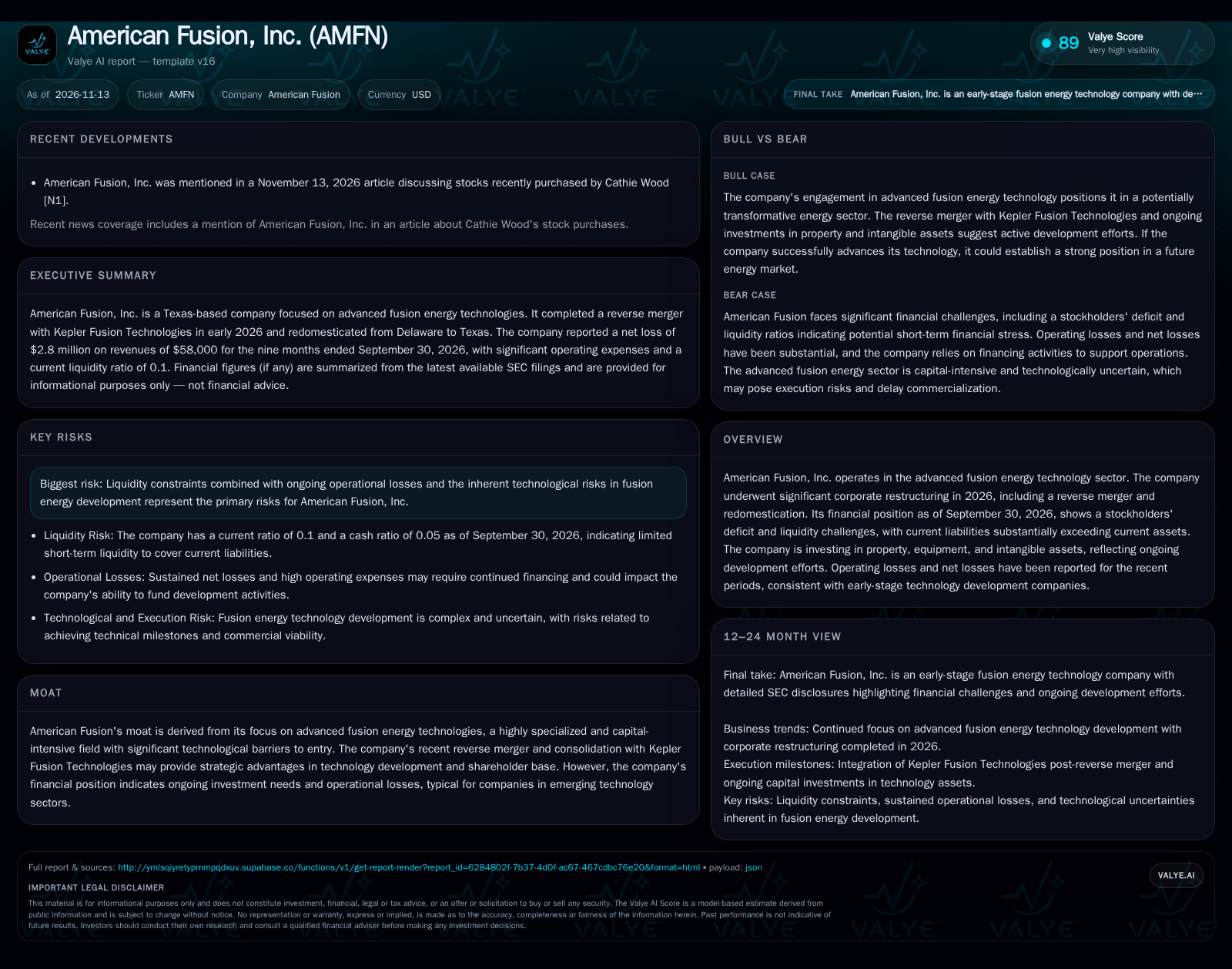
American Fusion, Inc. has completed a reverse merger, rebranded, and is pursuing advanced fusion energy with a Power-as-a-Service model, but remains in early development, posting substantial operating losses, a stockholders' deficit, and a current ratio of 0.1. The core question is whether American Fusion can secure enough capital and technical progress to bridge to commercial scale before financial constraints force retrenchment or dilution. [S1]
American Fusion, Inc. embodies both the promise and the perils of the fusion energy startup landscape. Following a transformative reverse merger, the company is aggressively investing in proprietary fusion reactor technology and has achieved a notable regulatory milestone authorizing operational testing in Texas. The next phase will hinge on American Fusion’s ability to demonstrate technical progress and secure additional capital before its financial runway expires.
Liquidity Strain and Regulatory Progress Define the Near-Term Reality
American Fusion, Inc. has emerged from a period of major restructuring, including a reverse merger with Kepler Fusion Technologies and a redomestication to Texas, consolidating its focus on advanced fusion energy. The company reported just $58,000 in revenue against a net loss of $2.8 million for the nine months ended September 30, 2026. Most strikingly, it ended the quarter with only $70,633 in cash, current assets of $147,402, and current liabilities of $1,473,333, producing a current ratio of 0.1 and a cash ratio of 0.05—clear markers of severe liquidity stress. [S1]
Despite these financial pressures, American Fusion achieved a key operational milestone when it received a multi-year Texas regulatory registration in July 2026, permitting the use and development of its Texatron™ fusion prototypes at its Lubbock R&D site. This license covers a broad spectrum of prototype classes and runs through 2034, providing crucial regulatory clearance for ongoing technical progress. [S1]
These facts set the immediate context: the company is advancing its technology under regulatory oversight but faces urgent liquidity and capital-raising needs if it is to survive and progress toward commercialization.
Fusion Business Model: Capital Intensity, Deferred Revenue, and the Scale-Up Challenge
American Fusion’s intended business model centers on owning and operating its proprietary Texatron™ fusion units and selling electricity to customers under long-term contracts—a version of the Power-as-a-Service approach. In theory, this model can generate recurring revenues and stable cash flow once reactors are operational and contracted, but it front-loads both technology risk and capital requirements.
In the current development stage, the company’s economics are dominated by R&D spending, prototype testing, and modest initial revenues—likely from grants, pilot projects, or consulting rather than commercial-scale contracts. The $2.7 million in operating expenses over nine months, mostly selling, general, and administrative costs, reflects the heavy fixed-cost burden typical of deep-tech energy startups. [S1]
Fusion energy ventures face daunting capital needs. Building, testing, and iterating reactor prototypes requires significant upfront investment, while the path to commercial deployment involves regulatory approvals, field demonstrations, and eventual scaling of manufacturing and operations. Until a working, validated reactor is grid-connected and contracted, revenue is likely to remain de minimis, and cash burn will persist. This creates an acute need for external capital and exposes the company to dilution and financing risk.
Positioning in a High-Barrier, Crowded, and Unproven Sector
Fusion energy is a field characterized by formidable technological barriers, long development lead times, and a growing cohort of private and public competitors. Advantages may accrue to firms that demonstrate credible scientific progress, secure regulatory milestones, and establish robust intellectual property. American Fusion’s recent regulatory clearance for multi-class prototype operation in Texas is a real differentiator at this stage, as not all fusion startups have achieved this level of government engagement. [S1]
However, the competitive landscape is rapidly evolving. Companies in the fusion space range from well-capitalized, globally recognized ventures to smaller, niche technology shops. Key axes of competition include technical approach (tokamak, stellarator, inertial confinement, pulsed systems, etc.), capital backing, regulatory traction, and ability to attract talent and partners. Substitutes and adjacent technologies—such as advanced fission, renewables, and grid-scale storage—may also compete for limited capital and policy attention.
Without evidence of commercial contracts, pilot deployments, or unique cost advantages, American Fusion’s defensible position currently rests on its regulatory progress and the proprietary status of its Texatron™ reactor design. The reverse merger with Kepler Fusion Technologies may strengthen its technology portfolio and shareholder base, but the company will need to demonstrate tangible technical milestones and secure major financing to stand out in a crowded field.
From Regulatory Milestone to Technical Breakthrough: The Path to Fusion Commercialization
In a favorable scenario, American Fusion leverages its recent Texas regulatory registration to accelerate R&D, successfully demonstrating a working Texatron™ prototype with compelling performance metrics (e.g., energy gain, operational reliability, safety). Such a breakthrough would likely attract both public and private investment, enabling the company to move toward pilot deployments and eventually secure power purchase agreements or long-term utility contracts.
Confirmation of this scenario would likely come from third-party technical validation, announced partnerships with utilities or industrial customers, and sizable non-dilutive funding (such as government grants or strategic investments). Evidence of rapid progress in prototype scaling, successful grid connection, or a signed offtake agreement would be strong signals of commercial momentum.
Falsification would occur if technical setbacks, regulatory non-compliance, or inability to attract sufficient capital stalls development, or if a competitor achieves a decisive technical or commercial lead.
Incremental Progress Paired with Financial Strain: Most Plausible Trajectory
The most probable outcome over the next 12-24 months is a continuation of incremental technical progress—such as further prototype refinement and additional regulatory steps—combined with persistent financial stress. American Fusion is likely to remain pre-revenue or generate only nominal revenues from R&D-related activities, with operating losses continuing at a similar pace.
To sustain operations, the company will almost certainly require additional equity or convertible debt financings, likely on dilutive terms given its current balance sheet. Progress would be measured by technical milestones (prototype test results, patent issuances, additional regulatory clearances) and the ability to extend runway through capital raises or strategic partnerships.
This scenario would be confirmed by further SEC filings disclosing new financings, technical updates, or incremental regulatory permissions, but not by breakthrough commercial traction. Falsification would occur if the company fails to raise sufficient capital, is forced into restructuring or asset sales, or if technical progress stalls.
Acute Liquidity Crunch or Technical Setback Triggers Restructuring or Stagnation
A negative scenario would see American Fusion unable to raise new capital in time, leading to a cash shortfall that forces operational retrenchment, staff reductions, or a halt in development work. [S1]
Alternatively, a major technical setback—such as a failed prototype test or regulatory compliance issue—could erode investor confidence, making further fundraising even more challenging and potentially triggering default on existing obligations or litigation. In this scenario, the company could enter a restructuring, sell technology assets, or become a shell for another reverse merger.
This scenario would be confirmed by missed payrolls, SEC filings disclosing going concern warnings (beyond what is already present), announced layoffs, halted R&D, or asset sales. Falsification would require evidence of new funding, breakthrough technical results, or a major partnership that alleviates immediate liquidity stress.
Milestones and External Factors That Could Reshape American Fusion’s Trajectory
Evidence of material capital raised (e.g., a disclosed financing round, government grant, or strategic investment) that extends the operational runway beyond the next quarter.
Announcements of successful Texatron™ prototype tests, especially those validated by independent third parties or regulatory bodies.
Disclosure of signed commercial agreements (power purchase, offtake, or demonstration contracts), which would indicate market validation.
Updates on additional regulatory approvals or expansions of the current Texas license, signaling progress toward commercial deployment.
Trends in operating expenses and cash burn rate, as reported in future SEC filings, to assess whether cost discipline or scale efficiencies are emerging.
Changes in the composition or terms of outstanding liabilities, including restructurings or settlements, that could affect solvency.
Any indication of management turnover, board changes, or shifts in strategic direction that might signal internal instability or a pivot in business model.
Patent issuances, IP litigation outcomes, or new technology disclosures that could strengthen or weaken the company’s competitive position.
Disclaimer: This is research-only, informational analysis and not investment advice. It may include AI-generated interpretation and general industry context. Always verify important details using primary sources.

Comments