
HCM III Acquisition Corp.: Post-SPAC Transition and Murano PV Integration Insights
HCM III Acquisition Corp. has completed its business combination with Murano PV, S.A. DE C.V., marking its transition from a blank-check entity to an operating public company. With significant trust proceeds deployed and a new business platform in Mexico, the company now faces the critical challenges of integration, capital allocation, and demonstrating sustainable operating performance.
HCM III Acquisition Corp. (HCMA) completed its business combination with Murano PV, S.A. DE C.V., deploying $253 million in trust proceeds and moving from a SPAC to an operating entity. The next phase hinges on successful integration, capital discipline, and the realization of growth promised by the combination.
HCM III Acquisition Corp. has crossed the pivotal threshold that defines every SPAC: the completion of its inaugural business combination. By acquiring Murano PV, S.A. DE C.V., a Mexican development company, HCMA transitions from a capital-raising shell to an operating public entity. With the trust proceeds deployed and the blank-check phase behind it, the company now faces a fundamentally different challenge—proving that it can integrate, operate, and scale a real business. The central questions now revolve around capital sufficiency, management’s ability to extract value from the combination, and whether the newly public Murano PV can deliver operational results that justify the transaction and sustain investor confidence.
Recent Milestones and Financial Standing After Capital Pool Phase
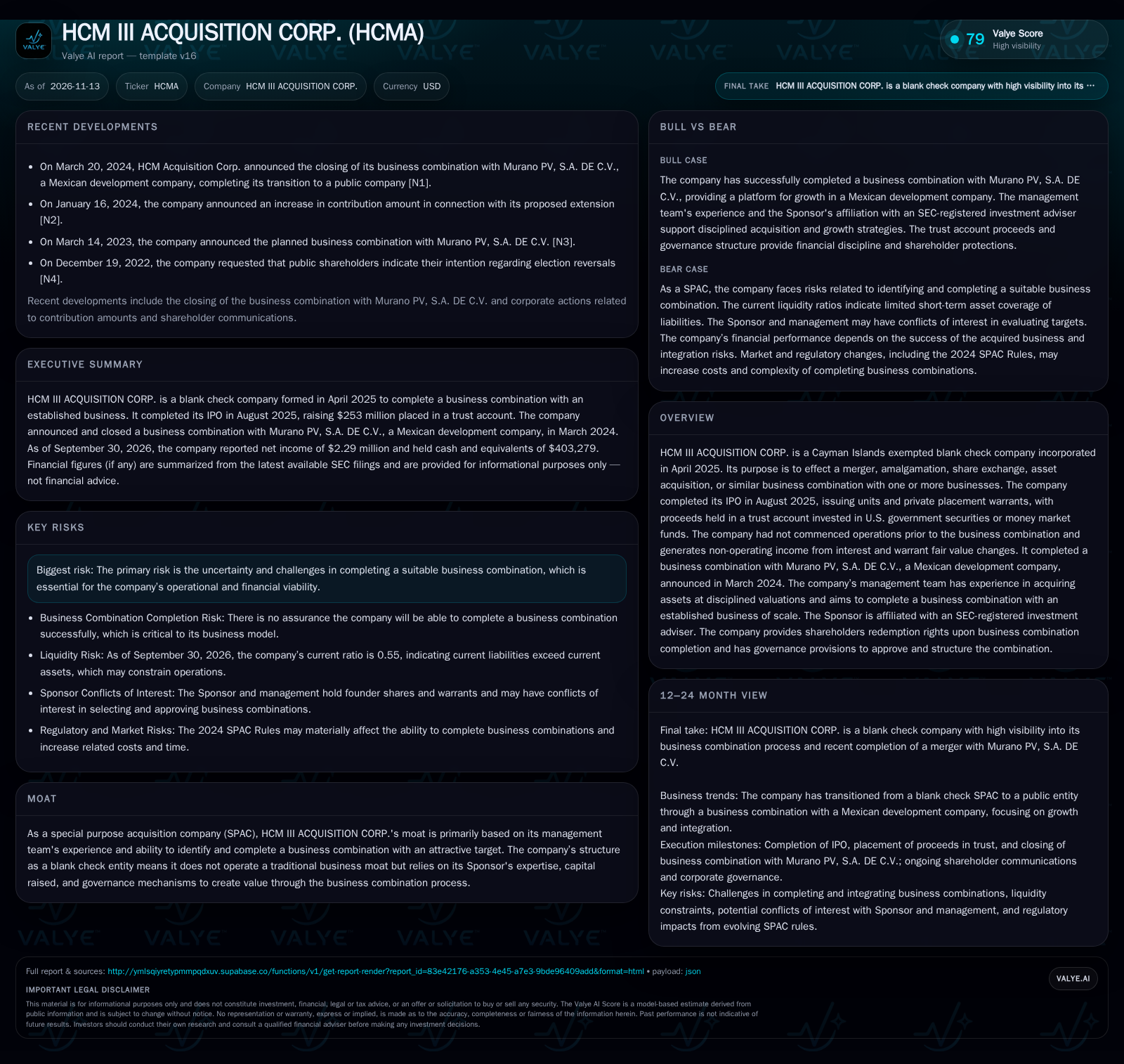
The most consequential development for HCM III Acquisition Corp. is the completion of its business combination with Murano PV, S.A. DE C.V., a Mexican development company, on March 20, 2024 [N1]. This marks the end of its status as a pure SPAC and the start of its life as a public operating company. Prior to this, HCMA had conducted its IPO in August 2025, raising $253 million by issuing 25.3 million units at $10 per unit, with proceeds and private placement warrant sales held in trust [S2].
As of September 30, 2026, the company’s balance sheet reflects the post-combination reality: current assets of $556,617 and cash of $403,279 are materially below current liabilities of $1,002,972, yielding a current ratio of just 0.55 [S2]. This suggests limited short-term coverage for obligations and highlights the importance of generating operating cash flow from the acquired business. Net income of $2.29 million for the period ending September 30, 2026, was driven primarily by non-operating income (interest and mark-to-market gains on trust account assets), not by core operating activities [S2].
Shifting Economics and Capital Requirements Following Combination
The economics of a post-SPAC entity like HCMA pivot sharply once the business combination closes. Pre-combination, value is preserved in the trust account, with earnings derived solely from interest income and changes in the fair value of warrants. After combining with Murano PV, the company’s ability to create shareholder value depends entirely on the operational performance and capital efficiency of the Mexican development platform.
In typical development businesses—real estate, infrastructure, or industrial projects—revenue is driven by project completion, asset sales, or recurring leases, with significant upfront capital expenditures and long project cycles. Margins and returns are highly sensitive to project execution, cost controls, and local market dynamics. The company’s future cash flow profile will likely shift from predictable interest income to lumpy or cyclical operating cash flows, depending on the nature of Murano PV’s projects.
Operating leverage could become meaningful if the company scales successfully, but only if fixed costs are managed and incremental projects deliver attractive returns. Conversely, project overruns, delays, or cost inflation could strain liquidity, especially given the company’s current liabilities in excess of liquid assets. The initial trust proceeds provided a financial cushion, but the current balance sheet indicates most has been deployed or encumbered in the combination process [S2]. Additional capital raises or project-level financing may be required to fund ongoing growth or bridge working capital gaps.
Competitive Landscape and Differentiators for the Combined Entity
Unlike operating companies with established products or recurring service revenues, a post-SPAC development platform’s competitive position depends on project pipeline quality, access to capital, and local execution expertise. The management team’s experience in disciplined acquisitions and the Sponsor’s affiliation with a registered investment adviser may provide some strategic advantage in sourcing and evaluating projects [S2].
However, the company now competes with a broad set of regional developers, infrastructure firms, and potentially private equity-backed platforms in Mexico. Barriers to entry in development can be low, but sustainable advantage requires proprietary access to land, permitting, or differentiated execution capabilities. Regulatory changes, such as evolving SPAC rules or local investment restrictions, could also alter the playing field.
A credible public listing may enhance capital access or project credibility, but the absence of a clear, recurring revenue stream or proprietary technology makes it harder to claim a traditional economic moat. The company’s relative performance will hinge on its ability to turn capital into high-return projects and avoid the pitfalls of overextension or misallocated investment.
Value Potential from Effective Integration and Project Delivery
The favorable scenario for HCMA rests on the rapid and effective integration of Murano PV, followed by the execution of high-return development projects in Mexico. If the management team can leverage its acquisition experience to identify, finance, and deliver projects on time and on budget, the company could generate strong operating cash flows and reinvest in further growth.
Evidence that would confirm this scenario includes a visible project pipeline, regular updates on project milestones, and the emergence of positive operating income and free cash flow from core activities. Successful project completions, asset sales, or recurring lease/rental income would demonstrate that the platform is operationally robust and can scale. If disclosed, improvements in liquidity metrics, such as a reported liquidity-ratio trends or positive working capital trends, would further validate sustainable progress.
Falsification would come from persistent negative operating cash flows, lack of project delivery, or the need for dilutive capital raises to meet basic obligations.
Risks Emerging During the Shift to Operational Status
The most plausible outcome is a period of operational transition, during which HCMA faces the typical challenges of integrating a new platform, aligning management incentives, and building out the project pipeline. The company may experience volatile or limited operating income as it ramps up, while working capital constraints and project risks test its ability to meet obligations.
Confirmation would come from incremental but inconsistent operating results, with occasional project wins offset by delays or cost overruns. Liquidity could remain tight, requiring careful cash management and possibly selective asset sales or project-level financing. If disclosed, metrics such as backlog, project progress, and working capital turnover would help track operational momentum.
Falsification would occur if the company either fails to demonstrate any operating traction (no new projects, ongoing net losses) or if liquidity deteriorates to the point of requiring emergency capital infusions or asset sales at depressed valuations.
Liquidity Challenges from Integration Setbacks or Project Shortfalls
In the adverse scenario, the integration of Murano PV stalls or fails, with the company unable to convert its trust proceeds into productive, cash-generating assets. Project delays, regulatory setbacks, or mismanagement could erode confidence and force the company to rely on expensive or dilutive external capital to meet obligations.
Warning signs would include a persistent current ratio below 1.0, rising short-term borrowings, and the absence of new project announcements or milestones. If disclosed, negative trends in operating cash flow, the need to renegotiate debt, or asset impairments would further corroborate downside risks.
Falsification of this scenario would require evidence of stable or improving liquidity, successful project delivery, and a credible path to positive operating income.
Key Events Shaping HCMA’s Value Trajectory After Merger
Disclosure of an actionable project pipeline for Murano PV, including project types, locations, and expected timelines, would help assess the platform’s growth potential.
Quarterly updates on operating income and cash flow from core business activities (not just interest or warrant gains) would clarify the company’s transition to sustainable operations.
Announcements regarding project completions, asset sales, or the securing of long-term leases/rentals would demonstrate execution capability.
Disclosure of new project wins or strategic partnerships in Mexico would indicate competitive traction and growth prospects.
Any capital raises, debt financings, or asset sales post-combination will reveal management’s approach to funding and capital discipline.
Material regulatory changes affecting SPAC structures or Mexican development projects could alter the business environment and risk profile.
If available, updates on management or board changes, especially those involving key integration or project leaders, would be highly relevant to the forward outlook.
Disclaimer: This is research-only, informational analysis and not investment advice. It may include AI-generated interpretation and general industry context. Always verify important details using primary sources.

Comments