
FiEE’s AI-Driven Pivot: Profitability Achieved, but Execution and Regulatory Hurdles Loom
FiEE, Inc. has rapidly transformed from legacy networking hardware to a profitable AI-centric digital services provider, generating $6.2 million in service fees and initial net income. As the company leverages AI and data analytics across digital content and authentication, questions remain about the durability of its early success amid operational, regulatory, and capital-raising risks.
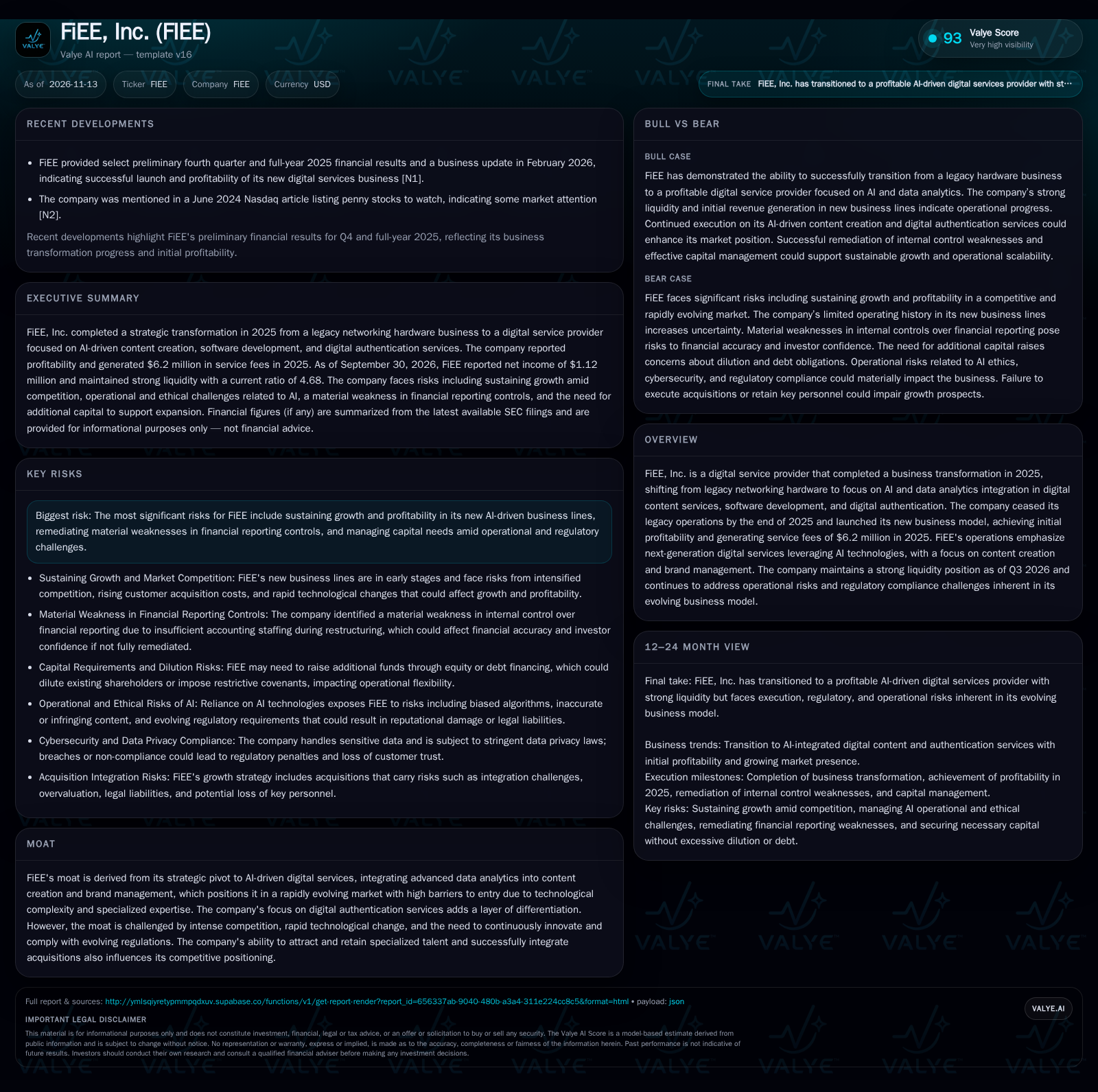
FiEE, Inc. exited legacy networking hardware in 2025 and launched a digital services business focused on AI-enabled content, software, and authentication. The company achieved profitability and $6.2 million in service fees, with a reported current ratio. Ongoing risks include sustaining growth, AI-driven operational and compliance challenges, internal control remediation, and potential capital needs as it scales.
FiEE, Inc.’s strategic overhaul in 2025, shifting from networking hardware to an AI-driven digital services model, has yielded rapid profitability and a reported liquidity position. By focusing on digital content, software development, and authentication services powered by AI and analytics, FiEE has positioned itself in a dynamic but fiercely competitive market. However, sustaining this early financial momentum will require the company to navigate operational risks tied to AI, address material weaknesses in controls, and secure additional capital for future growth—all while contending with evolving compliance and competitive pressures.
Transformation Completed, Early Profitability Achieved
FiEE, Inc. fully exited its legacy networking hardware business in 2025, completing a strategic transformation to focus on digital services integrating AI and data analytics into content creation, software development, and digital authentication [S1] [S2]. In its first year post-transition, the company generated $6.2 million in service fees and achieved profitability, reporting net income of $1,121,016 and basic EPS of $0.10 for the quarter ended September 30, 2026 [S2] [N1]. As of the same date, FiEE maintained $5.23 million in cash and a current ratio of 4.68, indicating a reported liquidity position [S2]. These results mark a successful launch of the new model, but the company remains in the early stages of its digital business expansion.
How FiEE’s Digital Service Model Could Scale
FiEE’s revenue now comes from service fees tied to digital content, software development, and authentication, with AI and data analytics at the core of its offerings [S2]. If the company employs project-based, retainer, or subscription pricing—common in digital services—recurring revenue and margin predictability may increase as its client base grows. Early profitability suggests that the shift to higher-margin services and lower capital intensity (relative to hardware manufacturing) is underway, but the durability of these margins will depend on FiEE’s ability to control customer acquisition costs and scale its delivery without proportionate increases in headcount or infrastructure.
The capital-light nature of digital services can enable operating leverage, but rapid headcount growth or heavy investment in proprietary AI infrastructure could compress margins. As the company expands, the need for additional capital—whether for technology investment, talent acquisition, or potential M&A—remains an open question, especially if organic cash flow is insufficient to fund ambitious growth. The company’s own disclosures highlight the risk of dilution or increased debt obligations if outside funding is required [S2].
Further analysis of FiEE’s business model scalability should consider the potential variability in client engagement types and contract durations. If the company can secure long-term contracts or subscription-based agreements, this would enhance revenue visibility and reduce volatility. Conversely, a predominance of short-term or project-based engagements may increase revenue unpredictability and require continuous sales efforts, elevating customer acquisition costs. Additionally, the balance between standardized AI-driven services and bespoke solutions will influence operational complexity and margin profiles. Standardized offerings typically allow for greater automation and economies of scale, whereas customized projects may demand higher-skilled labor and reduce operating leverage.
Another critical factor is the evolving cost structure related to AI infrastructure and data management. While digital services are generally capital-light, investments in proprietary AI models, cloud computing resources, and data security can represent significant ongoing expenses. If FiEE opts to develop or maintain proprietary AI capabilities internally, it may face higher fixed costs, potentially compressing margins during periods of slower revenue growth. Alternatively, reliance on third-party AI platforms could reduce capital requirements but increase variable costs and dependency risks. The company’s strategic choices in this area will materially impact both scalability and profitability over time.
Positioning in a Crowded AI-Enabled Services Arena
FiEE’s pivot places it in direct competition with established digital agencies, software consultancies, and AI-focused service providers—many of which have deeper client relationships, broader product portfolios, and greater brand recognition. Its differentiation stems from integrating advanced AI and analytics into content and authentication workflows, which, if executed well, could create defensible technical or workflow advantages. However, this edge is vulnerable to rapid technology shifts, low switching costs for clients, and the speed at which competitors can adopt similar tools.
The digital authentication segment could offer higher switching frictions if FiEE develops proprietary protocols or embeds itself in customer systems, but such lock-in is not established by current disclosures. The company’s ability to attract and retain specialized talent, stay ahead of AI regulatory changes, and rapidly innovate will be critical to sustaining any competitive moat.
In assessing FiEE’s competitive positioning, it is important to consider the potential for ecosystem partnerships and alliances. Collaborations with established technology providers or integration into broader digital platforms could enhance FiEE’s market reach and service differentiation. Such partnerships might facilitate access to new customer segments or complementary technologies, mitigating some competitive pressures. However, dependence on partners also introduces risks related to control over product roadmaps and margin sharing. FiEE’s ability to negotiate favorable terms and maintain strategic independence will be a key determinant of its competitive resilience.
Moreover, regulatory compliance and ethical AI considerations are increasingly becoming competitive differentiators in the AI-enabled services market. Firms that proactively embed privacy-by-design, transparent AI practices, and robust compliance frameworks may gain trust advantages with clients, particularly in regulated industries. FiEE’s progress in these areas could influence its ability to win contracts and avoid costly regulatory disruptions. Conversely, failure to anticipate or adapt to evolving AI governance standards may erode client confidence and invite legal or reputational risks, thereby weakening its competitive stance.
What Accelerated Expansion Would Look Like
A favorable trajectory for FiEE would see it rapidly scaling its digital services, converting early client wins into recurring relationships, and expanding its portfolio into higher-value verticals such as regulated digital authentication or complex brand management. Margin expansion could occur if AI automates substantial portions of content creation and analytics, reducing variable costs. Successful remediation of internal control weaknesses and disciplined capital management would also boost investor confidence and enable non-dilutive funding for growth.
Confirmation of this scenario would come from several quarters of sustained double-digit revenue growth, increasing net income margin, successful integration of acquired businesses (if any), and disclosure of significant multi-year client contracts or recurring revenue streams. Additional evidence would include remediation of material weaknesses in financial controls and clear progress on AI-driven product innovation.
Sustaining Momentum in an Unforgiving Market
The most plausible path is that FiEE continues to grow its service fees at a moderate pace, facing intermittent pressure on margins as it invests in talent, compliance, and technology. Customer acquisition costs may rise as the market for AI-driven digital services becomes more crowded, with price competition compressing margins in some segments. Operational hiccups—such as delays in internal control remediation or regulatory compliance—could periodically weigh on investor sentiment, even as the business remains fundamentally profitable.
Evidence for this scenario would include steady but not accelerating revenue growth, stable or slightly declining margins, and continued investment in internal systems and compliance. If FiEE is forced to raise capital, the terms and impact on dilution or leverage will be important markers of business health.
Where Early Gains Could Unravel
A negative outcome could stem from any combination of rising customer acquisition costs, slower-than-expected client wins, or technological obsolescence if FiEE’s AI offerings fail to keep pace with larger players. Persistent material weakness in financial controls could erode investor trust and restrict access to capital. Regulatory developments—such as new restrictions on AI content or data privacy—could impose costly compliance burdens or disrupt key product lines.
This scenario would be confirmed by flat or declining service fees, negative net income, high employee turnover (especially in technical roles), persistent or worsening audit findings, or the need to raise capital on unfavorable terms. Loss of major clients or publicized regulatory penalties would further undermine the business.
Milestones That Will Shape FiEE’s AI Service Trajectory
Quarterly service fee growth rates—especially the mix between new and recurring clients—would help test the scalability and stickiness of FiEE’s revenue base.
Gross and net income margin trends will clarify whether the company is achieving operating leverage or facing cost pressures as it expands.
Remediation status of material weaknesses in internal control over financial reporting, as disclosed in future filings, is critical for investor confidence.
The ratio of capital expenditures to revenues (if disclosed) would indicate whether scaling requires heavy investment or is capital-light.
Customer concentration metrics—such as the share of revenue from top clients—would illuminate dependency risks and pricing power.
Evidence of multi-year client contracts, renewals, or formal backlog would help establish revenue visibility.
Disclosures of regulatory or legal proceedings related to AI, data privacy, or IP would indicate emerging compliance risks.
Employee headcount and retention figures in technical and compliance roles would signal the company’s ability to execute on its roadmap.
Disclaimer: This is research-only, informational analysis and not investment advice. It may include AI-generated interpretation and general industry context. Always verify important details using primary sources.

Comments