
Versus Systems at a Crossroads: Gamification Ambition Confronts Revenue Constraints and Market Realities
Versus Systems aims to reinvent live event and digital engagement with proprietary gamification platforms, targeting sports venues and advertisers. Yet, persistent revenue weakness, a limited customer roster, and looming financial risks raise critical questions about its ability to scale and survive in an intensely competitive, fast-evolving ecosystem.
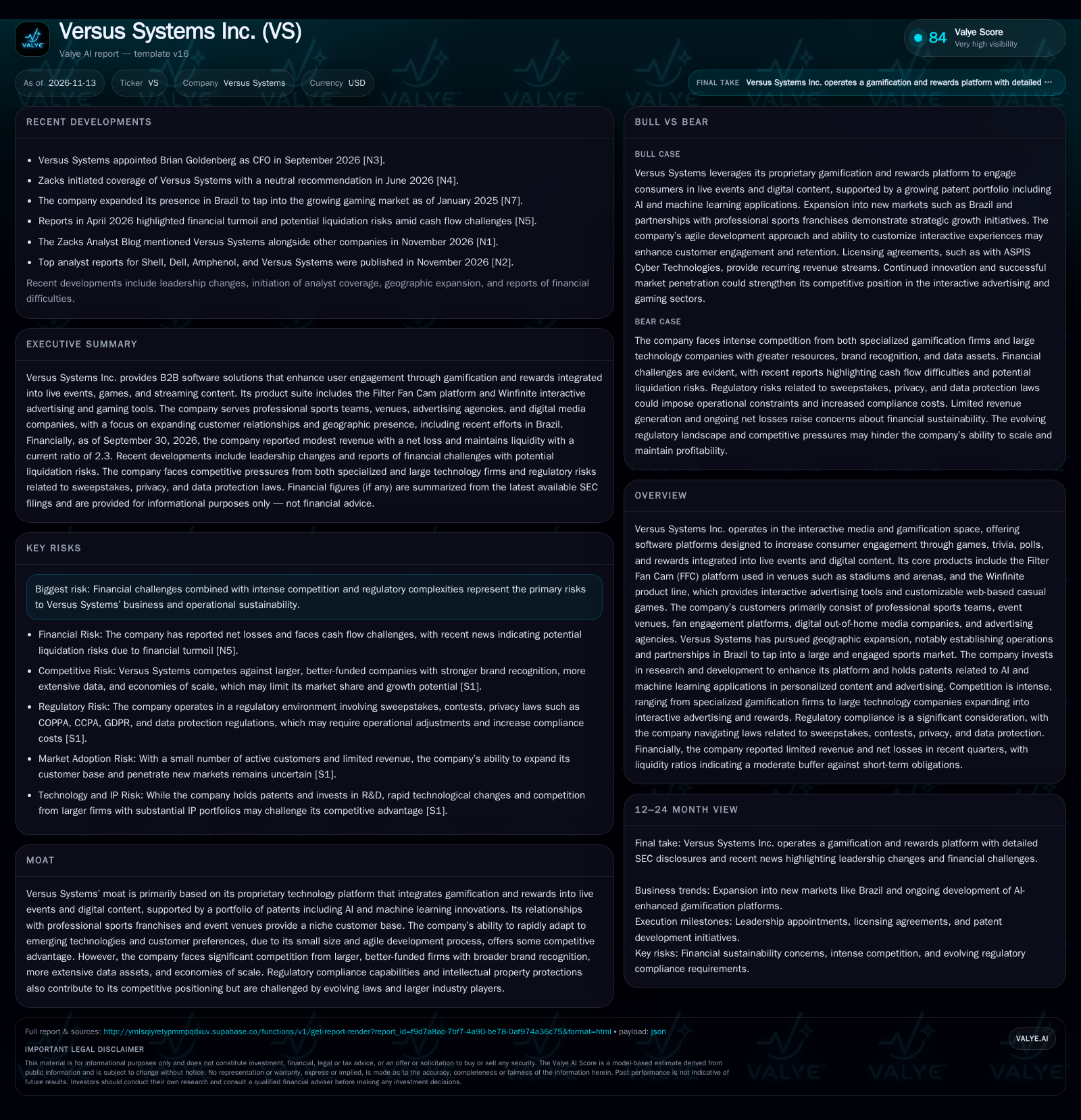
Versus Systems blends patented gamification tech with B2B partnerships in sports and events, seeking revenue from licensing and interactive advertising. Despite operational expansion, especially into Brazil, the company posted minimal revenue, ongoing losses, and faces financial turmoil risks as of late 2026. Competitive and regulatory headwinds further cloud near-term prospects, putting the focus on customer additions, recurring revenue, and tangible monetization of its tech portfolio.
Versus Systems Inc. is positioned at the intersection of gamification, live events, and digital advertising, offering B2B software platforms designed to deepen audience engagement through interactive tools and rewards. Despite carving out partnerships with professional sports teams and forays into international markets like Brazil, the company’s top-line remains stubbornly low, with just four active customers and ongoing net losses as of late 2026. With financial distress and liquidation risk making headlines, Versus must rapidly prove its technology’s commercial appeal, broaden its customer base, and navigate competitive and regulatory crosscurrents—or risk being subsumed by better-funded rivals or regulatory hurdles.
Recent Performance: Narrow Revenue Base and Financial Distress Dominate the Narrative
As of September 30, 2026, Versus Systems reported quarterly revenue of $24,121 and a net loss of $531,591, with only four active customers at the end of 2025, including the Texas Rangers and ASPIS, a related-party shareholder [S1] [S2]. These figures underscore persistent difficulties in scaling top-line growth and achieving operating leverage. The company reported cash and liquidity metrics for the period; these figures do not by themselves establish operating runway, investment capacity, financial flexibility, or financing capacity. [S2] [N5] Amid these pressures, Versus made a strategic push into the Brazilian market and completed a CFO transition in September 2026 [N3] [N7]. The immediate challenge is converting its technology and partnerships into a sustainable, growing revenue stream to stave off existential risks.
How Versus Systems Could Monetize Engagement: Licensing, Customization, and the Burden of Scale
Versus Systems’ core revenue model is B2B: licensing its proprietary engagement platform to sports teams, venues, event promoters, and advertisers, with additional income potentially from technology development fees and interactive advertising transactions [S1]. The company’s Filter Fan Cam and Winfinite products offer customizable experiences—such as trivia, polls, and branded mini-games—intended to increase fan engagement and deliver measurable value to sponsors and advertisers.
The economic logic depends on customer adoption, repeat usage, and the ability to charge premium license or recurring SaaS-like fees for access to the platform. However, with only four active customers, and evidence of related-party dependence, Versus has not yet demonstrated a scalable go-to-market engine or customer retention at meaningful volume. Margins at scale could be attractive if software licensing dominates, but the company’s low current revenue base suggests that fixed R&D and SG&A costs far outstrip gross profit, resulting in persistent operating losses [S2].
Capital requirements remain modest compared to hardware-intensive businesses, but cash runway is pressured by ongoing losses, and the company’s ability to invest in R&D or sales expansion is likely constrained without additional funding or rapid revenue growth. The economic challenge is to achieve enough customer wins and usage volume to flip the model from negative operating leverage to positive contribution margin.
Competing for Engagement: Versus Systems’ Niche Versus Giants and Agile Rivals
Versus Systems operates in a hyper-competitive landscape, facing direct competition from gamification and rewards specialists (such as TapJoy, Honey, Rakuten, Otello, Skillz) as well as indirect competition from major tech platforms (Apple, Google, Meta, Amazon, Microsoft, Netflix, Shopify, Yahoo) that increasingly incorporate interactive content and real-time engagement features [S1].
Its moat rests on proprietary IP—patents for AI and machine learning-driven personalization—and the ability to rapidly iterate features for live events and digital media. Relationships with professional sports franchises offer a foothold, but the small customer base and lack of clear network effects leave Versus vulnerable to both niche competitors and platforms with far greater distribution, data, and integration resources.
Switching frictions for B2B customers are likely modest, as venues and advertisers can test competing engagement platforms with limited sunk costs. Pricing power is therefore constrained unless Versus can prove superior fan engagement or measurable ROI for sponsors. Regulatory complexity (sweepstakes, privacy, data protection) is a barrier to entry, but also a risk that larger players may be better equipped to absorb.
From Technology to Traction: What Would a Versus Systems Turnaround Look Like?
A favorable scenario would see Versus Systems translating its IP and platform into rapid customer acquisition, particularly among sports leagues, venues, and large advertisers seeking differentiated fan engagement tools. Evidence of new multi-year licensing deals, expansion of the customer roster beyond the initial four, and a shift to recurring SaaS-style revenue would signal traction.
Successful monetization of the Brazil expansion—demonstrated by major contracts with local sports teams or event organizers—could provide proof of concept for international scaling [N7]. Licensing deals with digital media or streaming partners would further diversify revenue. If the company’s AI-driven personalization delivers measurable improvements in fan retention or sponsor ROI, Versus could justify higher pricing or usage-based fees, driving positive operating leverage.
Confirmation would come from sustained sequential revenue growth, expansion of gross margin, and a visible reduction in net losses. Falsification would occur if customer count stagnates, revenue per customer remains low, or international initiatives fail to yield contracts.
Incremental Progress Under Pressure: Survival Hinges on Modest Customer Gains and Cost Control
The most plausible near-term outcome is a continuation of limited revenue growth as Versus Systems works to convert its pipeline of prospects into paying customers. The company may secure a handful of new contracts—possibly in Brazil or adjacent event markets—but revenue per client is likely modest, and recurring revenue remains elusive.
Operating losses persist, given fixed development and compliance costs, but the company manages expenses tightly to preserve cash. Strategic partnerships, such as the ASPIS agreement, provide some recurring revenue, but dependence on related parties and small customers limits visibility and bargaining power.
This scenario would be confirmed by slow but steady customer and revenue growth, continued reliance on cost management to extend runway, and no further escalation of financial distress headlines. It would be falsified if the customer base contracts, costs accelerate, or Versus fails to close new deals despite ongoing R&D investment.
Failure to Scale: Liquidity Crunch and Competitive Squeeze Could Force Restructuring or Liquidation
In the adverse scenario, Versus Systems fails to expand its customer base or secure additional funding, leading to acute cash flow shortages. The company’s limited revenue and persistent losses exhaust available liquidity, and the April 2026 reports of potential liquidation risk materialize [N5].
Competitive pressures intensify, with existing customers switching to larger or better-integrated engagement platforms, eroding what little recurring revenue exists. Regulatory compliance costs rise, or the company encounters new legal barriers in target markets, further stretching resources.
Confirmation would come from further declines in revenue or customer count, unsuccessful capital raises, or public disclosures about restructuring, asset sales, or formal liquidation steps. The thesis would be challenged if Versus is able to secure bridge financing or a strategic acquirer emerges, but absent such developments, the downside risk is company failure.
Signals That Would Clarify Versus Systems’ Trajectory in Gamification and Live Event Tech
Net new customer additions, especially among non-related-party sports franchises, event venues, or large advertisers—if disclosed—would help test the company’s ability to scale beyond its current base.
Evidence of multi-year, recurring licensing contracts or SaaS-style agreements (rather than one-off projects) would indicate improving revenue visibility and customer stickiness.
Quarterly revenue growth and sequential trends, especially from international markets such as Brazil, would signal the commercial impact of geographic expansion.
Gross margin improvement and operating expense discipline, as shown in future filings, would clarify the path to profitability and operating leverage.
Updates on patent issuance, proprietary technology adoption, or successful deployment of AI-driven features would support the company’s competitive differentiation claims.
Disclosure of regulatory actions, compliance costs, or new privacy/data hurdles would help assess the sustainability of the business model.
Announcements of new capital raises, debt arrangements, or strategic partnerships would reveal management’s options for extending runway or accelerating growth.
Churn rates or customer retention data—if provided—would offer insight into switching frictions and satisfaction with Versus’ platform.
Disclaimer: This is research-only, informational analysis and not investment advice. It may include AI-generated interpretation and general industry context. Always verify important details using primary sources.

Comments