
ADTRAN Holdings' Strategic Edge in Fiber Networking Amid Market Shifts
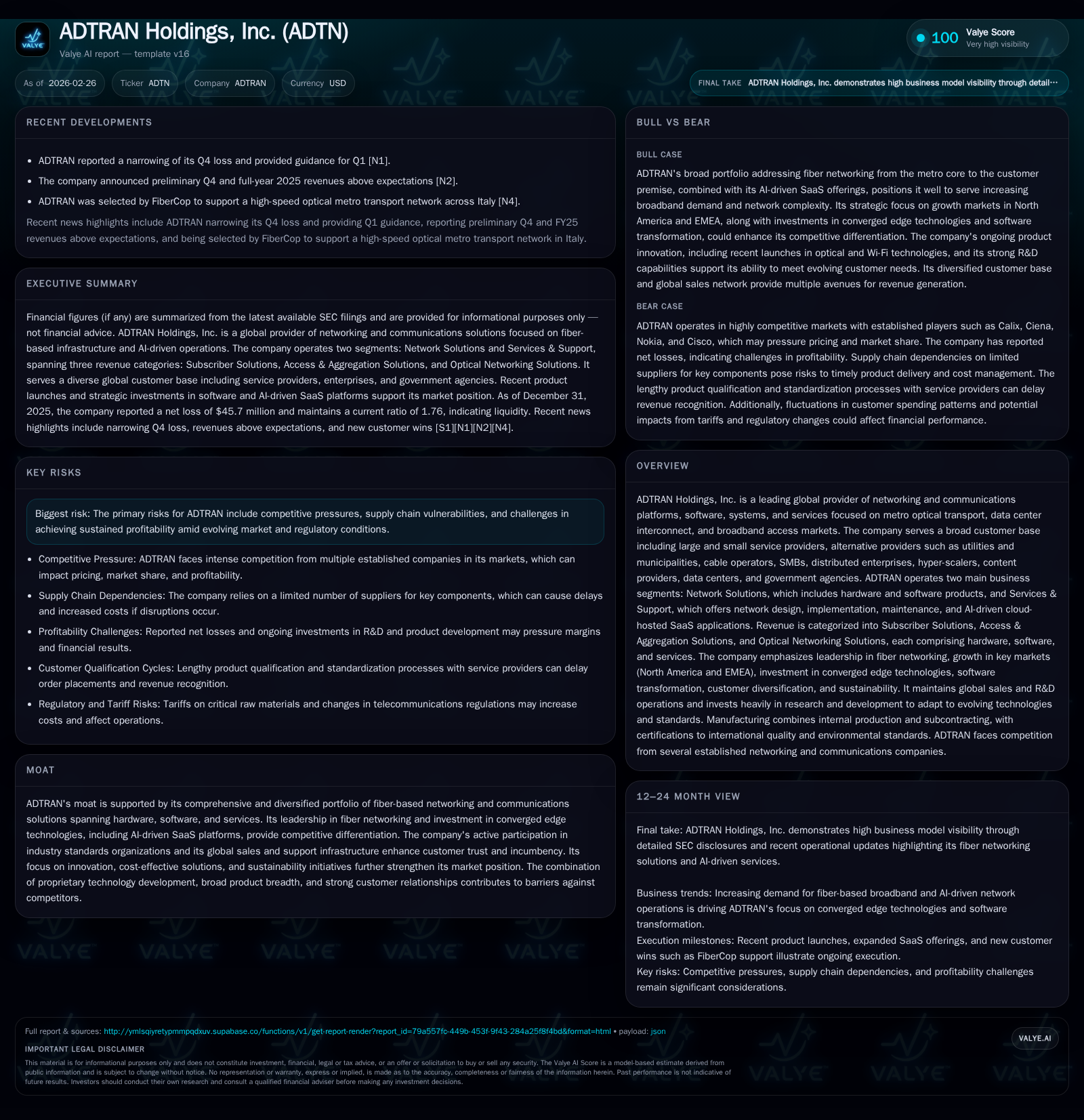
The juxtaposition of ADTRAN’s persistent net losses against strong operating cash flow underscores its evolving role in fiber networking and AI-driven SaaS innovation.
ADTRAN Holdings, Inc. has experienced a notable decline in revenue since 2016, with FY2025 revenues falling 22.2% from prior peaks, accompanied by sustained operating losses narrowing slowly year-over-year. Despite losses at the bottom line, the company has generated positive and growing operating cash flow, reflecting operational improvements and prudent capital management. ADTRAN’s diverse product portfolio spans hardware, software, and cloud-hosted services across broad customer verticals, supported by continuous R&D investment focused on converged edge computing and fiber-based optical transport. Key risks remain around supply chain challenges and regulatory complexities in global markets. Going forward, contract renewals, adoption of its AI-driven Mosaic One platform, and fiber infrastructure demand serve as critical growth indicators.
Revenue and Earnings Trends: The Path of Recent Years
ADTRAN Holdings has witnessed a sustained decline in its top-line revenue over the past decade. Revenues peaked around $163 million in FY2016 before declining to approximately $127 million by FY2017 and continuing to fall thereafter [F1]. By FY2025, annual revenue stood approximately 22% lower year-over-year from prior levels. This contraction aligns with challenging market conditions characterized by intensifying competition within fiber networking hardware and software markets.
Simultaneously, the company grappled with profitability pressures. Operating income remained negative throughout recent years but exhibited steady improvement: for FY2025 operating losses narrowed by about 7% YoY to roughly -$15.6 million [F1]. Meanwhile, net income losses sustained magnitude near -$45.7 million in FY2025 without significant improvement compared to FY2024 [F1]. Management attributes constrained margins and bottom-line performance partly to prolonged product qualification cycles required by service providers coupled with competitive pricing environments [S1][N3].
Strategies implemented focused on streamlining operations and enhancing product functionality to regain share but remain challenged by external headwinds.
Historical performance (annual)
| FY | Net ($mm) | CFO ($mm) | OpInc ($mm) | Capex ($mm) | Net YoY |
|---|---|---|---|---|---|
| 2025 | -46 | 130 | -16 | 32 | +1.0% |
| 2024 | -46 | 104 | -17 | 35 | +82.8% |
| 2023 | -268 | -46 | -221 | 43 | -13041.3% |
| 2022 | -2 | -44 | -73 | 17 |
Source: SEC companyfacts cache [F1].
Capital returns and efficiency (annual)
| FY | FCF ($mm) |
|---|---|
| 2025 | 98 |
| 2024 | 69 |
| 2023 | -89 |
| 2022 | -61 |
Source: SEC companyfacts cache [F1].
Note: Revenue figures for recent fiscal years are not explicitly reported; percentage changes derived from available data [F1].
Business Segments Unpacked: Network Solutions and Services & Support
ADTRAN structures its operations into two primary segments: Network Solutions—which encompasses hardware components like optical line terminals (OLTs), carrier ethernet switches, residential gateways, coherent optics modules—and complementary software products; alongside Services & Support that deliver network design consulting, maintenance contracts, cloud-hosted AI-driven SaaS applications under the Mosaic One umbrella [S4][S8][S9].
This segmentation ties into their three reported revenue categories:
- Subscriber Solutions: Customer premise equipment offering fiber termination for homes/businesses with devices supporting multi-gigabit speeds.
- Access & Aggregation Solutions: Platforms facilitating connectivity between subscriber networks and metro cores via fiber or enhanced copper technologies.
- Optical Networking Solutions: High-capacity metro optical transport products essential for data center interconnects and regional networks.
The blend offers significant modular benefits—service providers can adopt solutions incrementally while leveraging carrier ethernet capabilities for flexible deployment scenarios supportive of mobile backhaul or enterprise connectivity requirements [S15][S16]. The Services segment’s network orchestration and proactive maintenance enhance customer lock-in through integrated lifecycle support.
Innovation at the Converged Edge: R&D Focus and Product Pipeline
Despite facing fiscal pressure reflected in trimming R&D spend from $258 million in 2023 down to about $204 million in 2025 [F1][S6], ADTRAN maintains product development as a strategic linchpin.
R&D efforts concentrate on open architecture designs that facilitate disaggregated networking models integrating silicon photonics for optical transport enhancements—a sector seeing expanded attention due to bandwidth demands driven by cloud computing growth and telecom virtualization trends [S6][S11].
The company also develops AI-enriched SaaS platforms such as Mosaic One designed to optimize fiber access networks dynamically through predictive analytics and automation—representing a pivot towards software-centric solutions even when embedded within hardware ecosystems [S4][S6]. Lean agile development methodologies underpin expedited time-to-market while ensuring responsiveness to rapidly evolving standards from such bodies as ITU-T and BBF where ADTRAN actively participates [S11].
Customer Base and Market Presence: Diversification across Geographies and Verticals
Serving an eclectic mix spanning large national service providers (including one international customer generating over 10% of total revenue), alternative broadband suppliers like utilities/municipalities deploying fiber overbuilds, cable MSOs transitioning their networks as well as hyperscale cloud operators implies considerable global geographic breadth encompassing key markets like the U.S., UK, Germany, plus emerging EMEA regions [S4][S5].
This diversity reflects intentional cross-selling strategies deploying multiple product lines across service provider types at various scales while managing multi-year supply contracts typically sans minimum volume commitments but subjected to intense qualification processes stretching over several quarters or years—a telecom procurement hallmark that tempers order visibility but fosters long-term customer relationships once established [S4][S5].
The sales organization blends direct engagement with channel partners including MSPs/VARs with distribution channels calibrated per region’s market structure ensuring proximity support backed by localized sales engineering expertise [S5].
Capital Allocation and Financial Health: Cash Flow, Investments, and Returns
Amid operational losses impacting equity returns—with ROE approximated near negative 12.8% based on FY25 net loss relative to prior equity balances—the company has significantly bolstered liquidity yielding a current ratio close to 1.76 at year-end 2025 [F1][S23][S28].
More critically, operating cash flow rebounded dramatically from negative territory (-$44 million in FY22) to robust positive inflows surpassing $129 million by FY25 signaling better working capital management or reduction of non-cash charges compensated by improved collections or inventory control [F1]. Capex spending reduced moderately from $34.5 million in FY24 to $31.7 million in FY25 confirming disciplined capital reinvestment aligned with ongoing innovation objectives without excessive asset expansion pressures [F1][S6].
No dividends or significant share repurchases have been declared recently post-2018 indicating management preference towards reinvesting internally rather than capital return programs amid restructuring phases [F1]. Ensuring sufficient cash buffers supports ongoing R&D initiatives amidst volatile industry conditions.
Macroeconomic and Industry Headwinds: Risks Shaping Profitability Outlook
Operational risk factors feature prominently around elongated product qualification timelines—spanning months or even years—imposing revenue timing uncertainties; supply chain fragilities linked to single-source components such as silicon photonics modules or specialized optics further amplify volatility potential [S10][S12][S17]. Tariff uncertainties—with U.S.-imposed levies on semiconductors expected through mid-2027—pose additional cost headwinds notwithstanding partial mitigation strategies deployed so far [S12][S19].[N2]
Regulatory complexity notably affects sales into government agencies subject to intricate compliance regimes plus evolving AI-related regulations could impose stringent transparency mandates impacting Mosaic One deployments given its AI features [S17][S19]. Furthermore competitive dynamics remain intense involving established peers like Calix, Ciena, Nokia within overlapping market segments intensifying price-performance battles [S16].[N4]
Forward Indicators: What to Watch for in Growth Catalysts and Market Expansion
Explicit forward numeric guidance is currently undisclosed per recent earnings releases [N2][S3], spotlighting close observation of key contract ramp-ups such as the FiberCop engagement supporting Italy’s metro optical transport rollout—an indicator of pipeline health alongside broader North American/EMEA network buildouts driving demand.
Adoption velocity of the Mosaic One platform will be crucial given its role embodying ADTRAN’s shift towards cloud-managed AI operations combining monitoring with predictive orchestration—success here would substantiate recurring revenue streams beyond traditional hardware sales sectors.
Supply chain stability improvements alongside accelerated product qualification cycles will further delineate achievable milestones over short- to medium-term horizons amid competitive pressures.
Longer-term structural tailwinds stem from global digital transformation trends favoring ubiquitous fiber penetration aligned with expanding bandwidth requirements catalyzed by AI workloads proliferation and pervasive OTT video streaming.
This analysis is based solely on publicly available data including ADTRAN’s SEC filings ([F1],[S#]) and Nasdaq news reports ([N#]). It does not constitute investment advice nor an endorsement of any securities discussed herein.
Disclaimer: This is research-only, informational analysis and not investment advice. It may include AI-generated interpretation and general industry context. Always verify important details using primary sources.

Comments