
AI Era Corp. Expands Creator AI Ecosystem Amid Liquidity Constraints and Leadership Changes
The company’s growth fueled by strategic AI initiatives faces potential limits due to financial and execution challenges.
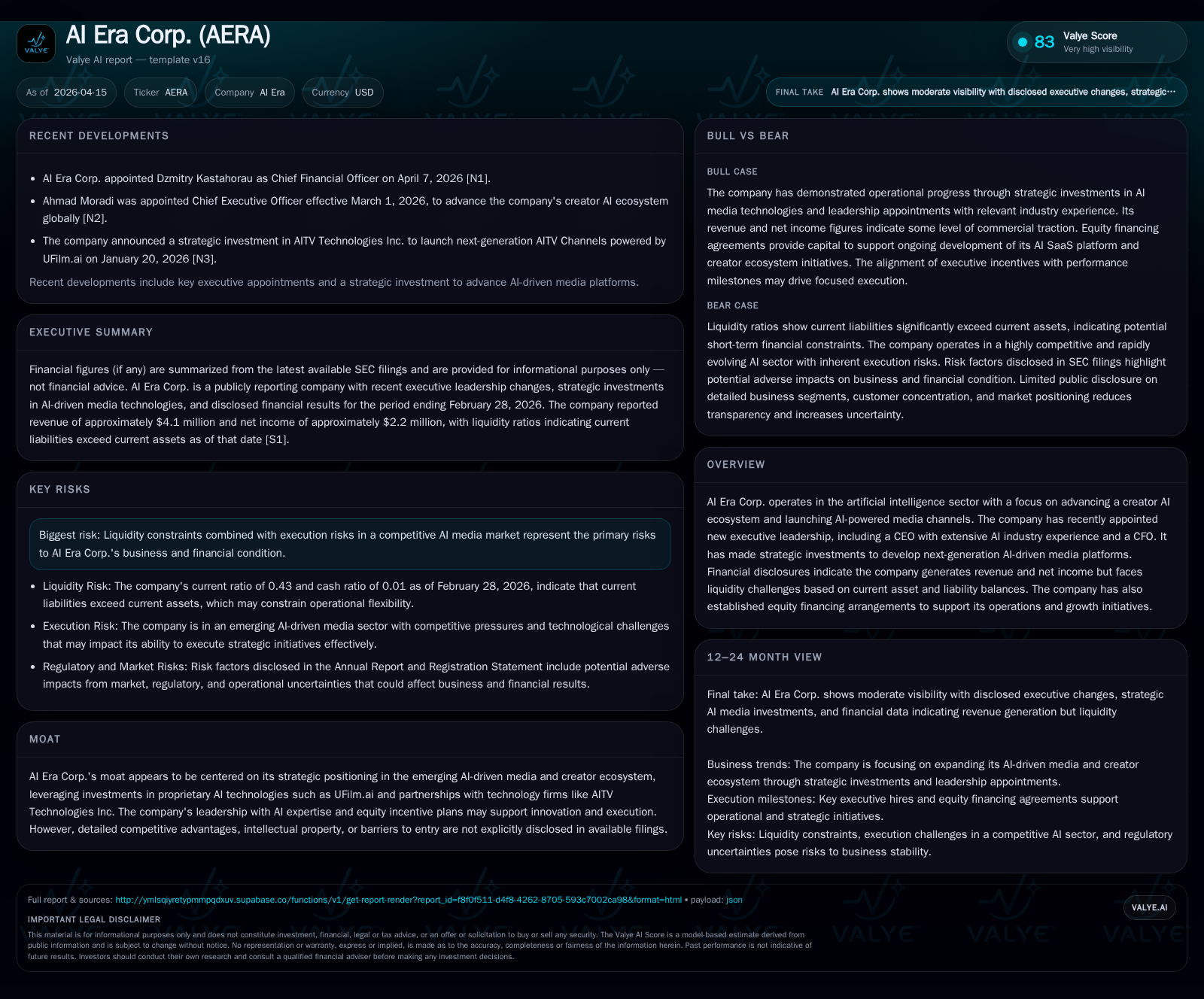
AI Era Corp. has demonstrated impressive revenue and profitability growth over the last three years, driven by its strategic investments in AI-powered media platforms and an ecosystem for content creators. Recent executive appointments of a CEO with extensive AI experience and a new CFO signal a pivot toward scaling operations and refining capital management amid liquidity pressures. While the company benefits from proprietary technologies and partnerships, its future expansion hinges on its ability to navigate competitive risks and manage balance-sheet constraints. Watching upcoming milestones around equity financing draws and operational KPIs will be critical.
Historical Performance Driving Structure
AI Era Corp.'s historical financial performance illustrates a remarkable growth trajectory over the last three fiscal years ending August 31, 2025. Revenue climbed sharply from $1.47 million in FY2023 to $3.30 million in FY2024, then nearly doubled again to $6.37 million in FY2025 [F1]. This expansion was complemented by a turnaround from operating losses exceeding $3 million to positive operating income of $1.88 million in FY2025, signaling improved operational efficiency or higher-margin product adoption.
Net income followed the same upward trend, moving from substantial losses in earlier years (-$2.17 million in FY2022; -$3.57 million in FY2023) to positive territory at $542k in FY2024 before culminating at $1.46 million for FY2025 [F1]. Despite this profit progress, operating cash flow revealed persistent challenges: after a modest positive inflow of roughly $162k in FY2024, cash outflows intensified again to approximately -$2.32 million by FY2025 year-end [F1], reflecting continued spending on growth initiatives or working capital needs.
Liquidity ratios as of February 28, 2026 further shed light on financial constraints: current assets of just over $1.2 million opposed current liabilities substantially above that at approximately $2.83 million yield a precarious current ratio near 0.43 [F1]. Such figures highlight that while revenue and earnings have improved dramatically, short-term obligations outpace liquid resources.
Historical performance (annual)
| FY | Rev ($mm) | Net ($mm) | CFO ($mm) | OpInc ($mm) | Rev YoY | Net YoY |
|---|---|---|---|---|---|---|
| 2025 | 6 | 1 | -2 | 2 | +93.0% | +168.4% |
| 2024 | 3 | 1 | 0 | 0 | +124.0% | +115.2% |
| 2023 | 1 | -4 | -1 | -4 | -49.7% | -64.1% |
| 2022 | 3 | -2 | -2 | -2 |
Source: SEC companyfacts cache [F1].
Capital returns and efficiency (annual)
| FY | Buybacks ($) | ROE% |
|---|---|---|
| 2025 | 50699 | 47.5 |
| 2024 | 50699 | 37.1 |
| 2023 | -400.3 | |
| 2022 | -54.1 |
Source: SEC companyfacts cache [F1].
Note: Year-over-year percentages calculated where applicable; net income change reflects significant recovery.
Strategic Shifts Fueling Growth Prospects
AI Era focuses on developing an AI-powered creator ecosystem anchored by proprietary technology such as UFilm.ai and collaborations with firms like AITV Technologies Inc., aiming to innovate content creation workflows through AI-driven media channels — areas attracting increasing market interest as demand for personalized automated content grows . The recent appointment of Ahmad Moradi as CEO introduces seasoned leadership laying out ambitions for global scale-up leveraging his extensive experience steering technology ventures across AI domains [N2/S27].
Complementarily, CFO Dzmitry Kastahorau's hiring signals renewed attention on managing complex financing structures necessary for prolonged development phases typical of AI SaaS enterprises [N1/S29]. Capital allocation plans through convertible notes issued since January 2026 (issuers include Monroe Street Capital Partners LP, Crom Structured Opportunities Fund I LP among others) maximize flexibility but introduce conversion risks impacting shareholder dilution . Equity purchase agreements allowing up to $30 million drawdowns subject to trading price formulas reflect an active funding strategy contingent on market conditions .
Key growth drivers are thus materially hinged on successful technology commercialization cycles balanced against maintaining sufficient operational runway amid fluid financing terms.
Financial Forecasting & Milestones To Monitor
Explicit public guidance remains limited beyond stated executive incentive frameworks linking up to roughly two million shares under new stock option plans vesting on continued employment plus performance triggers centered on revenue escalations and strategic partnerships established post-early-2026 plan adoption . These incentives underscore internal expectations for sustained top-line acceleration.
Forward-looking monitoring should focus on:
- Quarterly revenue trends validating sustained creator ecosystem adoption
- Realization of planned equity financings or refinancing events within approved structures mitigating liquidity gaps
- Emerging profitability contributions from new AI-driven media initiatives juxtaposed with ongoing investment spending.
No declared dividends or material share repurchase programs exist beyond minor buybacks noted historically which remain marginal relative to market capitalization [F1/S21-S22], suggesting reinvestment prioritization.
Returns & Capital Allocation Dynamics
With net income improving rapidly into positive zones by FY2025 remaining paired with negative operating cash flow implies earnings may be influenced by non-cash components or timing differences such as deferred revenues or accrued expenses common in SaaS models adopting aggressive growth strategies [F1]. Approximate return-on-equity based on last fiscal net income over shareholders’ equity stands near an estimated mid-40s percent range (47.5%), highlighting efficient equity utilization despite scale still being modest relative to enterprise potential [F1].
Capital allocation has emphasized securing convertible debt—often coupled with original issue discounts plus substantial early interest accruals factored into cost-of-capital dynamics—alongside structuring manageable conversion price floors aimed at mitigating downside dilution while preserving access to needed funds . Executive compensation through significant stock-based grants further aligns leadership with shareholder outcomes while imposing potential dilution that must be carefully managed given tight liquidity contexts.
Industry Context & Competitive Positioning Analysis
AI Era operates within an intensely competitive segment blending next-generation AI technologies with digital media innovation. Proprietary tools like UFilm.ai place it among emerging cohorts leveraging generative AI for automated content production which is rapidly gaining market relevance but also invites rapid innovation cycles from well-capitalized incumbents and startups alike.
The company’s moat appears tethered mainly to its early investments and partnerships within this ecosystem rather than protected intellectual property or regulatory barriers—a factor necessitating relentless innovation velocity alongside prudent financial stewardship to maintain differentiation [Valye overview/S4-S5 risk factors]. Liquidity constraints further compound risks related to execution delays or market shifts.
Conclusion: Balancing Opportunity With Financial Discipline
AI Era Corp.’s transformation from deep losses into profitability within three years illustrates successful early-stage commercial traction of its AI-driven media concepts coupled with strengthened leadership drawn from proven experience sets expanding operational capability. Yet the pronounced liquidity gap reflected in the low current ratio combined with reliance on convertible notes and equity lines heightens funding risk exposure characteristic of micro-cap tech companies scaling emergent business models. Prudent evaluation hinges on monitoring quarterly financial disclosures focusing on cash flow improvements, further clarity on capital raising impacts alongside realization of KPI targets tied closely to executive incentives—a critical climate for investors navigating speculative yet disruptive arenas within artificial intelligence applications.
This analysis synthesizes publicly available filings and news releases without offering investment advice or recommendations.
Disclaimer: This is research-only, informational analysis and not investment advice. It may include AI-generated interpretation and general industry context. Always verify important details using primary sources.

Comments