
Advanced Flower Capital Q2 2026: Managing Distribution Obligations Amid Income Recognition Challenges
Advanced Flower Capital reported stable liquidity in Q2 2026 while navigating income recognition timing issues under its RIC tax framework.
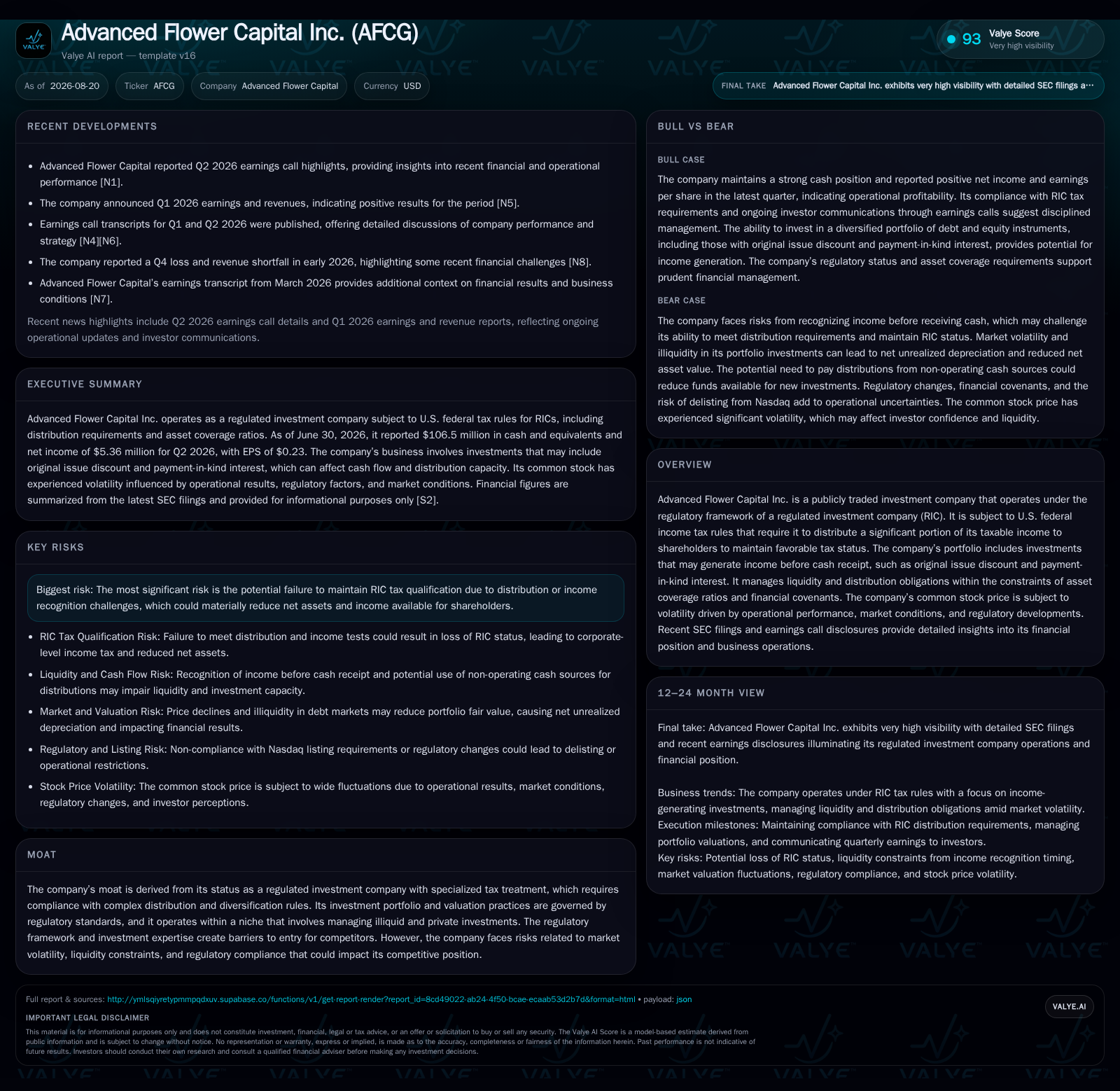
Advanced Flower Capital Inc. disclosed its Q2 2026 financial results showing $106.5 million in cash and equivalents, reflecting stable liquidity to support operations and mandatory distributions. The company continues to recognize certain non-cash income items such as original issue discount (OID) and payment-in-kind (PIK) interest before receiving cash, which presents challenges in meeting the 90% distribution requirement under its regulated investment company (RIC) status. No material changes to risk factors were noted compared to the prior annual report, underscoring a consistent regulatory and operational risk profile.
Q2 2026 Operating and Financial Update
Advanced Flower Capital Inc. reported stable liquidity as of June 30, 2026, with cash and cash equivalents totaling $106.5 million, according to SEC companyfacts [F1]. This level of liquidity supports the company’s ability to meet its near-term operational and distribution obligations under its regulated investment company (RIC) tax status [F1][S2].
However, AFCG’s income recognition includes certain non-cash components such as original issue discount (OID) and payment-in-kind (PIK) interest, which are accrued and recognized before the company actually receives corresponding cash payments [S1]. This timing difference introduces complexity in ensuring that distributions are adequately covered by cash rather than just reported income. Since OID and PIK interest increase reported taxable income without immediate cash inflow, AFCG faces the risk that it may need to generate cash through asset sales or capital raises to meet distribution requirements.
No material changes to risk factors were disclosed in the Q2 2026 filing relative to the 2025 annual report, indicating a consistent operating and regulatory risk profile [S2][S1]. This stability suggests that the company’s exposure to regulatory, market, and credit risks remains unchanged in the near term.
Business Model and Regulatory Framework
AFCG operates as a business development company (BDC) under the Investment Company Act of 1940, focusing on originating and managing senior secured loans primarily to cannabis industry operators and other middle-market companies [S1]. The company’s revenue is generated mainly from interest income on these loans, which includes both cash interest payments and accrued non-cash income such as OID and PIK interest.
The RIC tax framework requires AFCG to distribute at least 90% of its investment company taxable income, which includes accrued but unpaid income items [S1]. This creates a structural challenge because the company must ensure that distributions are supported by actual cash, not just recognized income. Failure to meet these distribution requirements could jeopardize AFCG’s tax status, forcing it to sell portfolio assets at potentially unfavorable times or raise additional capital, actions that might negatively impact net asset value (NAV) and shareholder returns.
Analytical Implications and Scenarios
The stable liquidity position, evidenced by $106.5 million in cash and equivalents at quarter-end, provides AFCG with a buffer to meet distribution obligations despite the timing mismatch between income recognition and cash receipt [F1][S2]. This liquidity is crucial for compliance with RIC distribution rules and supports operational continuity.
However, the recognition of non-cash income items such as OID and PIK interest presents a risk that AFCG might face cash shortfalls relative to its taxable income [S1]. If accrued income outpaces cash collections, the company may be compelled to sell investments or raise capital, potentially at suboptimal valuations, which could impair NAV and shareholder value.
One plausible base case scenario is that AFCG continues to manage its portfolio and cash flows prudently, maintaining stable liquidity and meeting distribution requirements without material disruption [S2][F1]. This scenario assumes no significant deterioration in portfolio valuation, continued cash generation from investments, and a stable regulatory environment.
Conversely, a bear case scenario could emerge if income recognition timing issues worsen, forcing AFCG to liquidate assets at inopportune moments or raise dilutive capital [S1][S2]. This would be more likely if OID and PIK accruals increase without corresponding cash inflows, market volatility reduces portfolio liquidity and valuation, or capital raising becomes challenging.
Watchpoints
Investors and analysts should monitor AFCG’s quarterly cash and equivalents trends to assess liquidity sufficiency. Changes in portfolio valuation and unrealized depreciation will also be important indicators of potential NAV pressure. Announcements of asset sales or capital raises could signal liquidity stress or distribution funding challenges. Additionally, regulatory developments affecting RIC status or cannabis lending could materially impact AFCG’s operating environment and distribution obligations.
The company’s ability to manage these factors will be critical for maintaining tax status and shareholder returns going forward.
Disclaimer: This is research-only, informational analysis and not investment advice. It may include AI-generated interpretation and general industry context. Always verify important details using primary sources.

Comments