
AGCO’s Precision Technology Ambitions Confront Cyclical Realities and Competitive Pressures
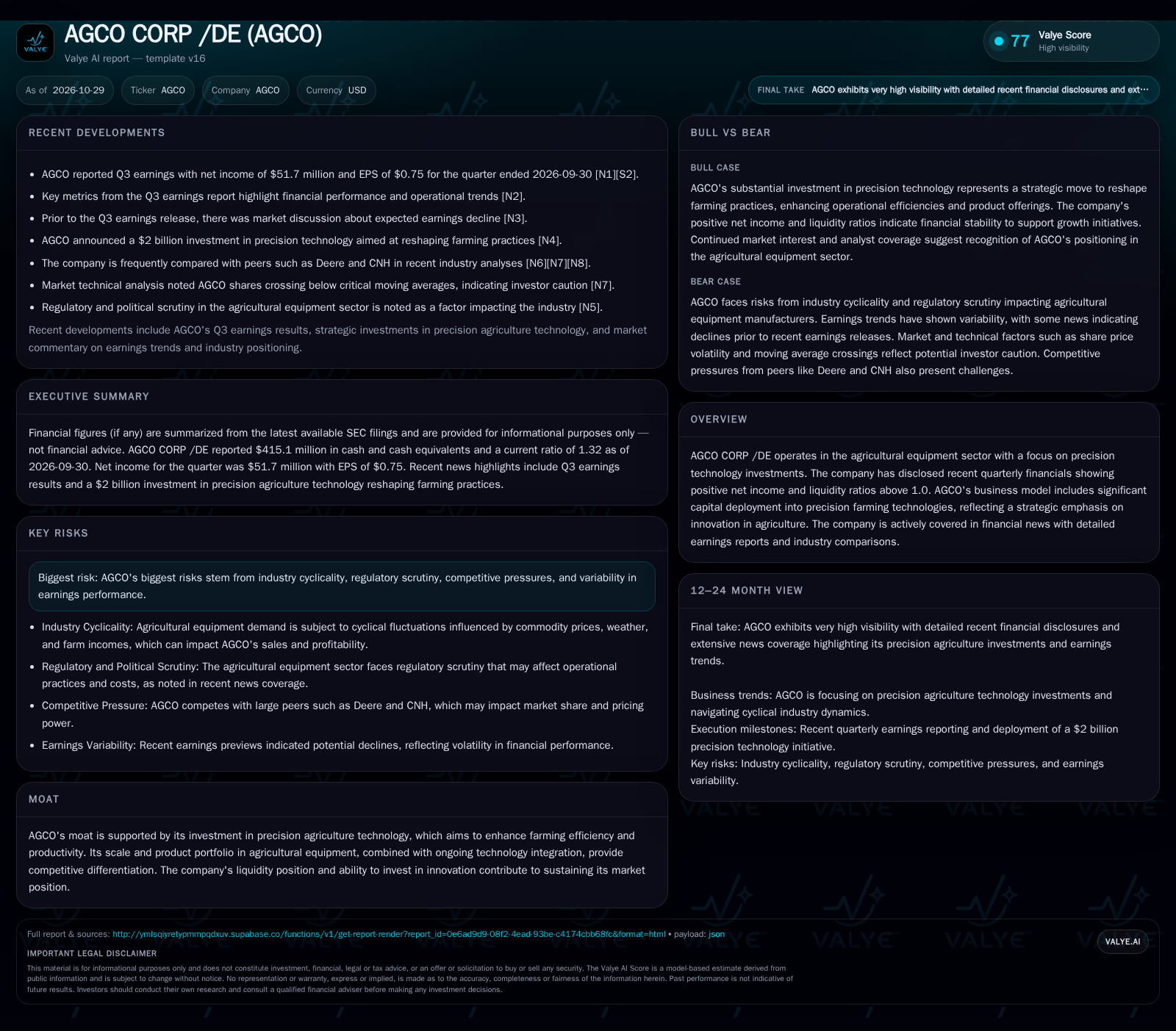
AGCO’s $2 billion push into precision agriculture technology marks a strategic pivot toward higher-value solutions, but recent earnings variability and industry cyclicality highlight the challenges of transforming business economics in a mature, competitive sector.
This strategic initiative aims to reposition AGCO in the evolving ag equipment market, yet recent earnings volatility and established competition from peers like Deere and CNH underscore the uncertainties around margin expansion and long-term growth [S2] [N4].
AGCO is betting big on precision agriculture, with a $2 billion technology investment that signals a bid to move beyond traditional machinery into data-driven, value-added solutions for modern farming. While the company posted positive Q3 net income and reported liquidity-ratio trends above 1.0, recent news coverage and analyst commentary point to persistent volatility in earnings and ongoing competitive pressure from industry giants. The success of AGCO’s transformation depends not just on technology deployment, but on the ability to turn innovation into sustainable margins in a sector shaped by cyclical farm economics and rapidly evolving customer expectations.
Q3 Earnings and Precision Tech Investment Define AGCO’s Present Trajectory
AGCO reported net income of $51.7 million for the quarter ended September 30, 2026, with basic and diluted EPS of $0.75. [S2]
The most material recent development is AGCO’s announcement of a $2 billion investment in precision agriculture technology, intended to reshape both its product offering and the broader farming landscape [N4]. This move comes amid ongoing analyst scrutiny and market commentary about earnings variability, with pre-Q3 coverage anticipating a potential decline in profitability [N3].
The confluence of a major strategic capital deployment and mixed earnings signals suggests AGCO is at an inflection point—balancing the costs and uncertainties of transformation against the imperative to maintain operational performance in a cyclical, competitive industry.
How Precision Tech Could Alter AGCO’s Margin Structure
Traditionally, AGCO’s economics have relied on high-ticket equipment sales—tractors, combines, implements—with significant exposure to agricultural cycles, farm incomes, and commodity prices. These cyclical drivers mean that periods of farm stress translate quickly into lower equipment volumes and margin compression.
The $2 billion investment in precision technology signals a bid to diversify away from pure hardware economics toward higher-value, potentially recurring revenue streams—such as software, data analytics, and digital service layers. If successful, this shift could introduce more stable, higher-margin revenue, reduce seasonality, and create switching frictions that insulate AGCO from purely price-driven competition.
However, the capital intensity of developing, integrating, and supporting advanced technology solutions is significant. Operating leverage may increase if fixed R&D and platform costs scale over a larger installed base, but this depends on adoption rates, pricing power, and the pace at which AGCO can convert traditional customers to precision-enabled platforms. The risk is that up-front capital outlays weigh on near-term margins if adoption lags or if price competition intensifies before recurring revenues reach critical mass.
Navigating Established Rivals and the Race for Digital Differentiation
AGCO operates in a highly consolidated agricultural equipment industry, with heavyweight competitors such as Deere and CNH that have deep distribution, brand strength, and significant R&D budgets. These peers are also aggressively investing in precision agriculture, telematics, and farm automation, making technology differentiation a moving target rather than a static moat.
AGCO’s competitive edge could stem from the breadth and openness of its technology ecosystem, the ability to retrofit legacy fleets, or partnerships that accelerate the deployment of new solutions. Nonetheless, barriers to customer switching may remain modest if interoperability, data portability, or dealer relationships are not sufficiently sticky.
The company’s challenge is to prove that its precision tech investments yield tangible on-farm ROI, compelling enough to drive both share gains and margin expansion. Otherwise, AGCO risks being caught in a technology arms race where returns accrue mainly to the largest incumbents or to nimble software-first entrants.
Unlocking Margin Expansion through Precision Adoption and Service Growth
The favorable scenario for AGCO rests on successfully executing its precision technology strategy, resulting in higher customer adoption, increased share of wallet, and a growing mix of software and service revenues. If the $2 billion investment translates into integrated solutions that deliver measurable productivity gains for farmers, AGCO could improve retention, create recurring revenue streams, and justify premium pricing.
Confirmation of this scenario would include accelerating growth in precision tech revenue as a percentage of total sales, expansion in gross and operating margins, and evidence of customer migration from legacy to connected platforms. Additional proof points would be new partnership announcements, ecosystem integrations, or customer testimonials quantifying on-farm benefits.
The scenario would be falsified if precision investments fail to deliver adoption at scale, if operating margins stagnate or decline, or if AGCO is forced into margin-eroding price competition before digital revenues reach a critical mass.
Cyclical Equipment Sales with Gradual Precision Transition
The most plausible medium-term outcome is that AGCO continues to be driven by the agricultural cycle, with periodic swings in equipment demand dictating topline and margin variability. Precision technology revenues may grow, but not at a pace sufficient to offset core equipment cyclicality in the next 12-24 months.
AGCO could see incremental improvement in product mix and customer stickiness as precision features become standard, but with continued exposure to farm income volatility and competitive pricing pressures from established rivals. Margins may remain stable to modestly improved, contingent on the pace of digital adoption and ability to control R&D and integration costs.
This scenario would be confirmed by steady, but not transformational, increases in technology revenue contribution, reported liquidity position, and ongoing references to macroeconomic and cycle-driven headwinds in quarterly reporting.
Margin Erosion if Precision Bet Fails to Gain Traction
On the downside, AGCO could face a double bind: continued cyclicality in core equipment markets and underwhelming returns on its precision tech investment. If farmers are slow to adopt new solutions, or if rivals outpace AGCO with superior offerings, the company could see margins pressured by both weak volumes and high fixed costs.
This scenario may be realized if AGCO’s precision products are perceived as costly, complex, or insufficiently differentiated, leading to poor uptake and limited ability to shift its revenue mix. Rising R&D and support costs could then weigh on profitability without offsetting recurring revenue streams.
Evidence of this scenario would include declining operating margins, stagnant or falling precision tech revenue, negative earnings surprises, and management commentary signaling delays or challenges in digital adoption.
AGCO’s Next Phase: What Will Validate or Challenge the Precision Pivot?
Precision technology revenue as a percentage of total sales—if disclosed—will be critical for assessing progress toward a more resilient business mix.
Gross and operating margin trends, particularly any sustained improvement attributable to digital or recurring revenue.
Customer adoption rates for new precision platforms and retrofit solutions, including metrics on installed base conversions.
Evidence of new or expanded commercial partnerships, integrations, or ecosystem initiatives that could accelerate technology adoption.
R&D and SG&A expense trajectories as a share of revenue, indicating the cost discipline of the digital transition.
Updates on competitive positioning, including market share movement relative to Deere, CNH, or new technology entrants.
Management commentary on the pace and ROI of the $2 billion precision tech investment, including qualitative and quantitative milestones.
Disclaimer: This is research-only, informational analysis and not investment advice. It may include AI-generated interpretation and general industry context. Always verify important details using primary sources.

Comments