
Pitney Bowes: Operational Efficiency Gains Battle Secular Mail Decline
Pitney Bowes’ cost-saving drive and digital shipping initiatives counteract persistent mail volume declines and capital structure pressure, forcing a strategic focus on margin optimization and debt reduction over growth.
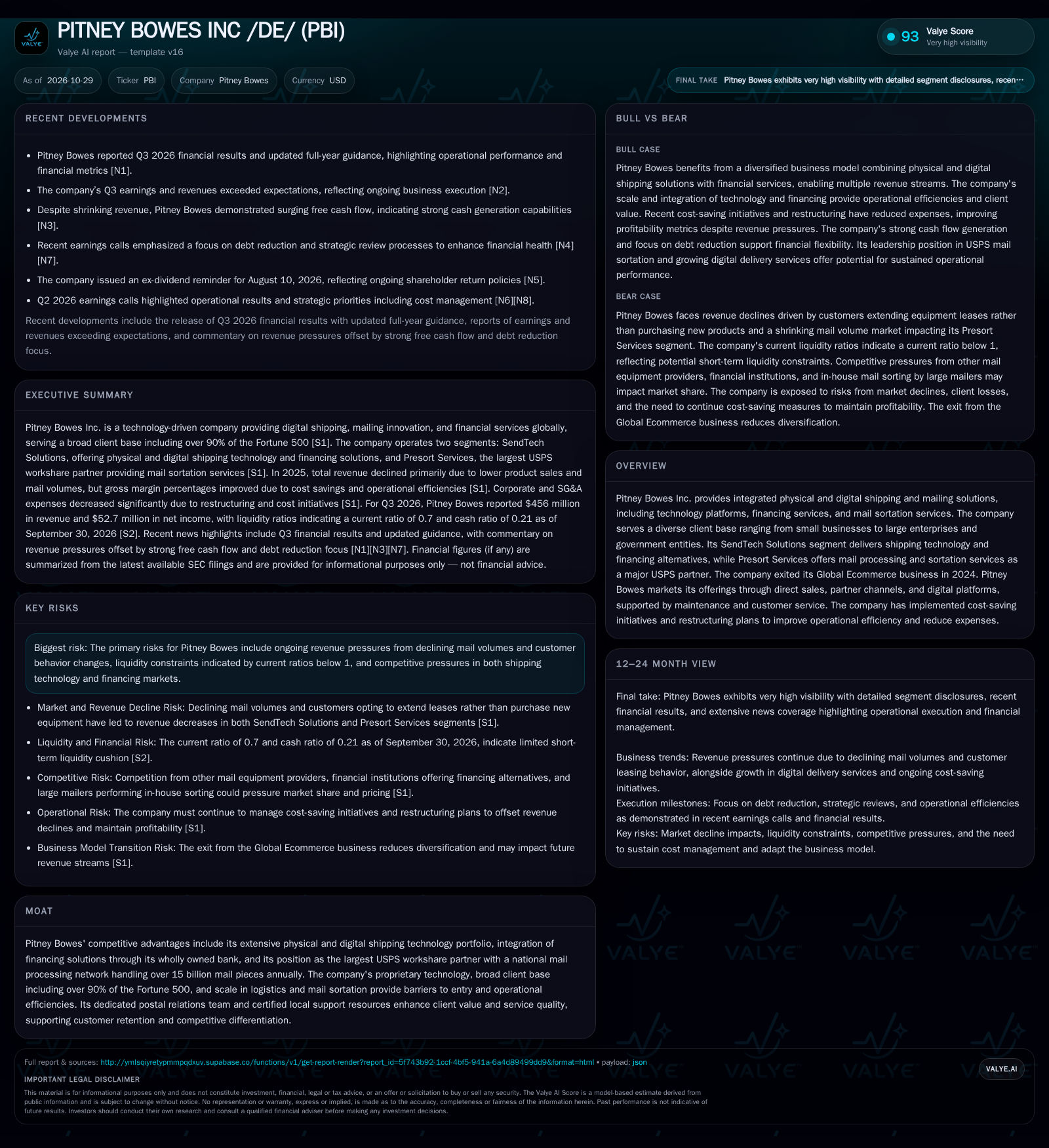
Pitney Bowes is navigating a shrinking mail market and customer reluctance to upgrade physical equipment by accelerating cost reductions and expanding digital shipping services. Despite revenue declines in both key segments, gross margin improvements and a surge in free cash flow have enabled continued profitability and a renewed debt reduction focus. However, liquidity ratios remain tight, highlighting the urgency for operational discipline and business model adaptation as the company pivots away from its exited ecommerce venture and faces entrenched competitive headwinds. [S1] [S2] [N3] [N4]
While recent quarters reveal successful cost-reduction efforts and a notable improvement in free cash flow—even in the face of falling revenue—the company’s reliance on its core mailing and shipping segments now looms larger after the wind-down of its Global Ecommerce business. The challenge ahead is to sustain operational gains, manage debt, and accelerate digital transformation, all while fending off competitive threats and maintaining service relevance for a shrinking, but still critical, client base.
Recent Financials Highlight Margin Improvement Amid Revenue Pressure
For Q3 2026, Pitney Bowes reported revenue of $456.2 million and net income of $52.7 million, translating to basic EPS of $0.39 and diluted EPS of $0.37. Despite these profits, both SendTech Solutions and Presort Services saw year-over-year revenue declines in 2025—7% and 4%, respectively—driven by customer lease extensions, a shrinking meter base, and a 7% drop in mail volumes. Nevertheless, gross margin percentages improved in both segments, attributed to successful cost-cutting and operational efficiencies. SG&A expenses fell by $96 million, and R&D spending by $17 million, reflecting headcount reductions and disciplined expense management. The company’s liquidity position is constrained, with a current ratio of 0.7 and a cash ratio of 0.21 as of September 30, 2026, underscoring the importance of continued cash generation and debt reduction. [S1] [S2] [N3] [N4]
Evolving Revenue Mix and the Economics of Mail, Shipping, and Financing
Pitney Bowes’ economic engine now depends on its SendTech Solutions and Presort Services segments following the exit from Global Ecommerce. SendTech’s revenue is pressured by customers opting to extend leases rather than invest in new hardware, leading to lower product sales and a declining meter population. However, growth in digital shipping subscriptions and delivery services provides a partial counterweight. These digital offerings, if they can be scaled, could offer higher-margin recurring revenue and lower servicing costs compared to legacy hardware.
Presort Services, as the largest USPS workshare partner, processes over 15 billion mail pieces annually, benefiting from scale and postal discounts. However, secular mail decline and client losses have eroded volumes, only partially offset by pricing actions. The segment’s economics rely on operational leverage: as volumes drop, fixed costs are spread over fewer units, threatening margin unless offset by cost reductions or pricing power.
The company’s wholly owned bank provides financing alternatives, likely supporting customer adoption and retention, but also introducing credit risk and capital requirements. Cost-saving initiatives have improved margins and cash flow, suggesting that further operational discipline and a pivot to digital solutions are central to future profitability. The need for capital investment is now primarily aimed at maintaining service quality and enabling digital transformation, rather than expanding physical infrastructure.
The interplay between fixed and variable costs within Pitney Bowes’ segments is critical to understanding margin sustainability amid volume declines. In Presort Services, significant fixed costs related to infrastructure and labor mean that volume reductions disproportionately pressure margins unless offset by efficiency gains or pricing power. Conversely, SendTech Solutions faces a dual challenge: declining hardware sales reduce upfront revenue, while digital shipping subscriptions, though recurring, require upfront investment in platform development and customer acquisition. The timing and scale of digital adoption thus directly influence the segment’s overall profitability profile, with early-stage investments potentially depressing near-term margins before realizing economies of scale.
Competitive Dynamics: Scale, Integration, and the Threat of Substitution
Pitney Bowes’ competitive moat is anchored by its integration of physical and digital shipping technology, proprietary financing solutions, and its unique scale as the largest USPS workshare partner. Its client roster, including over 90% of the Fortune 500, and a national mail processing network provide barriers to entry for smaller rivals. However, these advantages are increasingly tested by broader industry trends.
Competition arises from traditional mail equipment manufacturers, financial institutions offering alternative financing, and large mailers bringing sortation in-house. In digital shipping, software platforms and logistics tech startups are eroding differentiation, especially as mail volumes decline and digital delivery becomes table stakes. The exit from Global Ecommerce narrows product breadth, increasing vulnerability to substitution and customer churn if digital offerings do not achieve scale or demonstrate superior integration.
Switching costs in enterprise mailing and shipping can be moderate due to integration complexity and compliance requirements, but declining mail relevance and the rise of cloud-based alternatives may enable easier migration for some segments. The company’s continued investment in technology and support services is essential to sustain retention and pricing power.
If Digital Shipping Adoption Accelerates, Margin Expansion Could Offset Mail Decline
The most favorable scenario for Pitney Bowes is one in which its digital shipping and delivery solutions achieve rapid adoption, both among existing enterprise clients and new SMB customers. If digital subscriptions and API-driven delivery services can scale, the company could transition away from declining hardware and mail volumes, capturing higher-margin, recurring SaaS-like revenue. This transition would also reduce servicing costs and enable further SG&A leverage.
Confirmation of this scenario would require sustained growth in digital delivery revenue (if disclosed), rising subscription counts, and evidence of customer migration from legacy to digital platforms. Continued gross margin expansion and rising free cash flow would further validate the thesis. The company would also need to demonstrate retention of major clients and successful cross-sell of digital solutions into its core base.
Margin Management and Cash Generation Dominate in a Flat-to-Declining Market
The most plausible path forward sees Pitney Bowes managing persistent top-line declines through aggressive cost control, operational optimization, and selective digital growth. Revenue from SendTech Solutions and Presort Services continues to contract modestly as mail volumes erode and customers defer new hardware purchases, but efficiency gains and pricing actions help defend gross margins.
Confirmation of this scenario would include continued SG&A and R&D reductions, stable or improving margin percentages, and steady—if not growing—free cash flow.
Accelerated Mail Contraction and Liquidity Stress Could Force Restructuring
A negative scenario unfolds if mail volumes decline faster than anticipated, pricing actions fail to compensate, or key clients are lost to in-house processing or digital-first competitors. In this case, both revenue and gross margins would deteriorate, and cost-saving measures may prove insufficient to preserve profitability.
This scenario would be confirmed by sharper-than-expected declines in segment revenue, deteriorating margins despite cost initiatives, and negative free cash flow. Loss of major clients, higher churn, or failure to scale digital solutions would increase the risk of a downward spiral in both operational and financial terms.
Milestones and Metrics That Will Define Pitney Bowes’ Adaptation to Market Realities
Trends in digital shipping and delivery revenue (if disclosed), including subscription and API adoption rates, will be crucial in assessing the success of the company’s pivot to digital.
Year-over-year changes in mail volumes processed by Presort Services, and the impact of client wins/losses on volume and pricing power.
Gross margin percentages in both SendTech Solutions and Presort Services—continued improvement would indicate operational discipline, while erosion would signal pressure.
SG&A and R&D expense levels: further reductions or stabilization may be necessary to defend margins in a declining revenue environment.
Client retention and cross-sell rates for digital solutions (if disclosed), especially among the Fortune 500 and large enterprise base.
Competitive developments in digital shipping platforms and evidence of customer migration to alternative solutions.
Disclaimer: This is research-only, informational analysis and not investment advice. It may include AI-generated interpretation and general industry context. Always verify important details using primary sources.

Comments