
Indivior Pharmaceuticals: Profitability Inflection, Strategic Merger, and the Next Phase of Addiction Treatment Leadership
Indivior Pharmaceuticals, a leader in long-acting injectable treatments for opioid use disorder, has reached a new profitability milestone amid ongoing legal risks and a transformative merger with Supernus. With recent financial results showing strong earnings momentum and a special dividend declaration, the company stands at a strategic crossroads—balancing the promise of expanded scale against persistent liquidity and litigation headwinds.
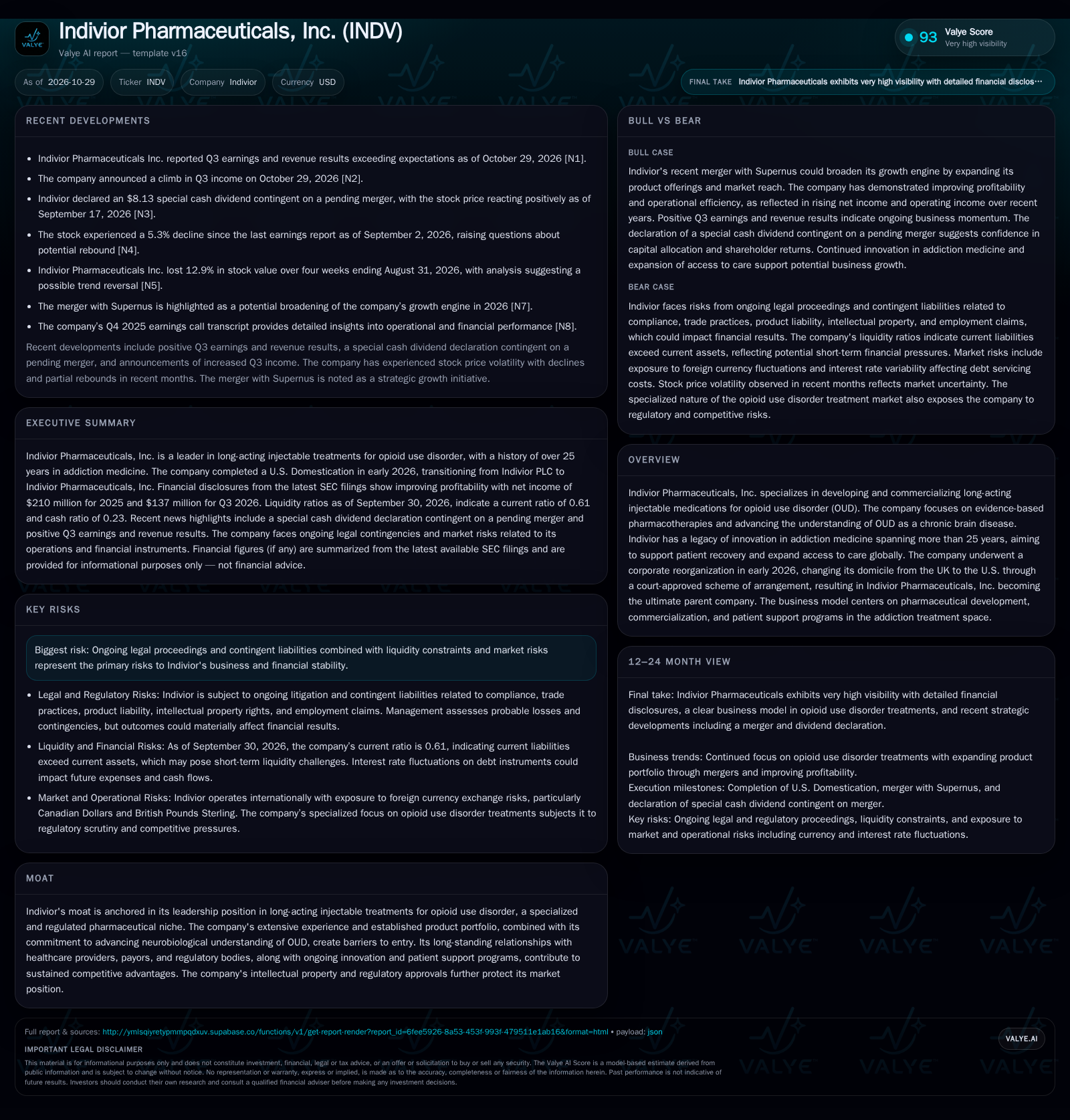
Indivior Pharmaceuticals reported sharply improved profitability in 2025 and Q3 2026, declared a significant special dividend contingent on a pending merger with Supernus, and remains the market leader in long-acting injectables for opioid use disorder. However, the company faces ongoing legal liabilities and a current ratio below 1, highlighting short-term financial pressures as it enters a transformative transaction.[S1] [S2] [N3] [N7]
Indivior Pharmaceuticals, renowned for its leadership in long-acting injectable therapies for opioid use disorder, has entered a pivotal phase defined by both financial resurgence and strategic transformation. The company’s net income and operating margins have rebounded dramatically, coinciding with the announcement of a merger with Supernus and a substantial special dividend. The next year will be critical as the company seeks to convert its operational gains and strategic moves into sustainable long-term value.
Recent Profitability Surge, Strategic Merger, and Special Dividend Reshape Indivior’s Outlook
Indivior reported net income of $210 million for 2025, a substantial increase from $7 million in 2024, and continued this momentum with $137 million in net income for Q3 2026. This sharp improvement follows a period of losses and signals a clear inflection in the company’s operating profitability.[S1] [S2] At the same time, the company declared an $8.13 per share special cash dividend, contingent on the completion of its pending merger with Supernus—a transaction expected to close in November 2026.[N3] [S2] The merger is positioned as a catalyst for broader product offerings and market expansion. [N7] [S2][S2] The company also continues to face legal proceedings and contingent liabilities that could impact future results.[S1] [S2]
How Indivior Generates Value: High-Margin Specialty Pharma, Operating Leverage, and Capital Needs
Indivior’s business model is built around the development and commercialization of long-acting injectable medications for opioid use disorder (OUD). In this niche, pricing tends to be robust due to the high clinical need, regulatory barriers, and payer willingness to reimburse for effective, evidence-based therapies. Unit economics in specialty pharmaceuticals are typically characterized by high gross margins, given the value of proprietary formulations and protected intellectual property. As volumes scale, fixed costs (R&D, regulatory, manufacturing infrastructure) can be leveraged, driving operating margin expansion—as reflected in the company’s move from operating losses in 2023 to $262 million in operating income in 2025.[S1]
Revenue growth from $1.093 billion in 2023 to $1.239 billion in 2025 suggests a combination of volume gains, possible price improvements, or favorable mix, though the specific drivers are not detailed.[S1] Cash generation and operating leverage are likely to remain sensitive to payer dynamics, competition, and the pace of new product launches. The special dividend and merger imply major capital allocation decisions and potential increases in debt or capital needs, especially given the sub-1.0 current ratio and the prospect of integration costs and transaction-related outflows.[S2] [N3]
Defending the Moat: Indivior’s Lead in OUD Treatments and Barriers to Disruption
Indivior’s competitive position is anchored in its established portfolio of long-acting injectable therapies for opioid use disorder, a market with high regulatory and clinical hurdles. The company’s 25-year legacy and relationships with prescribers, payors, and regulatory bodies create switching frictions and reinforce its brand credibility.[S1] Intellectual property and regulatory exclusivity provide further barriers to entry, while the specialized nature of addiction treatment limits the number of direct competitors capable of matching Indivior’s clinical data and delivery mechanisms.
Potential counterforces include the threat of generic entrants, evolving payer preferences, and the emergence of new pharmacological or digital therapies for addiction. Broader pharmaceutical players or biotech innovators could target OUD with alternative modalities, but the combination of regulatory complexity, entrenched provider relationships, and the need for robust real-world outcomes data make rapid displacement unlikely. The merger with Supernus may further strengthen Indivior’s position by diversifying its product base and extending its reach in neuropsychiatric and addiction indications.[N7]
Merger Synergies and Portfolio Expansion Drive Sustainable Earnings Growth
The most favorable scenario for Indivior is that the merger with Supernus closes smoothly, unlocking revenue and cost synergies, expanding the combined product portfolio, and accelerating growth in both OUD and adjacent neuropsychiatric markets. Successful integration would enable cross-selling, broader market access, and greater negotiating leverage with payors. Operating leverage could further improve as fixed costs are spread across a larger revenue base, while the combined R&D pipeline may yield new differentiated therapies.
Confirmation of this scenario would come from post-merger revenue and earnings accretion, improved operating margins, and evidence of new product launches or expanded market share in core OUD and neuropsychiatric segments. Early signs of successful integration—such as stable or rising prescription volumes, retention of key commercial talent, and realization of cost synergies—would support the bull case. Conversely, delays in integration, loss of key customers, or failure to launch new products would challenge this thesis.
Incremental Growth, Legal and Liquidity Pressures Persist as Indivior Transitions
The most plausible scenario is that Indivior delivers moderate organic growth in its core OUD portfolio, while the Supernus merger brings incremental rather than transformative gains over the next 12-24 months. Integration may proceed without major disruption, but synergy realization could be gradual.
Base-case confirmation would include stable to modestly rising revenues, sustained profitability, and gradual improvement in liquidity metrics. However, persistent legal expenses, integration costs, or adverse litigation outcomes could offset operating gains. Any slippage in prescription trends or payer pushback on pricing would also pressure margins. The scenario would be falsified if the company experiences a sharp deterioration in cash generation, adverse legal judgements, or failure to execute on integration milestones.
Legal Liabilities and Liquidity Constraints Derail Strategic Execution
The most adverse scenario is that Indivior’s legal and contingent liabilities crystallize, resulting in substantial cash outflows, regulatory fines, or settlement costs. Combined with a current ratio of 0.61 and reported cash balance, such events could force asset sales, emergency financing, or curtailment of R&D and commercial investments.[S2] If integration with Supernus is delayed or fails to deliver expected synergies, operating margins could contract and the company’s competitive position could erode.
Downside confirmation would include a material adverse legal judgement, covenant breaches, forced asset divestitures, or a negative spiral in prescription volumes. A spike in working capital needs or inability to refinance/roll over near-term debt would further stress the business. The scenario would be challenged if the company demonstrates resilience in the face of legal headwinds, rapidly restores its liquidity position, or secures favorable settlements.
What Will Determine Indivior’s Ability to Convert Momentum Into Durable Value?
Progress on closing and integrating the Supernus merger, including the timing of cost and revenue synergy realization.
Quarterly prescription trends, new patient initiations, and market share data in core OUD products—if disclosed.
Changes in legal and contingent liabilities, including updates on major litigation or settlements and associated cash impacts.
Operating cash flow generation and the evolution of the current ratio or other liquidity metrics in post-merger quarters.
Payer reimbursement rates, formulary access, and pricing trends for Indivior’s long-acting injectables.
Evidence of successful new product launches or label expansions in OUD or adjacent neuropsychiatric indications.
Retention of key commercial, regulatory, and R&D personnel following the merger.
Any strategic asset sales, capital raises, or material changes in capital allocation policy.
Disclaimer: This is research-only, informational analysis and not investment advice. It may include AI-generated interpretation and general industry context. Always verify important details using primary sources.

Comments