
EPR Properties: Experiential Real Estate, Financial Leverage, and Discretionary Demand Dynamics
EPR Properties posts strong Q3 2026 results and raises guidance as consumer-driven experiential assets rebound, but tenant credit health, debt constraints, and macro volatility remain central levers for future performance.
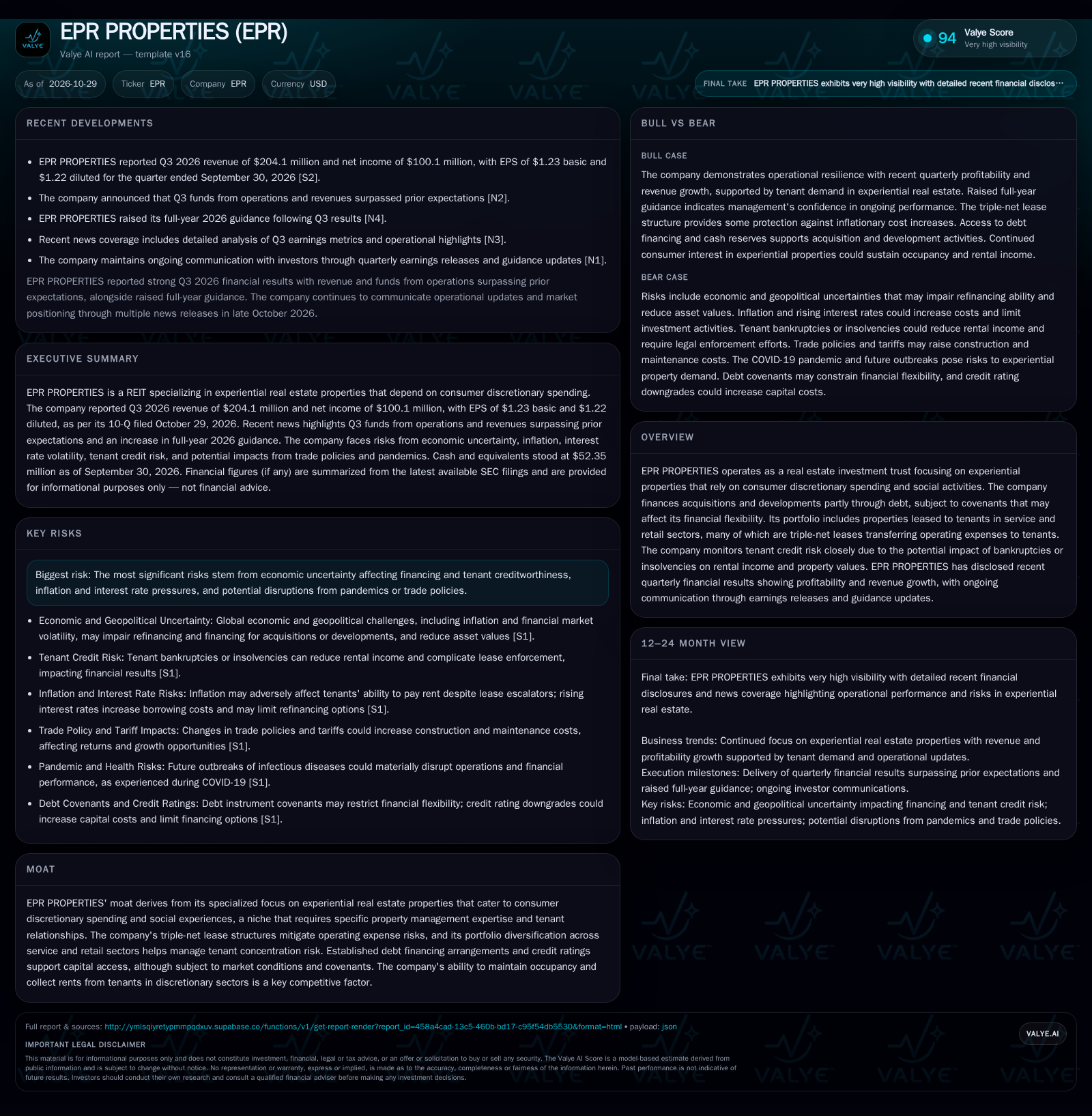
EPR Properties delivered Q3 2026 revenue and net income above expectations and raised full-year guidance, signaling a near-term rebound in experiential real estate demand. However, the company's reliance on debt financing, tenant credit exposure, and sensitivity to macroeconomic shifts—including inflation, rates, and discretionary spending cycles—define both its upside and risk profile. The durability of recent outperformance hinges on sustained consumer appetite for experiences, tenant solvency, and EPR's ability to navigate refinancing and capital allocation challenges in a volatile environment. [S2] [N2] [N4]
EPR Properties, a REIT focused on experiential real estate, has emerged from the pandemic-era downturn with a robust Q3 2026 performance—reporting revenue and net income above expectations and raising its full-year outlook. This rebound highlights renewed consumer demand for in-person experiences, but the company’s business model remains tightly linked to discretionary spending cycles, tenant financial health, and the cost of capital. As inflation, interest rates, and economic uncertainty linger, EPR’s ability to balance growth ambitions with risk management will shape its trajectory in a sector highly sensitive to both macro and micro disruptions.
Recent Results Highlight Rebound in Experiential Real Estate
EPR Properties reported Q3 2026 revenue of $204.1 million and net income of $100.1 million, with earnings per share of $1.23 basic and $1.22 diluted. These results surpassed market estimates for both funds from operations (FFO) and revenue, prompting the company to raise its full-year 2026 guidance. [S2] [N2] [N4]
This outperformance is significant as it suggests a strong recovery in the company’s core experiential real estate portfolio, which is heavily reliant on discretionary consumer spending and activity-based tenants. The company’s cash balance stood at $52.35 million as of September 30, 2026. [S2]
However, EPR continues to rely on debt financing for acquisitions and development, and its potential financial flexibility is subject to covenants and market conditions. Management highlights ongoing risks from inflation, interest rate volatility, and tenant credit issues, all of which could affect future results. [S1]
Earnings Quality Influenced by Triple-Net Leases and Consumer Spending Patterns
EPR’s economics are built around a specialized portfolio of experiential properties—such as theaters, entertainment venues, and other leisure assets—that generate rent from operators in consumer-driven sectors. The company typically uses triple-net lease structures, shifting property-level operating expenses (taxes, insurance, maintenance) to tenants. This model can produce stable, inflation-protected base rents and lower direct operating leverage, but it also heightens dependence on tenant solvency and sector health.
Revenue growth may be driven by occupancy, contractual rent escalators, and selective acquisition or development of new properties. However, since experiential properties are highly sensitive to consumer discretionary cycles, downturns can lead to abrupt declines in rent coverage or even tenant defaults—a risk realized during the pandemic and cited as a continuing concern by management. [S1]
On the capital side, EPR funds much of its growth with debt. While leverage can enhance returns in expansionary periods, it exposes the company to refinancing and interest rate risk, especially as covenants may restrict flexibility if market conditions deteriorate. Capital needs for new developments or opportunistic acquisitions must be balanced against liquidity and covenant headroom, particularly given relatively reported cash balance relative to the size of the portfolio. [S1] [S2]
Specialization Offers Edge Amid Macro and Substitute Market Pressures
EPR’s niche focus on experiential real estate differentiates it from generalist REITs and provides tenant and asset expertise that could deter new entrants. Relationships with operators in entertainment and leisure segments may also support sourcing and underwriting advantages.
However, competitive threats come from several directions: other specialized REITs targeting similar assets, private capital seeking yield in real assets, and broader shifts in consumer behavior (such as digital alternatives to in-person experiences). If discretionary spending weakens or if alternative entertainment formats gain share, demand for EPR’s properties could fall.
Moreover, EPR’s reliance on a relatively concentrated group of tenants—often in sectors prone to bankruptcy risk—means that tenant failures or sector-specific shocks can have outsized impact. The triple-net lease model’s risk transfer is only as strong as the tenant’s balance sheet; in periods of stress, lease enforcement can become costly and uncertain. [S1]
Cash Flow Growth Tied to Consumer Demand and Tenant Stability
In the most favorable scenario, robust consumer appetite for experiences sustains high occupancy and rent collections across EPR’s portfolio, while tenants maintain strong financial health. This environment could support consistent rent escalators, minimal credit losses, and opportunistic acquisitions or developments funded by manageable debt levels.
Upside could be further amplified if inflation-driven rent escalators outpace increases in operating or financing costs, and if refinancing occurs at attractive rates. The triple-net lease structure could buffer EPR from most property-level cost pressures, allowing incremental revenue to flow through to FFO and supporting dividend growth.
Evidence of this scenario would include multiple quarters of above-consensus FFO, stable or rising occupancy rates, improving tenant credit metrics, and successful execution of new acquisitions or developments without covenant strain. A broad-based rebound in leisure and entertainment spending would further reinforce the thesis.
Prudent Capital Allocation and Lease Management Address Market Volatility
The most plausible outcome is one of moderate growth punctuated by ongoing volatility. EPR continues to benefit from renewed consumer interest in experiential activities, but faces intermittent tenant stress as certain operators struggle with inflation and shifting demand patterns.
Revenue and FFO growth may be driven by contractual rent increases and selective property investments, but offset by occasional tenant defaults or lease restructures. Debt refinancing remains available, albeit at higher average costs, which compresses incremental returns on new investments.
Confirmation of this scenario would be steady, but not accelerating, FFO growth, stable dividend coverage, periodic but contained credit losses, and no material breaches of debt covenants. Any divergence from these trends—such as a spike in tenant bankruptcies or a sharp increase in borrowing costs—would push EPR toward the downside case.
Returns Face Pressure from Tenant Stress and Capital Limitations
In a negative scenario, macroeconomic headwinds—such as a consumer recession, persistent inflation, or renewed health-related restrictions—erode discretionary spending and weaken tenant financial health. This could trigger a wave of tenant bankruptcies, missed rent payments, and costly lease enforcement actions, directly reducing cash flow.
Simultaneously, tighter credit markets or a downgrade in EPR’s credit ratings could limit access to affordable refinancing, forcing asset sales or curtailment of growth initiatives. Rising construction and maintenance costs, driven by tariffs or supply chain issues, would further compress returns on any new investments.
This outcome would be confirmed by a sharp decline in occupancy rates, escalating credit losses, breaches or near-breaches of debt covenants, and negative FFO trends. News of major tenant insolvencies or sector-wide retrenchment in experiential real estate would further validate the downside thesis.
Factors Shaping EPR’s Path in Experiential Real Estate
Quarterly same-property occupancy and rent collection rates, to assess the resilience of tenant demand and portfolio cash flow.
FFO per share growth and dividend coverage, as indicators of distributable earnings strength and capital allocation discipline.
Tenant concentration levels and credit quality, especially any material exposures to financially unstable operators or sectors.
Debt maturity schedule and average cost of debt, to gauge refinancing risk and the impact of interest rate movements.
Incidence of tenant bankruptcies or lease restructures, which would signal rising credit stress or sector-specific weakness.
Volume and terms of new acquisitions or developments, indicating management’s confidence and access to capital.
Changes in lease escalator provisions or inflation pass-through mechanics, if disclosed, to evaluate inflation protection.
Disclaimer: This is research-only, informational analysis and not investment advice. It may include AI-generated interpretation and general industry context. Always verify important details using primary sources.

Comments