
NewMarket Corporation: Specialty Additives, Margin Resilience, and the Levers of Chemical Profitability
With strong Q3 2026 earnings, consistent dividends, and a diversified additives portfolio, NewMarket stands at the intersection of chemical market cycles, commodity risk, and regulatory flux. The company’s next phase will hinge on margin management, operating leverage, and the ability to offset input volatility while preserving customer relationships in a tightening specialty chemicals landscape.
Its business spans petroleum, lubricant, and fuel additives plus specialty materials, but faces commodity price and regulatory headwinds. The thesis now pivots on the company’s ability to balance margin protection with capital discipline as chemical cycles evolve. [S2]
NewMarket Corporation’s latest results reinforce its status as a specialty chemical additive leader with solid profitability and a diversified segment mix. The story is less about momentum and more about resilience and adaptation in a specialized, cyclical market. [S2]
Solid Q3 Earnings and Dividend Continuity Anchor NewMarket’s Current Position
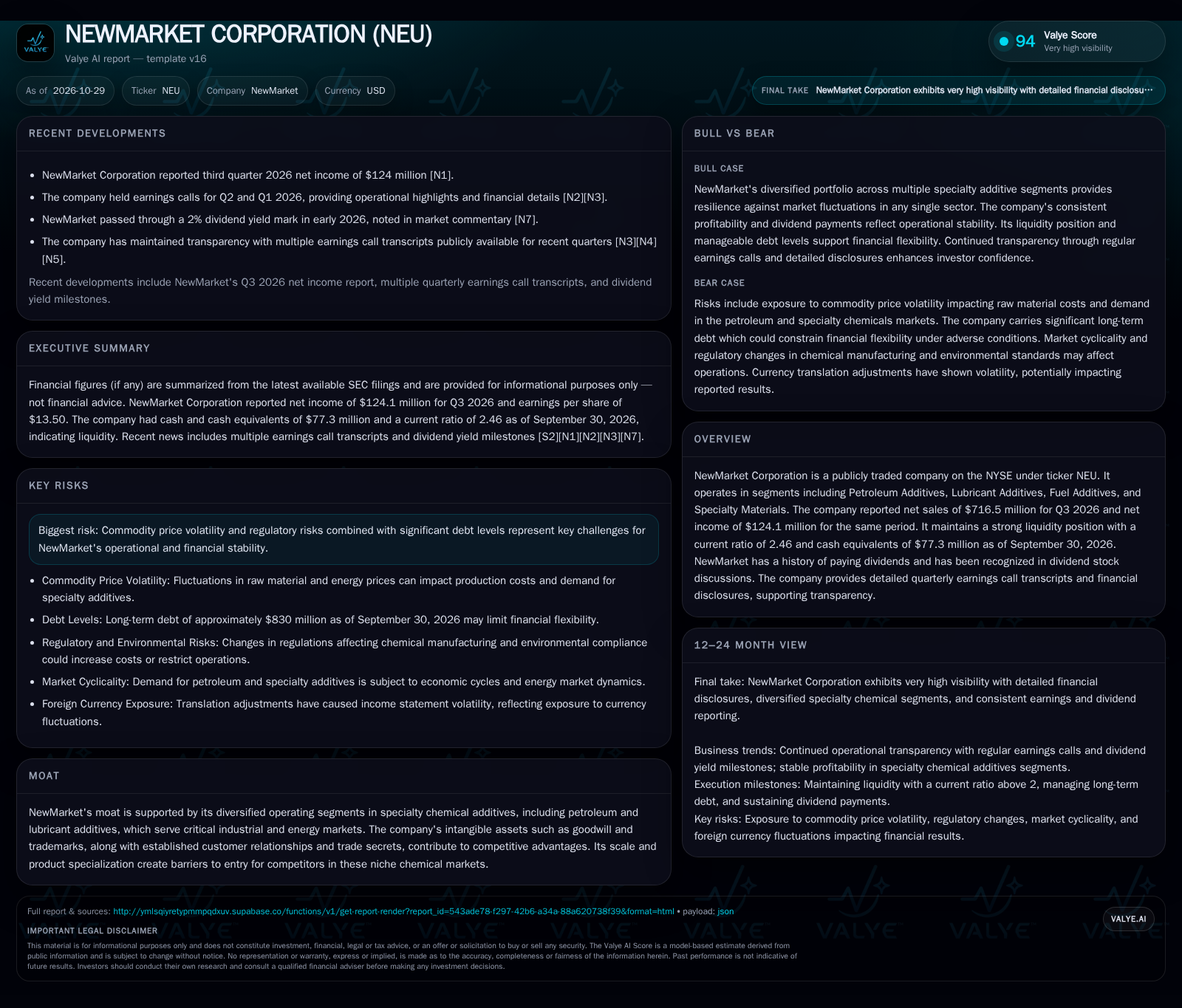
NewMarket reported $716.5 million in net sales and $124.1 million in net income for Q3 2026, translating to basic and diluted earnings per share of $13.50. For the nine-month period ended September 30, 2026, net sales reached $2.13 billion, with net income at $375.9 million. [S2] These figures underscore a sustained level of profitability and suggest that the company’s core additive segments—petroleum, lubricant, and fuel additives—continue to generate robust cash flow.
The company reported cash and liquidity metrics for the period; these figures do not by themselves establish operating runway, investment capacity, financial flexibility, or financing capacity. However, a cash ratio of 0.16 and long-term debt of $830.1 million introduce leverage and liquidity nuance, particularly in a cyclical sector. [S2]
The company’s segment structure and disclosure transparency, including regular earnings call transcripts, provide visibility into both operations and risk exposures. [S2] [N1] [N2] [N3]
Additives Margin Dynamics: Pricing Power and Input Cost Tensions
NewMarket’s business model is built around the formulation and sale of specialty chemical additives—primarily for petroleum, lubricants, and fuels—where gross margins are typically higher than in commodity chemicals due to product complexity, technical requirements, and customer integration. Pricing in these segments is often negotiated on a contract basis, with some ability to pass through input cost increases, but not always on a one-to-one basis or with perfect timing.
The company’s revenue mix likely skews toward higher-value, lower-volume specialty formulations, but its cost base remains exposed to swings in petroleum-derived raw materials and energy. This creates a margin management challenge: while the company can adjust prices, sharp input cost volatility or demand shocks can compress margins before pricing actions take effect.
Operating leverage is a double-edged sword: high fixed costs tied to R&D, production infrastructure, and regulatory compliance mean that incremental volume gains can drive outsized profit improvement in upcycles, but magnify downside in demand contractions. Capital needs are moderate for specialty chemicals relative to basic chemicals, but ongoing investment in product innovation, regulatory compliance, and process optimization is required to maintain competitive relevance and margin profile.
The timing and structure of contractual price adjustments play a critical role in NewMarket's margin resilience. In environments where input costs fluctuate rapidly, the lag between cost increases and price pass-through can create temporary margin pressure. The company's ability to negotiate shorter contract durations or incorporate escalation clauses tied to raw material indices could mitigate this risk. Additionally, strategic procurement practices, such as forward purchasing or supplier diversification, may help smooth input cost volatility. However, these approaches entail trade-offs, including potential inventory carrying costs or supplier relationship complexities, which must be balanced against margin objectives.
Defensible Niche, But Not Immune: Competitive Dynamics in Specialty Additives
NewMarket’s positioning in specialty additives confers advantages not easily replicated by new entrants: technical expertise, customer relationships, proprietary formulations, and regulatory know-how create meaningful barriers to entry. The company’s intangible assets, including $910 million in goodwill, likely reflect acquired capabilities, brand, and embedded customer value. [S2]
However, competition remains vigorous among established specialty chemical players—especially multinationals with overlapping product lines, global reach, and the ability to compete on both price and service. Substitution risk, while lower than in bulk chemicals, is not negligible: customers can reformulate or switch suppliers if price, performance, or regulatory factors change materially.
Technology substitution—such as increased adoption of alternative fuels, electrification reducing demand for fuel additives, or regulatory shifts favoring new chemistries—could gradually erode certain product lines. The company’s ability to innovate and adapt its portfolio will determine whether it can maintain or extend its competitive moat.
The evolving regulatory environment not only shapes product demand but also acts as a catalyst for innovation-driven competition. Competitors investing aggressively in sustainable and environmentally friendly additive technologies may erode NewMarket's market share if the company does not keep pace. Intellectual property protection and speed to market become critical factors in maintaining a competitive edge. Furthermore, collaboration with customers on co-development initiatives can deepen relationships and could increase switching costs, enhancing customer retention. However, such partnerships require alignment of strategic priorities and can increase operational complexity, which must be managed carefully.
If Input Volatility Is Managed, Margin Expansion Could Drive a Step-Change in Earnings
The most favorable scenario for NewMarket hinges on its ability to pass through input cost increases, leverage its specialty product mix, and capture incremental volume growth as industrial and energy markets recover or stabilize. If the company successfully manages commodity price swings—either through hedging, procurement strategy, or contractual pass-throughs—gross margins could expand, translating to higher operating income and supporting further dividend growth.
Confirmation of this thesis would come from expanding EBITDA margins, sequential improvement in gross profit per segment, and management commentary indicating successful cost recovery.
Falsification would occur if input costs rise sharply but are not recouped in pricing, or if volume gains fail to materialize despite favorable macro conditions.
Margin Pressures Offset by Diversification: What Steady-State Looks Like
The most plausible near-term outcome is for NewMarket to maintain its current profitability profile, with modest margin compression offset by portfolio diversification and incremental pricing actions. In this scenario, the company absorbs some input cost increases and regulatory expenses, but its specialty focus, customer relationships, and operational discipline prevent a major earnings deterioration.
The company continues to invest in R&D and compliance, maintaining relevance in its core segments but not achieving breakout growth.
This scenario would be confirmed by stable or slightly declining margins, continued transparency in quarterly disclosures, and a lack of major segmental revenue or profit swings. Falsification would occur if regulatory costs or commodity volatility overwhelm the company’s ability to offset them through pricing or mix.
Prolonged Input Inflation or Regulatory Shock Could Squeeze Cash Flow and Payouts
A less favorable scenario would see sustained commodity price inflation, regulatory tightening, or demand contraction outpace NewMarket’s ability to adjust pricing or optimize costs.
If leverage ratios deteriorate or refinancing becomes more expensive, the company could face pressure on its credit profile, further constraining flexibility. Segmental exposure to legacy petroleum and fuel additives could amplify risk if energy transition trends accelerate or if regulatory changes disproportionately affect these categories.
Evidence for this scenario would include a sharp decline in gross margins, negative free cash flow, dividend cuts, or adverse changes in debt covenants or credit ratings. Conversely, resilience in margins or stable payouts would falsify the downside case.
What Will Determine NewMarket’s Margin Resilience and Capital Discipline?
Quarterly gross and operating margin trends by segment—if disclosed—will reveal whether input cost inflation is being offset by pricing or mix.
Net debt to EBITDA and interest coverage ratios, as ongoing debt service costs could become constraining if cash flow weakens.
Volume and revenue growth in lubricant and specialty materials segments, as these may be less exposed to energy transition risk than petroleum additives.
Management commentary on regulatory compliance costs and strategic responses to environmental policy changes.
R&D spending trends and new product launches, which would indicate commitment to innovation and portfolio refresh.
Evidence of customer churn, contract renegotiations, or margin concessions in earnings call transcripts or segment disclosures.
Foreign currency impacts on reported results, particularly if volatility increases and is not hedged.
Disclaimer: This is research-only, informational analysis and not investment advice. It may include AI-generated interpretation and general industry context. Always verify important details using primary sources.

Comments