
Marcus Corp’s Theater Economics: Navigating Liquidity Constraints and Competitive Reinvention
Despite a profitable Q3 2026, Marcus Corp faces a liquidity squeeze and intensifying competition from both traditional theater peers and alternative entertainment. The company’s future hinges on its ability to drive higher per-visit revenue and loyalty, while managing short-term financial pressure and adapting to evolving consumer preferences.
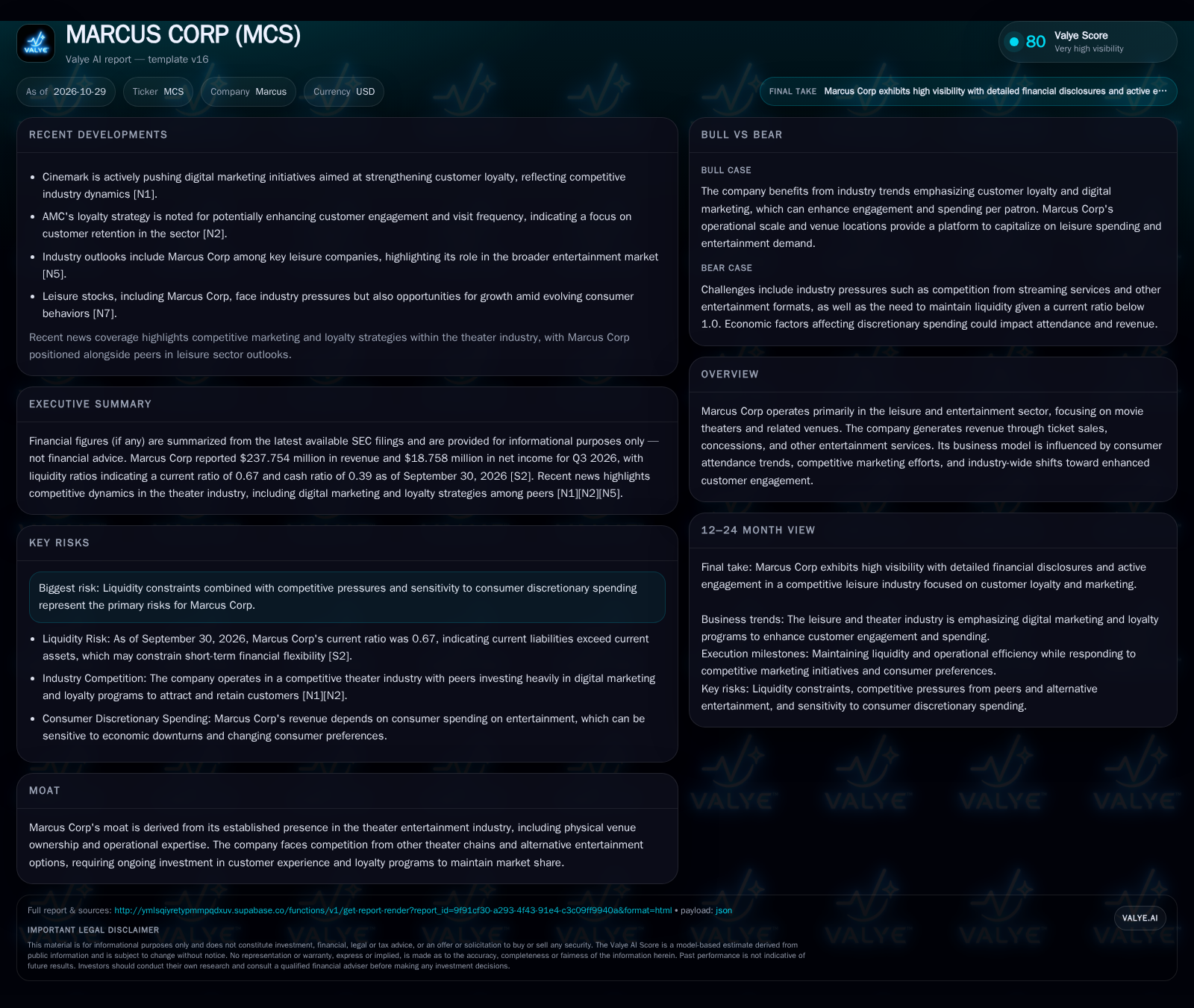
Marcus Corp posted $237.8M in Q3 2026 revenue and $18.8M net income, but a current ratio of 0.67 highlights liquidity pressure. With theater attendance and spending shaped by digital loyalty strategies and competition from streaming, the company’s economics depend on maximizing venue utilization, upselling, and differentiating the customer experience. Execution on loyalty and operational efficiency will be central to Marcus’s ability to manage risk and seize upside.
Marcus Corp stands at a crossroads, posting solid profitability in Q3 2026 but entering a period of heightened liquidity pressure and competitive reinvention. As theater chains double down on digital loyalty and customer experience to combat streaming and shifting leisure habits, Marcus must balance operational efficiency with the need for strategic investment. The company’s ability to drive higher per-visit revenue and adapt to evolving consumer tastes will determine whether it can weather industry headwinds or find itself squeezed by both financial and competitive constraints.
Earnings Strength Meets Liquidity Headwinds
Marcus Corp reported $237.754 million in revenue and $18.758 million in net income for the quarter ended September 30, 2026, reflecting continued profitability in a challenging environment [S2]. However, the company’s balance sheet tells a more cautious story: current assets of $104.192 million versus current liabilities of $156.127 million result in a current ratio of 0.67, and a cash ratio of just 0.39 as of the same date [S2]. This mismatch between short-term assets and obligations highlights a potential vulnerability to shocks or seasonal swings in cash flow. With no material changes to risk factors disclosed, the focus remains on liquidity management and competitive response in a sector where peers are ramping up digital engagement and loyalty strategies [S2].
How Marcus Corp’s Revenue Model Faces Fixed-Cost Pressure
Marcus Corp’s core economics are grounded in the traditional theater model: high fixed costs for venue ownership or leases, staffing, and film exhibition rights, with variable costs tied to concessions and event-driven promotions. Revenue is a function of ticket sales, concessions, and ancillary services—each highly sensitive to both attendance volume and per-visit spending. Operating leverage is significant: incremental increases in attendance or per-patron spend can disproportionately boost margins once fixed costs are covered, but the reverse is also true during downturns.
The capital intensity of theaters means that liquidity shortfalls can quickly constrain flexibility, especially when current liabilities outweigh liquid assets. This creates a scenario in which Marcus must optimize pricing, upsell concessions, and experiment with premium formats or events to maximize revenue per square foot. The economics further hinge on the company’s ability to sustain or grow attendance in the face of streaming substitution and alternative leisure options—a challenge that may require ongoing investment in customer experience, marketing, and technology. If Marcus can successfully drive loyalty and higher per-visit spend, it could partially offset the structural risk of flat or declining attendance.
Competitive Dynamics: Loyalty, Digital Engagement, and Substitution Risk
Theater industry competition is intensifying, with leading chains such as AMC and Cinemark deploying digital marketing and loyalty programs to deepen customer engagement and increase repeat visits. These initiatives are designed to counteract the pull of streaming platforms and other entertainment alternatives, which offer convenience and a growing slate of exclusive content. Marcus’s moat derives from its established venue footprint and operational expertise, but these traditional strengths are increasingly under pressure as consumer expectations shift toward personalized experiences, value-added perks, and seamless digital interaction.
In this environment, Marcus’s ability to differentiate itself may depend on the effectiveness of its own loyalty initiatives, partnerships with studios or content providers, and the integration of technology to enhance the on-site experience. The risk is that without matching or exceeding peer investments in customer retention, Marcus could lose share to more digitally nimble competitors or see further erosion from out-of-home entertainment substitutes.
Unlocking Value Through Enhanced Customer Engagement and Per-Visit Economics
A constructive scenario for Marcus Corp hinges on the company’s ability to leverage its venue network and operational base to drive deeper customer engagement. If Marcus can match or exceed peer investments in digital loyalty, personalized marketing, and premium in-theater experiences, it could boost both attendance frequency and per-visit spending. Success would be confirmed by sustained or growing top-line revenue despite broader industry stagnation, expansion in loyalty program membership and usage (if disclosed), and improving operating margins as fixed costs are leveraged across higher traffic.
Further upside could come from creative partnerships with content providers, exclusive events, or alternative content (e.g., live sports, gaming) that diversify revenue streams and increase utilization. Evidence supporting this scenario would include a positive inflection in per-patron spend, rising membership in loyalty programs, and expanded gross margin as a result of higher concession or premium ticket sales. Conversely, a failure to deliver on these fronts—or signs that digital engagement initiatives are lagging peers—would falsify the thesis.
Stability Through Incremental Efficiency and Industry Tailwinds
The most plausible near-term scenario for Marcus Corp is a gradual adaptation to industry trends, with modest gains in per-visit economics offsetting flat or modestly declining attendance. The company may achieve incremental improvements in operational efficiency, such as optimizing staffing, renegotiating supplier contracts, or fine-tuning show schedules to maximize utilization. If Marcus can maintain profitability and service its obligations without major asset sales or dilutive financing, this would validate a base case of cautious stability.
Supporting evidence would include stable or slightly growing quarterly revenue, consistent net income, and no material deterioration in liquidity ratios. A key test will be the company’s ability to preserve or modestly grow its share of the local leisure market even as broader consumer discretionary spending fluctuates. If Marcus is forced to take on high-cost debt, divest assets, or report sustained declines in attendance and revenue, this scenario would be challenged.
Liquidity Squeeze and Competitive Displacement
The principal risk for Marcus Corp is that liquidity constraints—reflected in its sub-1.0 current ratio—combine with competitive and macroeconomic pressures to create a negative spiral.
This adverse scenario would be confirmed by material deterioration in cash or current assets, missed debt payments or covenant breaches (if disclosed), and forced asset sales or expensive borrowing to bridge short-term gaps. Further evidence would include declining revenue, negative net income, and loss of market share to more digitally advanced or capitalized competitors. Any signs that Marcus is unable to maintain or grow customer engagement—such as falling loyalty program participation or lower per-visit spending—would reinforce the downside risk.
Evidence That Will Clarify Marcus Corp’s Competitive and Financial Trajectory
Quarterly revenue and net income trends, as reported in SEC filings, will indicate whether the company is maintaining or growing its top line and profitability in the face of industry pressures.
Attendance figures and per-patron spending (if disclosed) would provide insight into the effectiveness of marketing, loyalty, and upselling initiatives.
Growth in loyalty program membership and engagement, if reported, would help test whether Marcus is keeping pace with peers’ digital strategies.
Any announcements regarding new content partnerships, exclusive events, or alternative programming could indicate efforts to diversify and boost venue utilization.
Disclosure of capital expenditures or operational investments will reveal whether Marcus is prioritizing innovation or forced into retrenchment.
Evidence of debt restructuring, asset sales, or new financing would signal either proactive management or mounting financial stress.
Disclaimer: This is research-only, informational analysis and not investment advice. It may include AI-generated interpretation and general industry context. Always verify important details using primary sources.

Comments