
UMB Financial’s Acquisition Playbook: Integration, Margin Expansion, and the Challenge of Regional Scale
UMB Financial’s aggressive acquisition strategy—most recently with Heartland Financial and El Dorado Savings Bank—has transformed its balance sheet and regional footprint. The company’s ability to translate these deals into durable operating leverage, defend margins amid rate cycles, and manage integration risk will define its next phase.
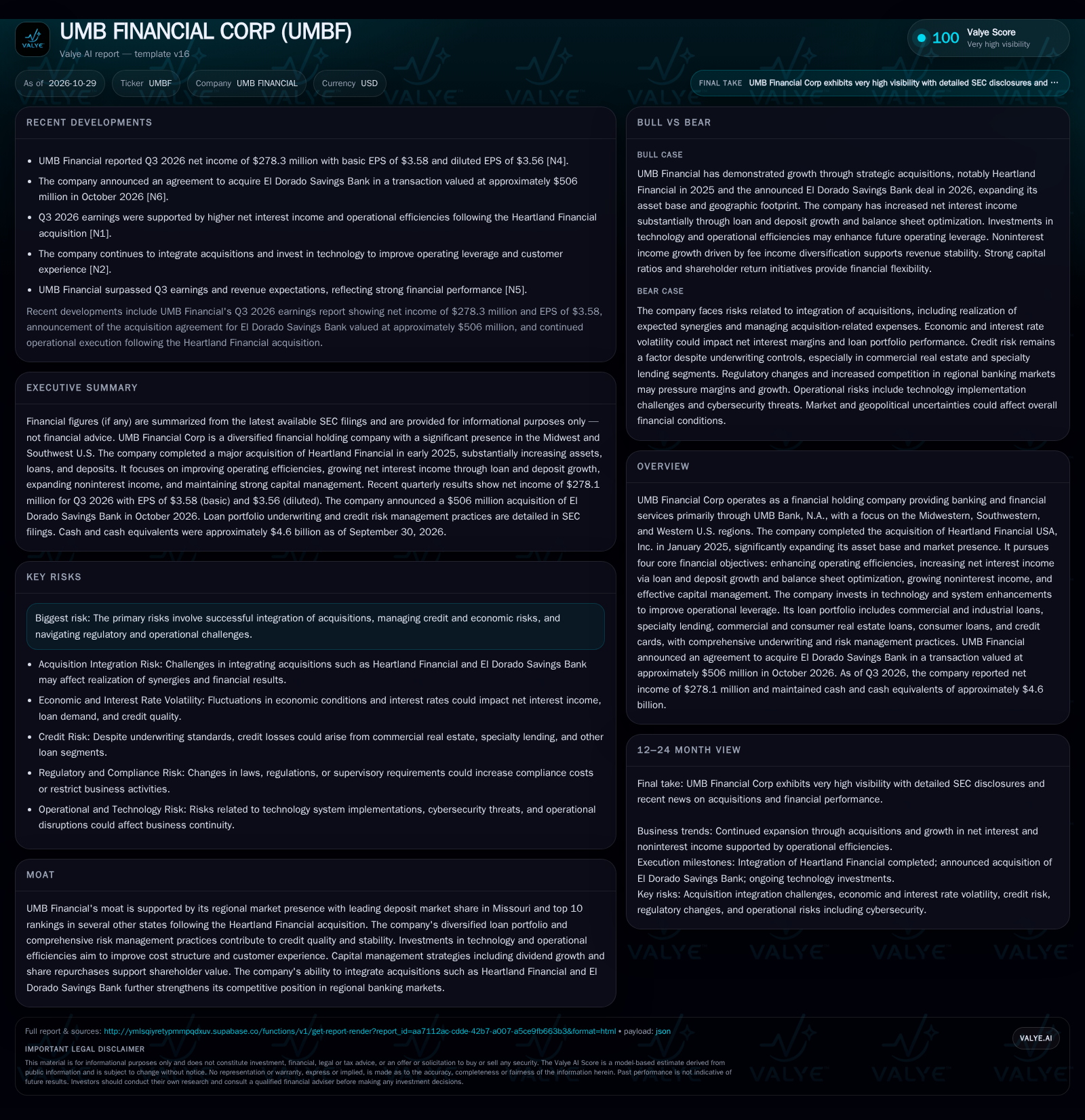
UMB Financial has rapidly expanded its scale and regional presence through large acquisitions, including Heartland Financial in 2025 and the pending El Dorado Savings Bank deal. The company’s 2026 results show substantial gains in net interest income and capital, but future value hinges on achieving operating efficiencies, sustaining margin improvements, and managing integration complexity in a competitive regional banking landscape. Watch for evidence of cost takeout, noninterest income growth, and credit performance as leading indicators of durable returns. [S1] [S2] [N6]
UMB Financial Corp has rapidly transformed its operating scale and geographic reach, fueled by the 2025 acquisition of Heartland Financial and the pending purchase of El Dorado Savings Bank. The company’s financials now reflect a much larger asset base, higher net interest income, and a broader deposit franchise across the Midwest and Southwest. However, the real test for UMB is whether it can translate these headline-grabbing deals into sustained profitability by extracting cost and revenue synergies, defending margins, and managing credit risk as it navigates a more complex organization and a competitive regional banking landscape. [S1] [S2] [N6]
A Rapidly Expanding Balance Sheet and Regional Footprint
UMB Financial’s acquisition of Heartland Financial in January 2025 added $16.1 billion in assets, $9.7 billion in loans, and $14.3 billion in deposits, establishing leading market share in Missouri and top-10 rankings in Colorado, New Mexico, Kansas, and Arizona. This deal nearly doubled the company’s capital base, with shareholders’ equity rising 122% year-over-year to $7.7 billion at the end of 2025. [S1]
Net interest income surged 86.1% in 2025, primarily due to the Heartland acquisition, mix changes, and purchase accounting accretion, while average earning assets climbed 49%. The net interest margin increased by 59 basis points to 3.10%. [S1]
In October 2026, UMB announced an agreement to acquire El Dorado Savings Bank for $506 million, continuing its strategy of regional expansion through targeted acquisitions. [N6]
The company reported cash and liquidity metrics for the period; these figures do not by themselves establish operating runway, investment capacity, financial flexibility, or financing capacity. [S2]
How Scale, Mix, and Efficiency Shape Bank Profitability
UMB’s profitability is fundamentally driven by its net interest spread—the difference between yield on earning assets and cost of deposits and funding. The Heartland acquisition sharply increased both sides of the balance sheet, offering scale benefits but also integration complexity. With a net interest margin of 3.10% in 2025, the company benefitted from favorable repricing and accretion income, though these sources can be transitory as portfolios mature. [S1]
Noninterest income, which rose nearly 26% in 2025, provides important diversification and comes from trust, deposit, and bankcard fees. The sustainability of these revenues depends on successfully retaining acquired customers, cross-selling, and defending against fee compression as competitors target similar segments. [S1]
Fixed cost leverage is a central thesis: technology and system investments are intended to lower unit costs as volume grows, but the realization of these efficiencies depends on successful integration and rationalization of acquired operations. If integration stalls or duplicative systems persist, anticipated operating leverage may not fully materialize.
Capital management is another lever. With a risk-based capital ratio of 13.36% at year-end 2025, UMB has capacity to absorb shocks or support further growth, but future capital returns to shareholders hinge on maintaining credit quality and integrating new assets without unexpected losses or compliance costs. [S1]
Regional Market Density and the Race for Core Deposits
UMB’s competitive moat is built on its regional density in core Midwestern and Southwestern markets, boosted by the Heartland acquisition and, prospectively, the El Dorado Savings Bank deal. Leading deposit market share in Missouri and top-10 rankings in several states give UMB scale to compete with both large super-regionals and local community banks. [S1]
However, the regional banking sector is crowded, with competitors ranging from larger regionals with technology budgets to nimble community banks with deep local ties. The pressure to retain low-cost core deposits is particularly intense in a rising-rate or volatile-rate environment, as customers shop for yield and digital offerings.
Technology investments and system enhancements are intended to improve customer experience and lower operating costs, but these are now industry standards rather than unique differentiators. The real advantage may lie in UMB’s ability to integrate acquisitions smoothly and realize cross-market synergies faster than peers.
Substitution risk is rising: fintechs and digital-first banks can attract rate-sensitive or digitally native customers, while nonbank lenders threaten segments like specialty and consumer lending. UMB’s broad loan portfolio and risk management practices may provide some insulation, but sustained differentiation will require ongoing investment and execution.
If Integration Yields Synergy and Margin Expansion
The most favorable outcome for UMB is that it successfully integrates Heartland and El Dorado, rapidly rationalizing overlapping operations, consolidating systems, and achieving targeted cost takeouts. If technology investments lower unit costs and customer attrition remains low, UMB could see further improvement in its efficiency ratio and operating leverage.
Sustained growth in noninterest income—driven by cross-selling trust, bankcard, and deposit services to a larger customer base—would further diversify earnings. If core deposits remain sticky and funding costs are managed, the net interest margin could remain resilient even as purchase accounting accretion fades.
Evidence that would confirm this scenario includes sequential improvement in the efficiency ratio, stable or rising noninterest income per branch, low merger-related expense drag, and positive trends in deposit and loan growth in acquired geographies.
Falsification would come from persistent integration costs, rising customer attrition, or a reversal in efficiency gains relative to peers.
Managing Growth While Defending Margins and Credit Quality
The most plausible trajectory is that UMB delivers moderate net interest income growth as the enlarged balance sheet stabilizes and integration proceeds at a measured pace. Purchase accounting benefits gradually diminish, and net interest margin normalizes closer to industry averages unless the company can consistently attract low-cost deposits or reprice loans upward.
Noninterest income continues to grow, but at a slower rate as initial post-acquisition gains are absorbed and competition for fee-based business intensifies. Operating expenses trend downward as integration progresses, but some redundancy and system overlap persists for several quarters.
Credit quality is managed through established underwriting and diversification, but the larger, more complex loan book brings increased exposure to sectoral downturns—especially in commercial real estate and specialty lending. Provisioning may rise if macro conditions weaken.
Confirmation of this scenario would include net interest margin stabilizing near recent levels, a gradual improvement in the efficiency ratio, and credit costs remaining in line with historical averages. Falsification would be visible in margin compression, unexpected credit losses, or higher-than-anticipated integration expenses.
Integration Stumbles or Credit Deterioration Erode Returns
The adverse scenario is that UMB struggles to integrate Heartland or El Dorado, leading to higher-than-expected costs, customer attrition, and delays in realizing operational synergies. If system conversions create disruption or brand confusion, deposit outflows or lost fee income could pressure earnings.
Margins could compress sharply if funding costs rise faster than asset yields, especially if the company cannot defend its core deposit base or faces heightened competition for loans. If economic or sectoral shocks trigger elevated credit losses—particularly in commercial real estate or specialty lending—capital ratios could come under pressure, curtailing shareholder returns or forcing a strategic retrenchment.
Confirmation would come from a spike in merger-related expenses, negative operating leverage, a rising efficiency ratio, or a marked increase in nonperforming assets and charge-offs. Falsification would be indicated by smooth integration, stable margins, and benign credit trends.
Evidence That Will Define UMB’s Acquisition-Led Value Creation
Sequential changes in the efficiency ratio, especially post-integration, would help test whether cost synergies are being realized.
Retention and growth rates of core deposits in newly acquired markets—if disclosed—could indicate whether UMB is defending its funding base.
Noninterest income per customer or per branch, particularly in fee-based lines, would clarify cross-selling success and customer integration.
Trends in loan growth and mix, particularly in commercial real estate and specialty segments, would reveal risk appetite and portfolio diversification.
Provision expense and net charge-offs, especially in acquired portfolios, will be crucial for assessing credit discipline.
Quarterly merger and integration costs, as a percentage of operating expense, would signal execution effectiveness.
Technology platform consolidation milestones—if disclosed—would provide tangible evidence of operating leverage and customer experience improvements.
Capital ratio trends post-acquisition will signal balance sheet resilience and capacity for further shareholder returns or growth investments.
Disclaimer: This is research-only, informational analysis and not investment advice. It may include AI-generated interpretation and general industry context. Always verify important details using primary sources.

Comments