
Sterling Infrastructure: Strategic Shift to High-Margin Segments Powers Record Results, but Execution and Macro Risks Loom
Sterling Infrastructure’s transformation away from low-bid heavy highway work toward high-margin, complex projects is delivering operational momentum and earnings upside. Yet, fixed-price contracts, volatile input costs, and joint venture exposures underscore the importance of disciplined execution as the company expands through acquisitions and new infrastructure markets.
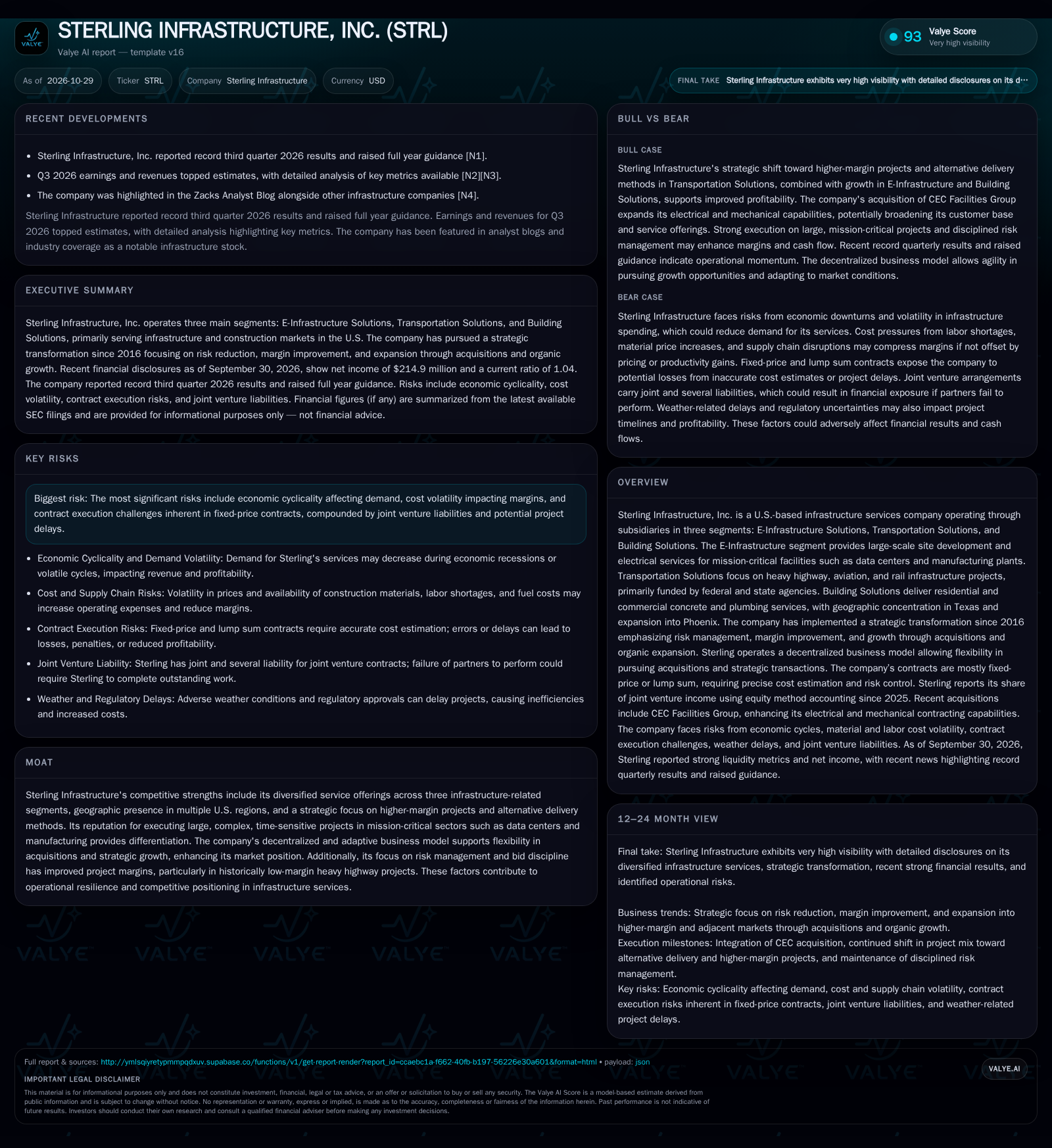
Sterling Infrastructure reported record Q3 2026 results and raised full-year guidance, reflecting its strategic focus on higher-margin E-Infrastructure and alternative delivery projects, as well as the integration of CEC Facilities Group into its platform. The company’s shift away from low-bid heavy highway work has improved profitability, but exposure to fixed-price contracts, joint venture obligations, and economic cyclicality create ongoing execution and risk-management challenges. Monitoring project mix, margin trends, and successful integration of recent acquisitions will be key to assessing the durability of Sterling’s current momentum. [S1] [S2] [N1] [N2] [N3]
Sterling Infrastructure, Inc. has engineered a notable transformation over the past decade, shifting from a traditional, low-margin contractor into a diversified platform delivering high-value infrastructure solutions. Its latest record-setting quarter and raised guidance highlight the earnings power unlocked by targeting complex projects in data centers, alternative transportation, and building solutions. Yet, beneath the surface, the company’s heavy reliance on fixed-price contracts, exposure to economic cycles, and integration of multiple acquisitions mean that operational discipline and risk management remain as critical as ever for sustaining growth and profitability.
Record Earnings and Strategic Expansion Define Sterling’s Current Position
Sterling Infrastructure reported record third quarter 2026 results, raising its full-year guidance and demonstrating the positive impact of its ongoing strategic transformation. Net income for Q3 2026 reached $214.9 million, with basic EPS of $7.02 and a cash balance of $216.9 million as of September 30, 2026 [S2] [N1]. The company’s current ratio stood at 1.04, reflecting a balance between liquidity and operational commitments [S2]. Sterling’s acquisition of CEC Facilities Group in September 2025 further strengthened its E-Infrastructure Solutions segment, broadening its capabilities in mission-critical electrical and mechanical contracting for high-growth data center and industrial end markets [S1]. Importantly, the company has reduced its exposure to low-bid heavy highway projects to just 9% of Transportation Solutions segment activity, down from 79% in 2016, signaling a decisive pivot toward higher-margin, alternative delivery projects [S1]. These developments collectively highlight Sterling’s focus on profitable growth and risk-adjusted capital allocation.
How Sterling’s Project Mix and Contract Structure Shape Its Earnings Power
Sterling’s business economics hinge on a three-segment model: E-Infrastructure Solutions, Transportation Solutions, and Building Solutions. The E-Infrastructure segment delivers large-scale site development and electrical work for data centers, semiconductor plants, and related mission-critical facilities—sectors typically characterized by higher margins, longer project durations, and growing demand. Transportation Solutions, once dominated by low-bid heavy highway projects, now emphasizes alternative delivery methods (such as design-build and construction manager at risk) for airports, rail, and commercial infrastructure, capturing higher value through complexity and specialization. Building Solutions, concentrated in Texas with expansion into Phoenix, primarily serves residential and commercial concrete and plumbing needs.
A key economic lever is Sterling’s contract mix, which is predominantly fixed-unit price and lump sum. This structure can yield stable, predictable revenue if costs are accurately forecasted and managed, but leaves the company vulnerable to input cost volatility, labor shortages, and unforeseen project delays. The fixed-price nature of contracts places a premium on disciplined cost estimation, robust project management, and supply chain coordination. As Sterling grows through acquisitions, integration costs and realization of expected synergies add another layer to the margin equation. The decentralized business model offers flexibility and localized decision-making, but requires rigorous oversight to ensure consistent profitability across diverse markets and contract types.
Operating leverage may be realized as Sterling continues to shift toward higher-margin, complex projects and scales its E-Infrastructure and Building Solutions platforms. However, capital needs can be significant, particularly for upfront project mobilization, equipment, and working capital tied to large contracts. The company’s ability to convert backlog into profitable revenue—and to avoid losses on fixed-price work—will be central to sustaining recent earnings momentum.
Sterling’s Differentiators Versus Infrastructure Peers and the Evolving Competitive Landscape
Sterling competes across three infrastructure verticals, facing a mix of national and regional contractors, specialty electrical/mechanical providers, and diversified engineering firms. Its competitive positioning is strengthened by its broad service portfolio, geographic reach (Southern, Northeastern, Mid-Atlantic, Rocky Mountain regions, and Pacific Islands), and reputation for delivering large, time-sensitive, mission-critical projects—particularly in the fast-growing data center and advanced manufacturing sectors [S1]. The strategic shift away from commodity, low-bid highway work reduces exposure to price-based competition and positions Sterling to win on technical capability, project management, and integration of specialty services.
The acquisition of CEC Facilities Group enhances Sterling’s ability to self-perform complex electrical and mechanical scopes, potentially reducing reliance on subcontractors and improving project control. This could create a cost and quality advantage in E-Infrastructure projects, especially as data center and industrial clients demand turnkey solutions and rapid delivery. However, the company remains exposed to competition from larger, vertically integrated infrastructure players, as well as specialized firms with deep relationships in targeted end markets. Barriers to entry in public infrastructure remain moderate, but Sterling’s track record, scale, and risk management orientation offer some insulation against new entrants.
The trend toward alternative delivery methods (such as design-build, P3s, and EPC contracts) favors firms with proven execution, integrated offerings, and strong balance sheets. Sterling’s ability to bundle services and deliver high-stakes projects may enhance its win rate, but also increases complexity and risk if project controls are insufficient.
If Sterling Sustains Execution Discipline, Margin Expansion and Market Share Gains Could Accelerate
In a favorable scenario, Sterling’s transformation continues to bear fruit as its project mix further tilts toward high-margin E-Infrastructure and alternative delivery work. Successful integration of CEC Facilities Group catalyzes cross-selling and operational synergies, while the company leverages its decentralized model to capture regional growth opportunities and expand into new geographies. Federal and state infrastructure spending remains robust, supporting a healthy pipeline of complex transportation and building projects.
Margin expansion could accelerate if Sterling delivers projects on time and within budget, maintaining bid discipline and avoiding costly overruns. The company’s reputation for reliable execution in mission-critical environments may lead to preferred-contractor status with major data center and industrial clients, creating recurring opportunities and deepening customer relationships. Operating leverage emerges as higher-margin segments comprise a growing share of revenue, while improved risk management keeps losses on fixed-price contracts to a minimum.
Evidence supporting this scenario would include continued increases in gross and operating margins, a rising proportion of revenue from E-Infrastructure and alternative delivery projects, consistently positive free cash flow, and accretive acquisition outcomes. Confirmation could also come from new multi-year awards with blue-chip technology or industrial clients and further upward revisions to guidance.
Disciplined Growth Amid Industry Volatility Remains the Most Likely Trajectory
The most plausible path forward is that Sterling maintains its disciplined approach, balancing growth in higher-margin segments with continued exposure to cyclical demand and execution risks. The company’s backlog remains healthy, benefiting from secular demand in data centers, transportation infrastructure, and select residential/commercial markets. Acquisitions like CEC Facilities Group are integrated smoothly, though not without some frictional costs and initial margin drag.
Margins remain stable or improve modestly as project mix shifts, but periodic cost overruns or delays on fixed-price contracts still occur due to labor and material volatility or weather disruptions. Economic slowdowns or pauses in infrastructure funding could create temporary softness, especially in Transportation or Building Solutions. Nevertheless, Sterling’s diversified end-market and geographic footprint help buffer against isolated shocks. The company continues to generate solid net income and cash flow, supporting organic reinvestment and selective M&A.
This scenario would be confirmed by quarterly results showing steady (if not dramatic) margin improvement, a balanced revenue mix across segments, and manageable swings in working capital. Occasional project write-downs or integration costs are offset by overall portfolio performance. Guidance is met or adjusted within a modest range, and management continues to emphasize risk management and bid discipline in public commentary.
Cost Surprises or Project Missteps Could Erode Recent Gains
Adverse outcomes could materialize if Sterling encounters significant cost overruns, labor shortages, or supply chain disruptions on fixed-price contracts—particularly in its Transportation or Building Solutions segments. A sharp economic downturn or unexpected reduction in public infrastructure funding could cut demand, leading to lower backlog and pricing pressure. Integration challenges or cultural clashes from recent acquisitions (such as CEC Facilities Group) could dilute expected synergies or distract management, resulting in operational inefficiencies.
If project estimation or execution falters, Sterling could face margin compression, project losses, or even litigation tied to joint and several liability in joint ventures. Weather-related delays or regulatory setbacks might also cause schedule disruptions and cost escalation.
Confirmation of this scenario would include a spike in project write-downs or loss provisions, declining gross or operating margins, missed guidance, or evidence of working capital strain. Negative industry news—such as federal budget cuts or a construction market contraction—would further pressure results.
What Will Test the Durability of Sterling’s Strategic Pivot?
The proportion of revenue and backlog derived from E-Infrastructure and alternative delivery projects—continued growth here would support the margin and risk-reduction thesis.
Gross and operating margin trends by segment—if disclosed, these would clarify whether the shift to higher-value projects is delivering sustained profitability.
Integration progress and margin contribution from CEC Facilities Group—updates on realized synergies, retention of key personnel, and cross-selling successes would help validate acquisition strategy.
Incidence and magnitude of project write-downs or loss provisions—especially on fixed-price or joint venture contracts, as these signal execution risk.
Net working capital swings and free cash flow generation—persistent negative trends could indicate hidden stress or project overruns.
Changes in public infrastructure funding or macroeconomic indicators—monitoring federal/state budget allocations and construction market health is essential for demand visibility.
Disclosure of new, multi-year awards with technology, industrial, or public sector clients—such wins would confirm Sterling’s positioning in mission-critical, high-barrier segments.
Disclaimer: This is research-only, informational analysis and not investment advice. It may include AI-generated interpretation and general industry context. Always verify important details using primary sources.

Comments