
Alnylam Pharmaceuticals’ RNAi Platform: Profitable Expansion, Pipeline Ambition, and the Next Phase of Biotech Maturity
With six approved RNAi drugs, robust profitability, and a deep late-stage pipeline, Alnylam enters 2027 as a rare example of a commercial-stage biotech with both scientific and financial momentum. The question is whether its platform and strategic collaborations can drive durable leadership in rare and prevalent diseases amid intensifying competition and execution risk.
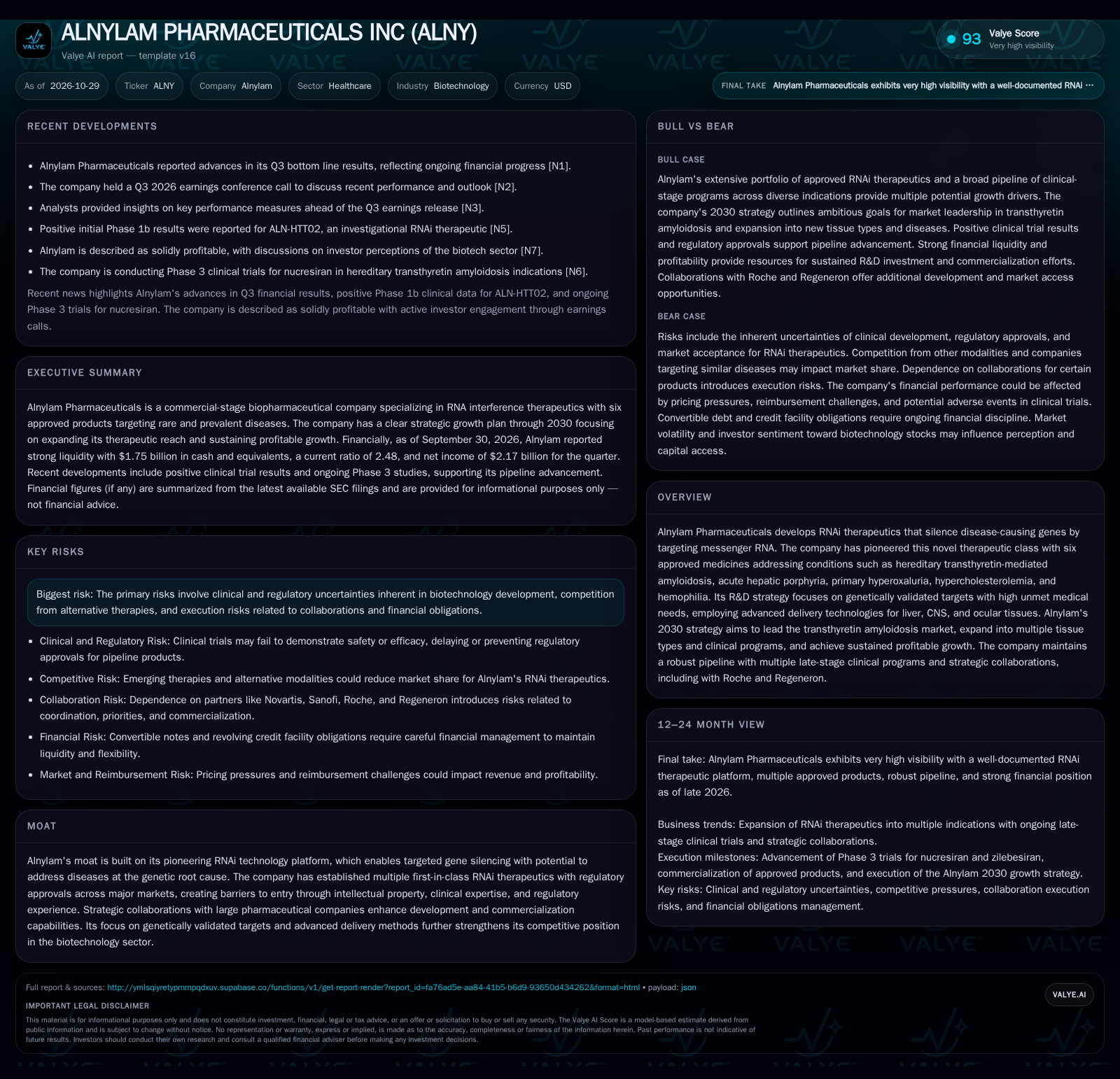
Alnylam Pharmaceuticals stands out as a profitable, commercial-stage RNAi pioneer with six approved medicines, a reported balance sheet position, and a maturing pipeline targeting both rare and large-market indications. Its 2030 strategy aims for sustained growth and market leadership, but future value creation depends on continued clinical success, effective commercialization, and navigating competitive and execution risks. The durability of its RNAi platform and partnerships will be critical to extending its advantage in a rapidly evolving biotech landscape. [S1] [S2] [N1] [N7]
Alnylam Pharmaceuticals has achieved a rare feat in biotechnology: turning a pioneering scientific platform into a commercial engine with real profits. As of late 2026, Alnylam boasts six approved RNAi therapeutics, a pipeline spanning rare and prevalent diseases, and net income over $2 billion for the latest quarter. The company’s 2030 strategy sets ambitious targets for growth, margin expansion, and disease leadership. But as the biotech sector faces shifting investor sentiment and intensifying competition, the sustainability of Alnylam’s edge will hinge on clinical and commercial execution, the scalability of its RNAi platform, and its ability to translate pipeline bets into durable revenue streams.
Profitable Scale and Pipeline Depth Define Alnylam’s 2026 Position
Alnylam Pharmaceuticals reported net income of $2.167 billion for the quarter ended September 30, 2026, with basic EPS of $16.19 and diluted EPS of $15.72. This marks a transition to sustained profitability, a threshold few commercial-stage biotechs reach [S2] [N1] [N7].
The company now markets six approved RNAi drugs, including AMVUTTRA and ONPATTRO (for hereditary transthyretin-mediated amyloidosis), GIVLAARI (acute hepatic porphyria), OXLUMO (primary hyperoxaluria type 1), Leqvio (hypercholesterolemia, commercialized by Novartis), and Qfitlia (hemophilia, commercialized by Sanofi) [S1].
Alnylam’s balance sheet as of September 30, 2026, included $1.754 billion in cash and equivalents, $5.113 billion in current assets, and $2.063 billion in current liabilities, with a current ratio of 2.48 [S2].
The company’s pipeline remains active, with positive initial Phase 1b results for ALN-HTT02 and several late-stage programs (nucresiran, zilebesiran, cemdisiran) advancing in large indications [S1] [N5].
RNAi Economics: Fixed R&D, Portfolio Leverage, and Commercial Complexity
Alnylam generates revenue from direct sales of its proprietary RNAi drugs and royalties or milestones from products commercialized by partners (e.g., Leqvio with Novartis, Qfitlia with Sanofi) [S1]. For wholly owned products, pricing typically reflects the high unmet need and orphan-drug status of early indications, supporting premium price points. As pipeline assets expand into more prevalent diseases (e.g., hypertension, complement-mediated diseases), pricing and payer dynamics may become more competitive.
The RNAi platform enables a modular approach to drug development, with core chemistry, delivery, and manufacturing investments leveraged across multiple programs. This creates potential for operating leverage as the portfolio matures and fixed R&D costs are spread over a wider revenue base.
However, commercial expansion—especially into non-orphan indications—entails rising variable costs: larger salesforces, broader market access investments, and potentially lower per-patient margins. Collaborations with large pharma partners can offset some costs and accelerate access, but typically reduce Alnylam’s share of downstream economics.
Convertible debt ($661 million in 0% notes due 2028) and a $500 million revolving credit facility add modest financial obligations, but current cash levels and profitability reduce near-term funding risk [S1] [S2].
RNAi Leadership, Barriers, and the Next Wave of Biotech Competition
Alnylam’s competitive moat rests on first-mover advantages in RNA interference, a broad patent estate, and deep experience in RNAi chemistry, delivery, and clinical development [S1]. Six approved drugs across multiple geographies, regulatory expertise, and established commercial infrastructure further raise barriers to entry for would-be RNAi competitors.
However, the competitive landscape is evolving. Alternative modalities—such as antisense oligonucleotides, gene editing (CRISPR/Cas9), monoclonal antibodies, and small molecules—are being developed for many of the same indications. Larger pharmaceutical companies and emerging biotechs are pursuing both RNAi and non-RNAi approaches, increasing the risk of therapeutic substitution.
Partnerships with Novartis, Sanofi, Roche, and Regeneron expand Alnylam’s competitive reach but also create dependencies and potential for strategic misalignment. Should partners prioritize competing assets or under-resource Alnylam-derived products, market share and revenue could be at risk.
Intellectual property and delivery technology remain critical differentiators. But as RNAi delivery platforms mature and generic competition eventually emerges, Alnylam will need to continually advance its chemistry and broaden its tissue-targeting capabilities to preserve its leadership.
Platform Scale and Pipeline Success Propel Durable Growth
A favorable scenario sees Alnylam’s late-stage pipeline (nucresiran for ATTR, zilebesiran for hypertension, cemdisiran for complement diseases) delivering positive pivotal data, regulatory approvals, and rapid market uptake. Expansion into larger indications enables the company to compound revenue beyond the orphan-drug base, driving the 25%+ CAGR and 30% non-GAAP operating margin targeted for 2030 [S1].
Strong execution in global launches, effective navigation of payer dynamics, and successful partner collaboration (especially with Roche for zilebesiran and Regeneron for cemdisiran) would validate the scalability of the RNAi platform. Continued scientific innovation—such as next-generation CNS and ocular delivery—could open additional high-value markets.
Confirmation of this scenario would include: robust sales ramp for new indications, expansion of label claims, favorable reimbursement in major healthcare markets, and evidence of platform leverage (e.g., new programs advancing efficiently into late-stage trials).
Mature Biotech Execution: Profitable Growth, Pipeline Progress, and Operational Hurdles
The most plausible outcome is that Alnylam continues to grow revenues and profits by expanding the reach of its approved RNAi drugs, while advancing select pipeline assets through late-stage trials. Some programs (e.g., zilebesiran for hypertension) face longer commercialization timelines or competitive pushback, but core rare-disease franchises remain resilient.
Operating margins improve gradually as fixed costs are leveraged, but are tempered by higher commercial and R&D investments for larger-market indications. Collaborations deliver incremental value but also introduce periodic execution friction.
Evidence supporting this scenario would include steady revenue growth from existing products, incremental label expansions, manageable R&D and SG&A expense growth, and continued positive cash flow. Falsification would come from a major clinical setback, regulatory delay, or sustained margin erosion due to pricing pressure or commercialization missteps.
Pipeline Setbacks, Competitive Entrants, and Platform Vulnerability
In a negative scenario, one or more late-stage pipeline programs fail in pivotal trials or encounter regulatory obstacles, stalling revenue growth and undermining confidence in platform scalability. New entrants—using either alternative modalities or next-generation RNAi technologies—capture share in key indications, while payer pushback compresses pricing in both rare and prevalent diseases.
Dependence on partners for major launches exposes Alnylam to strategic deprioritization or suboptimal commercialization, particularly if larger partners shift focus to competing internal assets. Financial obligations from convertible debt and the credit facility become more constraining if profitability reverses or R&D spending surges to rescue the pipeline.
Falsifying this scenario would require resilient product sales despite clinical or competitive headwinds, successful mitigation of pipeline setbacks (e.g., rapid pivot to alternative assets), and maintenance of positive operating cash flow.
Milestones Shaping Alnylam’s RNAi Leadership Trajectory
Revenue growth and margin trends for AMVUTTRA, ONPATTRO, and other core products—especially in newly approved indications or geographies—would help test the scalability of the RNAi platform.
Clinical trial readouts for late-stage assets (nucresiran, zilebesiran, cemdisiran) are pivotal for confirming the pipeline’s contribution to future growth.
Updates on payer coverage, reimbursement rates, and pricing dynamics in both rare and prevalent disease indications will clarify the sustainability of premium pricing.
The pace and breadth of regulatory approvals—particularly for pipeline assets targeting larger populations—will indicate Alnylam’s ability to expand beyond its orphan-drug base.
Financial discipline: monitoring R&D and SG&A expense growth versus revenue and cash flow will highlight the company’s ability to achieve targeted operating leverage.
Partner execution: commercial results for Leqvio (Novartis) and Qfitlia (Sanofi), and collaboration milestones with Roche and Regeneron, will test the effectiveness and alignment of external partnerships.
Intellectual property developments or delivery platform enhancements—if disclosed—would help assess the durability of Alnylam’s technological moat.
Any material adverse events, safety signals, or regulatory warnings related to RNAi products would be critical for testing platform risk.
Disclaimer: This is research-only, informational analysis and not investment advice. It may include AI-generated interpretation and general industry context. Always verify important details using primary sources.

Comments