
Cadiz Inc.: Water Asset Leverage, Execution Risk, and the Challenge of Monetizing Scarcity
The company’s future hinges on project execution, regulatory navigation, and the ability to secure long-term offtake agreements in a competitive and politically sensitive market.
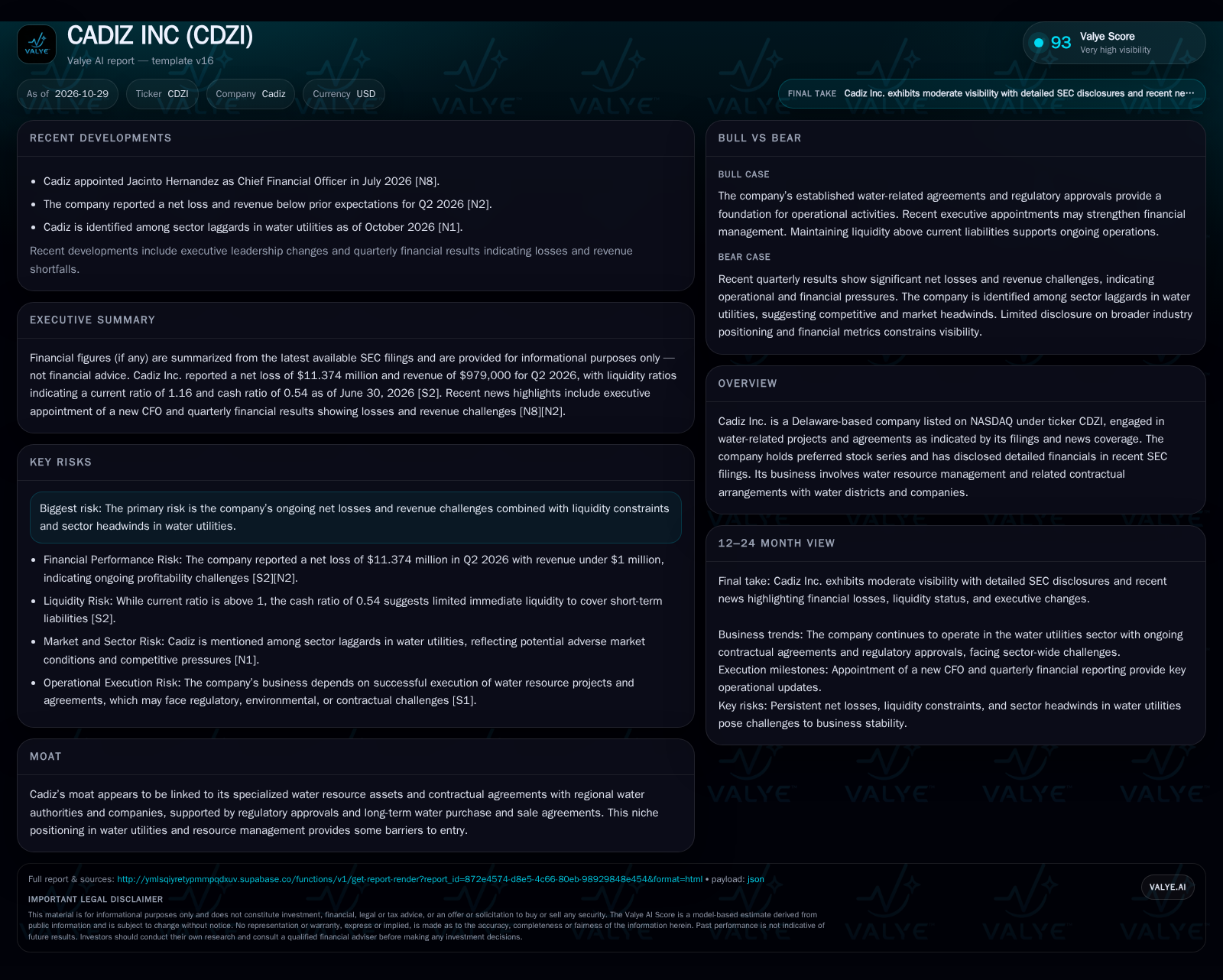
Cadiz Inc. owns substantial water rights and infrastructure assets in Southern California, including the ability to withdraw up to 50,000 acre-feet of groundwater annually and operate a 220-mile pipeline. Despite these assets, the company reported a net loss of $11.374 million on just $979,000 in Q2 2026 revenue and faces liquidity limitations. The recent CFO appointment signals a potential focus on financial discipline, but the company’s path to profitability depends on its ability to execute water projects, secure customers, and manage sector headwinds. [S2] [N2] [N8]
Cadiz Inc. sits atop a rare portfolio of water rights, storage capacity, and pipeline infrastructure in drought-prone Southern California—a region where water scarcity can create both opportunity and contention. Yet recent financials reveal the disconnect between asset potential and realized earnings: Q2 2026 revenue was less than $1 million, while net losses exceeded $11 million. The company’s future will be shaped by its ability to convert rights and infrastructure into contracted, recurring revenue streams, all while navigating political, regulatory, and competitive forces that define the Western U.S. water market. The recent CFO appointment may signal a new phase of operational focus, but execution risks remain high. [S2] [N2] [N8]
Recent Losses and Asset Scale Define Cadiz’s Strategic Crossroads
Cadiz Inc. reported Q2 2026 revenue of $979,000 against a net loss of $11.374 million, highlighting a persistent gap between asset potential and current cash generation. As of June 30, 2026, the company’s liquidity profile included $5.319 million in cash and cash equivalents, current assets of $11.444 million, and current liabilities of $9.859 million—resulting in a current ratio of 1.16 and a cash ratio of 0.54. The company reported cash and liquidity metrics for the period; these figures do not by themselves establish operating runway, investment capacity, financial flexibility, or financing capacity. [S2]
The company’s core assets—2.5 million acre-feet of permitted water supply, 1 million acre-feet of groundwater storage, and a 220-mile pipeline—position it as a potential strategic player in regional water solutions. Yet with ongoing net losses and revenue flagged as below expectations in Q2 2026, there is clear evidence that these assets have not yet been monetized at scale. [S2] [N2]
The July 2026 appointment of Jacinto Hernandez as CFO could mark a pivot toward stronger financial management and operational discipline, but the impact of this leadership change remains to be seen. [N8]
Asset-Heavy Model Hinges on Volume Contracts and Project Execution
Cadiz’s economics depend on leveraging its water rights, storage capacity, and pipeline infrastructure to generate recurring, contract-based revenue from water supply, conveyance, and storage services. The company’s permitted withdrawal of up to 50,000 acre-feet per year, if fully contracted and priced at prevailing Southern California wholesale water rates, could theoretically support substantial annual revenue. However, the current revenue base—under $1 million in Q2 2026—suggests that only a fraction of potential volume is monetized.
The capital intensity of water infrastructure creates high fixed costs, while operating leverage is possible if utilization increases. Margins could scale rapidly if Cadiz can secure long-term, take-or-pay contracts with municipal or commercial water users. Conversely, underutilization exposes the company to persistent losses and cash burn, especially given the need for ongoing maintenance, regulatory compliance, and periodic capital upgrades.
Funding needs remain a central concern. [S2] The company’s preferred stock structure could provide a future source of capital but may also dilute common shareholders or add cash obligations if dividends accrue.
Strategic Water Assets Offer Barriers, but Regulatory and Political Risks Loom
Cadiz’s core advantage lies in its unique aggregation of water rights, groundwater storage, and pipeline infrastructure in a region where new water projects face intense regulatory and environmental scrutiny. This asset base creates barriers to entry for would-be competitors, particularly given the length and difficulty of securing both water rights and the permits required to build or expand infrastructure in California.
However, the company’s competitive position is tempered by several factors. First, regulatory approvals, while in place for current extraction levels, are subject to challenge and political shifts, especially as environmental groups and local governments scrutinize large-scale water transfers. Second, the pace at which Cadiz can secure additional offtake agreements is uncertain, especially as major municipal water agencies often have alternative supply options, including state-run projects, desalination, and conservation programs.
Peer competitors in this sector typically include public water agencies, large investor-owned utilities, and infrastructure funds with access to lower-cost capital. Cadiz’s need to monetize assets through contract wins and project execution exposes it to both competitive bidding and the risk of customer concentration.
Full Utilization of Water Rights and Pipeline Unlocks Recurring Cash Flow
A favorable trajectory for Cadiz would see the company fully contracting its annual permitted water withdrawals and pipeline capacity to municipal and commercial buyers through long-term, take-or-pay arrangements. If the company can demonstrate reliable delivery, regulatory compliance, and environmental stewardship, it could become a preferred supplier in a market increasingly anxious about drought and water security.
Upside confirmation would come from new multi-year contract announcements, rising quarterly revenue that materially exceeds current levels, and evidence of positive operating cash flow. Additional validation would include updates on regulatory stability, customer diversification, and progress in deploying the company's water treatment technology for new revenue streams.
This scenario could be falsified if future filings show stagnant or declining contracted volumes, continued subscale revenue, or new regulatory/legal challenges that delay or block project execution.
Gradual Monetization Amid Persistent Losses and Execution Uncertainty
The most plausible near-term outcome is incremental progress—Cadiz continues to operate with modest revenue growth as it seeks to convert more of its water rights and infrastructure capacity into contracted business. Ongoing net losses may persist given the high fixed cost base and the slow pace of contract wins typical in regulated water markets.
Evidence confirming this scenario would include steady, but not dramatic, improvements in quarterly revenue, continued net losses (albeit potentially narrowing), and periodic updates on project milestones or customer announcements. The company may need to raise additional capital to fund operations or project buildout, especially if cash burn continues at the current rate.
This scenario would be challenged if Cadiz secures a step-change in contracted volumes or a major capital infusion, or if it faces an unexpected regulatory setback that materially impairs its ability to operate or expand.
Liquidity Squeeze and Project Delays Threaten Business Continuity
Regulatory or legal setbacks—such as project permitting delays, environmental injunctions, or adverse legislative actions—could further erode confidence and access to capital.
External evidence could include negative regulatory news, loss of key customers, or sector-wide shocks that limit access to the capital markets.
The downside may be mitigated if the company can quickly secure bridge financing or if external events (such as regional drought emergencies) accelerate demand for its services. However, absent such catalysts, persistent underperformance could threaten business continuity.
Testing the Cadiz Thesis: Execution, Contracting, and Regulatory Milestones to Track
Quarterly revenue growth, especially sequential acceleration above current levels, would help validate commercial traction.
Disclosure of new or expanded long-term water supply or pipeline contracts, including customer names, volumes, and pricing if available, would clarify monetization progress.
Updates on regulatory proceedings, permitting milestones, or litigation outcomes that could impact water rights utilization or project timelines.
Operating cash flow trends—whether quarterly burn moderates or the company approaches break-even—would test economic viability.
Changes in liquidity metrics, including cash ratio and current ratio, especially if disclosed alongside capital-raising or debt events.
Evidence of customer diversification versus concentration risk; a useful metric would be revenue by customer if disclosed.
Progress in deploying water treatment technology with commercial customers, including pilot project outcomes or early revenue contributions, would help test the thesis.
Announcements related to financing, preferred stock issuance, or other capital structure changes that could affect dilution or balance-sheet resilience.
Disclaimer: This is research-only, informational analysis and not investment advice. It may include AI-generated interpretation and general industry context. Always verify important details using primary sources.

Comments