
L3Harris Technologies: Record Backlog and Missile Growth Fuel Profitability Prospects
With a $53.2 billion backlog and a multi-year, multi-billion-dollar missile capacity buildout underway, L3Harris stands at a crossroads: can it translate robust defense demand and segment diversity into sustained earnings growth, or will execution, supply chain, and policy risks erode the returns on its unprecedented investment?
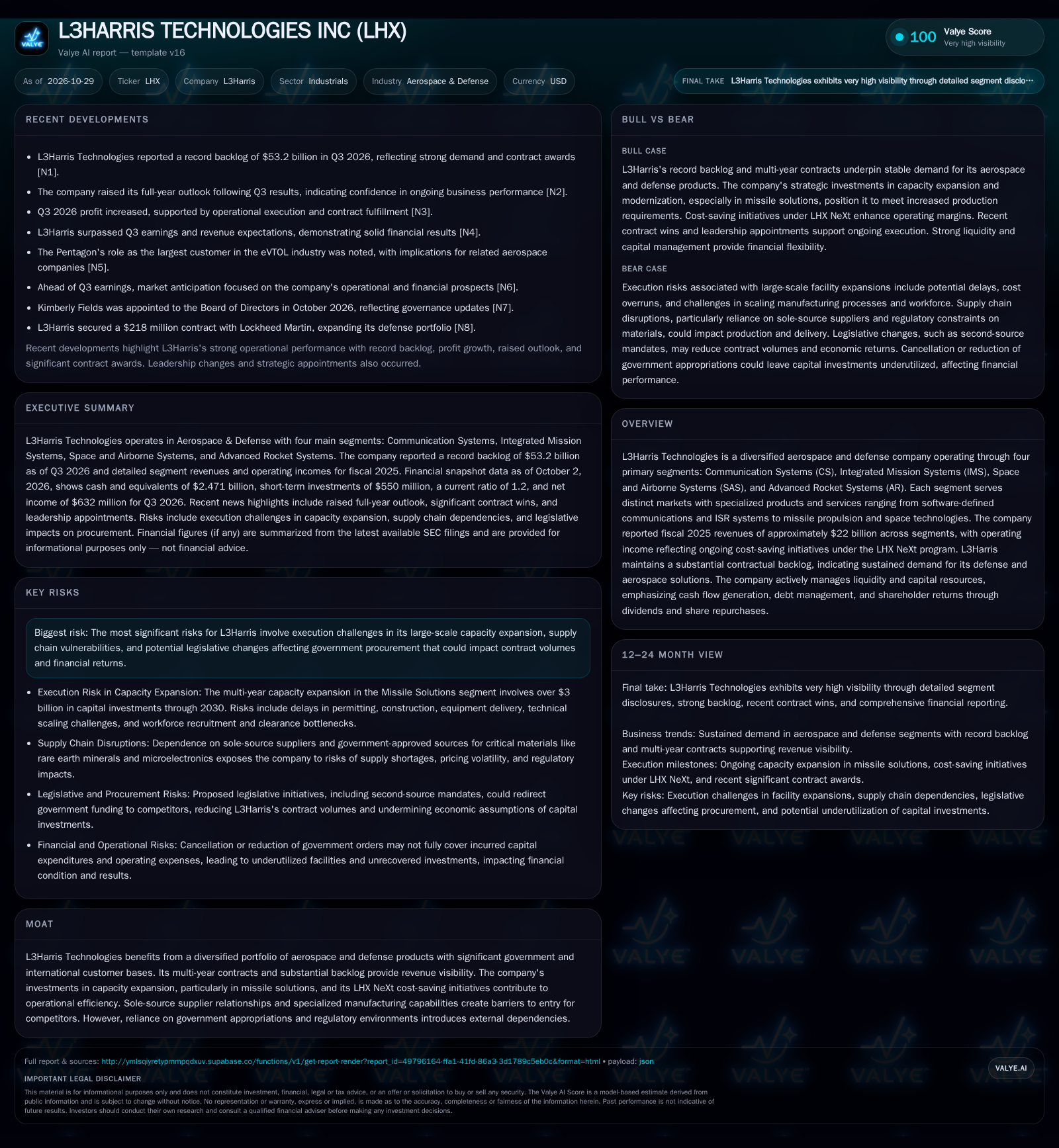
L3Harris Technologies reported a record $53.2 billion backlog in Q3 2026, underpinned by multi-year contracts and strong segment performance. The company is executing a $3 billion+ missile solutions capacity expansion through 2030, aiming to capture rising demand but facing execution, supply chain, and policy risks. Financially, L3Harris posted Q3 net income of $632 million and continues to prioritize cash flow, capital investments, and shareholder returns. The key question is whether operational execution and policy stability can convert backlog into durable, margin-rich growth. [S2] [N1] [N2] [N4]
L3Harris Technologies enters late 2026 with a record $53.2 billion backlog and ambitious plans to expand missile production capacity by over $3 billion through 2030. This surge in demand, driven by multi-year defense contracts and broad segment coverage, positions L3Harris as a pivotal supplier to U.S. and allied military programs. But while strong order flow and a diversified portfolio offer tangible revenue visibility, the company’s future earnings power hinges on its ability to execute large-scale facility expansions, manage supply chain complexities, and navigate shifting legislative and procurement priorities. The stakes are high: success could lock in durable, margin-accretive growth, but missteps could leave capital underutilized and returns under pressure. [S2] [N1] [N2] [N4]
Backlog Peaks and Missile Expansion Define the 2026 Outlook
L3Harris Technologies reported a record contractual backlog of $53.2 billion in Q3 2026, spanning its four core segments: Communication Systems, Integrated Mission Systems, Space and Airborne Systems, and Advanced Rocket Systems. This backlog, which increased year-over-year, signals persistent demand for the company’s aerospace and defense offerings and underpins near- to medium-term revenue visibility. Segment performance for fiscal 2025 demonstrated substantial revenue contributions from SAS ($6.946B), IMS ($6.63B), and CS ($5.673B), with AR (missile solutions) at $2.845B. Critically, the company has embarked on a multi-year, $3 billion-plus capital expenditure program to expand missile production capacity through 2030, a strategic bet on continued demand for propulsion and missile defense systems. Q3 2026 also saw net income of $632 million and healthy cash resources ($2.471B cash, $550M short-term investments) alongside a current ratio of 1.2. These facts collectively frame L3Harris’s operating and strategic landscape as it seeks to capitalize on defense spending cycles while managing complex capital and operational risks. [S2] [N1] [N2] [N4]
Revenue Visibility Meets Capital Intensity: The Economics of L3Harris’s Growth Model
L3Harris’s business model combines multi-year defense contracts, high-value engineered systems, and a diversified segment base. The record backlog provides a foundation for revenue planning, but the economics are shaped by a blend of fixed and variable costs unique to defense manufacturing. Missile and propulsion capacity expansion is heavily capital intensive, requiring upfront investment in facilities, equipment, and workforce clearances—costs that only pay off if future order volumes materialize as expected. Segment operating margins vary: Communication Systems delivered the highest operating income ($1.432B in 2025) relative to revenue, suggesting higher incremental margins, while AR’s missile segment, despite revenue growth, posted lower operating income ($270M on $2.845B), reflecting the capital and scaling challenges inherent in that business. Operating leverage can be substantial if volume ramps are smooth and contracts are fulfilled without major disruptions, but any delays, supply chain shocks, or order cancellations could leave the company with underutilized assets and unrecovered costs. The company reported cash and liquidity metrics for the period; these figures do not by themselves establish operating runway, investment capacity, financial flexibility, or financing capacity. [S2]
Diversification and Barriers: How L3Harris Stakes Its Place in Defense
L3Harris’s competitive positioning rests on its broad portfolio—spanning communications, ISR, space, and missile systems—and its entrenched relationships with U.S. and allied defense agencies. The company benefits from sole-source and limited-competition contracts in areas like missile propulsion, where specialized manufacturing and high switching costs discourage new entrants. Multi-year contracts and a record backlog provide a buffer against short-term budget fluctuations, while ongoing investments in modernization and cost-saving (LHX NeXt) aim to defend margins. However, the company faces counterforces: legislative changes such as second-source mandates could erode its sole-source advantages and direct funding to rivals; technological advances in autonomy, electronic warfare, or commercial space could shift procurement preferences; and international peers, as well as large U.S. defense contractors, remain formidable competition. Supply chain dependencies—particularly for rare earths and microelectronics—are an additional vulnerability, as disruptions could impact both cost and delivery timelines.
When Investment Pays Off: Capital Expansion Converts Backlog into High-Margin Growth
The bull case for L3Harris centers on flawless execution of missile segment capacity expansion, stable government appropriations, and continued demand for advanced defense systems. If the company delivers new capacity on time and on budget, it could capture growing missile and propulsion orders, driving segment operating margins higher as fixed costs are absorbed over larger production volumes. Confirmation would come from sustained double-digit revenue growth in the Advanced Rocket Systems segment, rising segment operating income, and upward revisions to backlog and guidance—especially if new contracts extend beyond current projections. Evidence of smooth workforce recruitment, minimal supply chain disruptions, and on-schedule facility ramp-ups would further support the upside scenario. Additionally, if L3Harris leverages its LHX NeXt cost-saving initiatives to drive group-wide margin expansion, the combined effect could be robust free cash flow and increased returns to shareholders.
Sustained Demand, Execution Challenges: The Most Likely Trajectory
The most plausible scenario is that L3Harris converts its record backlog into steady, but not breakout, revenue and earnings growth. The company’s diversified segment mix and long-term contracts provide revenue stability, and the missile capacity expansion proceeds with typical large-project friction: some delays and cost overruns, but no catastrophic setbacks. Segment operating margins are stable or modestly improve as new capacity comes online, but supply chain and labor constraints occasionally slow production. Legislative and procurement changes create periodic headwinds, but core programs remain funded. Confirmation would come from backlog levels remaining above $50 billion, modest year-over-year revenue growth in AR and other segments, and operating income tracking with historical norms. Falsification would involve sharp increases in unabsorbed overhead, persistent underutilization of new facilities, or significant project delays that force downward revisions to earnings guidance.
When Expansion Outpaces Demand: Facility Underutilization and Policy Shocks
The bear case unfolds if L3Harris’s capital expansion in missile solutions is met with either a sudden shift in defense procurement priorities (due to legislative mandates, budget cuts, or geopolitical developments) or sustained execution failures. If appropriations are reduced or contracts canceled, newly built capacity could become stranded, saddling the company with high fixed costs and unrecovered investments. Supply chain breakdowns—especially in sole-source materials—could halt production, while second-source requirements could shift orders to competitors. In this scenario, segment revenues stagnate or fall, operating margins compress, and cash flow deteriorates as capital projects fail to deliver expected returns. Confirmation would be signaled by backlog declines, guidance cuts, facility closures or write-downs, and persistent negative operating leverage in the AR segment.
What Will Determine Whether L3Harris Converts Backlog into Profitable Growth?
Progress and cost discipline in missile capacity expansion—monitoring project timelines, capital deployed, and facility ramp-up rates (if disclosed).
Quarterly and annual trends in Advanced Rocket Systems segment revenues and operating margins.
Backlog evolution by segment: sustained growth or attrition in core areas, especially missile and space programs.
Supply chain stability: incidents of material shortages, delivery delays, or price spikes in critical components (rare earths, microelectronics).
Legislative and procurement developments, particularly any enacted second-source mandates or major shifts in defense appropriations.
Utilization rates for new facilities and workforce recruitment/clearance progress (if disclosed).
Any updates to the LHX NeXt cost-saving program's impact on segment and consolidated operating margins.
Disclaimer: This is research-only, informational analysis and not investment advice. It may include AI-generated interpretation and general industry context. Always verify important details using primary sources.

Comments