
Conectisys Corp: Shell Company Mechanics, Dilution Dynamics, and the Realities of Microcap Public Listings
With no operations or assets and a mission to merge with an operating business, Conectisys Corp’s value is a function of its public shell status, but faces acute dilution risk, resource constraints, and a fiercely competitive reverse-merger landscape.
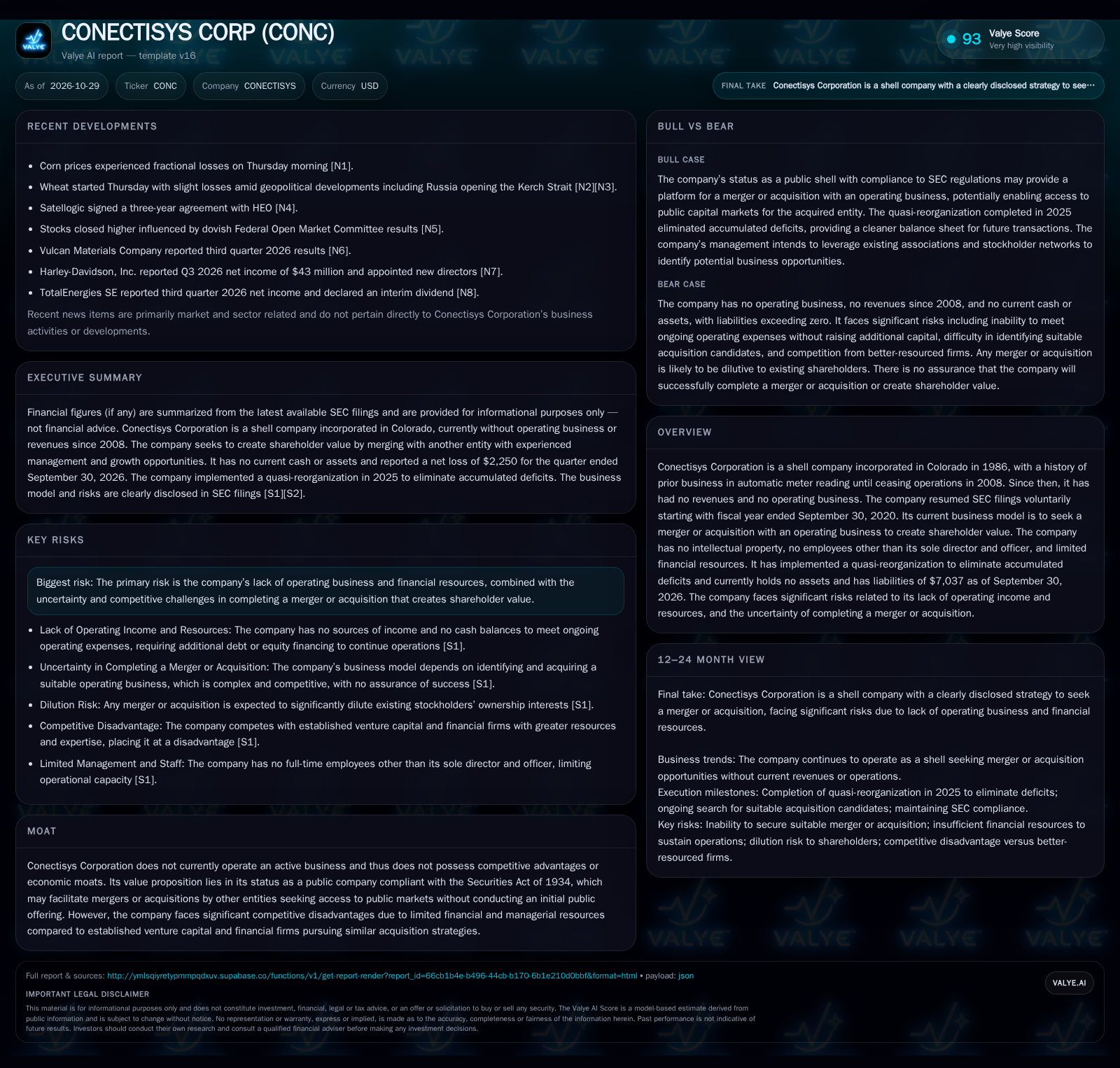
Conectisys Corp is a non-operating public shell with no revenues, cash, or assets, and minimal liabilities. Its strategy is to identify and merge with a private company seeking public market access. While its clean reporting and SEC compliance offer some transactional appeal, the absence of resources, staff, or a targeted industry makes execution highly uncertain. Any successful deal would likely be highly dilutive, with value realization dependent on the quality and post-transaction performance of any acquired business. The primary risk is perpetual inactivity or a value-destructive merger, given the company’s competitive disadvantages and lack of financial runway. [S1] [S2]
Conectisys Corp exemplifies the microcap shell company archetype: a public entity with no operating business, no assets, and minimal liabilities, whose sole purpose is to serve as a transactional vessel for a private business seeking public listing status. While such shells can theoretically provide a shortcut to public capital markets—especially for growth companies unable or unwilling to pursue a traditional IPO—Conectisys’s nearly total lack of resources, single-director governance, and unrestricted industry focus create a scenario where both opportunity and risk are extreme. The company’s fate rests entirely on its ability to identify, negotiate, and consummate a value-creating merger, all while facing dilution, execution, and competitive headwinds that are the norm for this segment. [S1] [S2]
Conectisys Corp’s Current State: No Operations, No Assets, and a Merger-Driven Mandate
As of September 30, 2026, Conectisys Corp has no revenues, no cash or current assets, and $7,037 in current liabilities. The company reported a net loss of $2,250 for the most recent quarter. It has not conducted any operating business since 2008 and is managed solely by its director and officer, Danilo Cacciamatta. The company’s only stated business plan is to seek a merger or acquisition with an operating business that desires public market access. No merger targets have been identified, and there are no ongoing operations, employees, or intellectual property. The company completed a quasi-reorganization in 2025 to eliminate accumulated deficits, but this was a balance sheet exercise rather than an operational reset. [S1] [S2]
How Shell Companies Like Conectisys May Create Value—And Why Most Don’t
Conectisys’s economics are wholly transactional: it generates no operating revenue and incurs only minimal expenses, which must be funded by future debt or equity raises. The company’s only plausible value creation comes from acting as a vehicle for a reverse merger. In such a transaction, a private operating company injects its assets and business into the public shell in exchange for a controlling share of the merged entity’s stock. Typically, the shell company’s existing shareholders retain a small minority stake post-transaction, and the incoming business gains the advantages of an SEC-compliant public listing, potentially easing access to public capital or providing liquidity for founders and early investors.
However, the economics for legacy Conectisys shareholders are almost always highly dilutive. The company reported cash and liquidity metrics for the period; these figures do not by themselves establish operating runway, investment capacity, financial flexibility, or financing capacity. The shell’s minimal liabilities are a modest advantage, but without a cash balance, Conectisys cannot contribute to the merged company’s working capital or transaction costs. The only enduring value is the public listing itself, which has become less scarce due to the proliferation of SPACs and other shell structures post-2020.
Operating leverage, in the traditional sense, does not apply until and unless an acquisition is completed. Until then, ongoing expenses (filing fees, legal, audit) are small but not zero, and must be covered by new financing or shareholder advances. The capital needs for a successful merger are unpredictable but likely to be funded via equity, further diluting current holders.
The Public Shell Marketplace: Conectisys’s Competitive Disadvantages
Conectisys operates in a crowded field of public shells, SPACs, and direct listing alternatives, all targeting private businesses seeking a shortcut to public markets. Its primary asset is its SEC compliance and clean reporting history, which can reduce the due diligence burden for a potential merger partner. However, the company is at a sharp competitive disadvantage due to its lack of cash, assets, or multiple directors, as well as its absence of connections to specific industries or deal pipelines.
By contrast, many other public shells are actively managed by small investment groups, have cash on hand, or are tied to industry specialists who can source and vet deals. SPACs, in particular, often raise significant capital upfront and have large sponsor teams with sector expertise, making them more attractive to high-quality targets. Even among microcap shells, those with cash, a track record of successful transactions, or specific industry focus are typically preferred by merger candidates.
The rise of direct listings and the persistence of micro-IPO routes further erode the value proposition of a generic shell. For a private company, merging with Conectisys means accepting a highly illiquid microcap base, likely penny-stock status, and the reputational risks that come with reverse mergers unless the shell’s compliance and governance are impeccable.
A Successful Reverse Merger: What Would Need to Happen for Conectisys Shareholders to Benefit
The best-case scenario is that Conectisys attracts a credible, growth-oriented private company that wishes to go public quickly, is unable or unwilling to pursue a traditional IPO or SPAC route, and values Conectisys’s clean shell status. If this company has strong audited financials, a compelling growth narrative, and post-merger access to additional capital, the merged entity could trade at a premium to the pre-merger shell value, and legacy shareholders could retain a small but meaningful minority stake.
Evidence supporting this scenario would include the announcement of a definitive merger agreement with a private operating company, disclosure of the target’s audited financials, and immediate post-transaction capital raising at a premium to the shell’s pre-merger market cap. Additional confirmation would come from trading liquidity, analyst coverage, and positive price action following the deal. For this outcome to be realized, Conectisys would need to demonstrate effective deal sourcing, due diligence, and the ability to close a transaction with minimal pre-closing liabilities or legal complications.
Prolonged Inactivity or a Value-Neutral Transaction Remains the Likely Outcome
The most plausible scenario is continued inactivity, with Conectisys maintaining its shell status but failing to consummate a merger in the near term. This reflects the reality that most microcap shells struggle to identify credible acquisition targets and lack the resources to compete for the best candidates. Over time, ongoing filing and compliance costs erode remaining shareholder value, and the company may need to raise small amounts of dilutive capital simply to remain current with regulators.
Alternatively, the company could complete a merger with a low-quality or distressed private business—often a common fate for shells with minimal leverage in negotiations. Such transactions are typically highly dilutive, and the post-merger entity often struggles to attract investor interest or capital, resulting in poor share performance and little value creation for legacy holders. Confirmation of this scenario would include continued lack of deal announcements, small capital raises for operating expenses, or a merger with a business lacking audited financials or growth potential.
Destructive Dilution or Regulatory Non-Compliance Could Leave Shareholders With Nothing
The adverse case is that Conectisys either fails to keep up with SEC compliance (due to lack of funds or management bandwidth), leading to deregistration or trading suspension, or executes a merger with a business that brings significant undisclosed liabilities, regulatory issues, or outright fraud. In such cases, legacy shareholders could see their stakes reduced to near zero through massive dilution, reverse splits, or legal actions.
Evidence of this scenario would include missed or late SEC filings, trading halts, announcements of mergers with non-audited or overseas entities with questionable financials, or sudden increases in authorized shares followed by large-scale issuances. The shell could also be used as a vehicle for pump-and-dump schemes, further eroding any residual value for legitimate shareholders.
Testing the Shell Thesis: What Would Indicate Progress or Value Destruction for Conectisys
Announcement of a signed letter of intent (LOI) or definitive merger/acquisition agreement with a credible private operating company.
Disclosure of audited financial statements for any proposed merger target, as required by SEC rules and company policy.
Filing of any new equity or debt financing agreements to fund ongoing expenses or facilitate a transaction.
Changes in management, board composition, or the addition of industry-experienced directors or advisors.
Timely filing of all required SEC reports and financial statements; any lapses would signal risk of deregistration.
Shareholder approval of any proposed merger, including disclosure of expected post-transaction ownership and dilution.
Notice of reverse splits, increases in authorized shares, or other capital structure changes that may foreshadow dilution.
Any evidence of improved trading liquidity or sustained share price increase following transaction announcements.
Disclaimer: This is research-only, informational analysis and not investment advice. It may include AI-generated interpretation and general industry context. Always verify important details using primary sources.

Comments