
Quanta Services: Infrastructure Expansion, Execution Complexity, and the Shifting Economics of Electrification
Quanta Services’ Q3 2026 results underscore the scale and momentum behind North American infrastructure investment—yet the company’s decentralized, labor-driven model and contract mix expose it to project volatility, weather swings, and margin risk. The next phase hinges on integrating acquisitions, managing cost variability, and sustaining demand from utilities and industrials amid the energy transition.
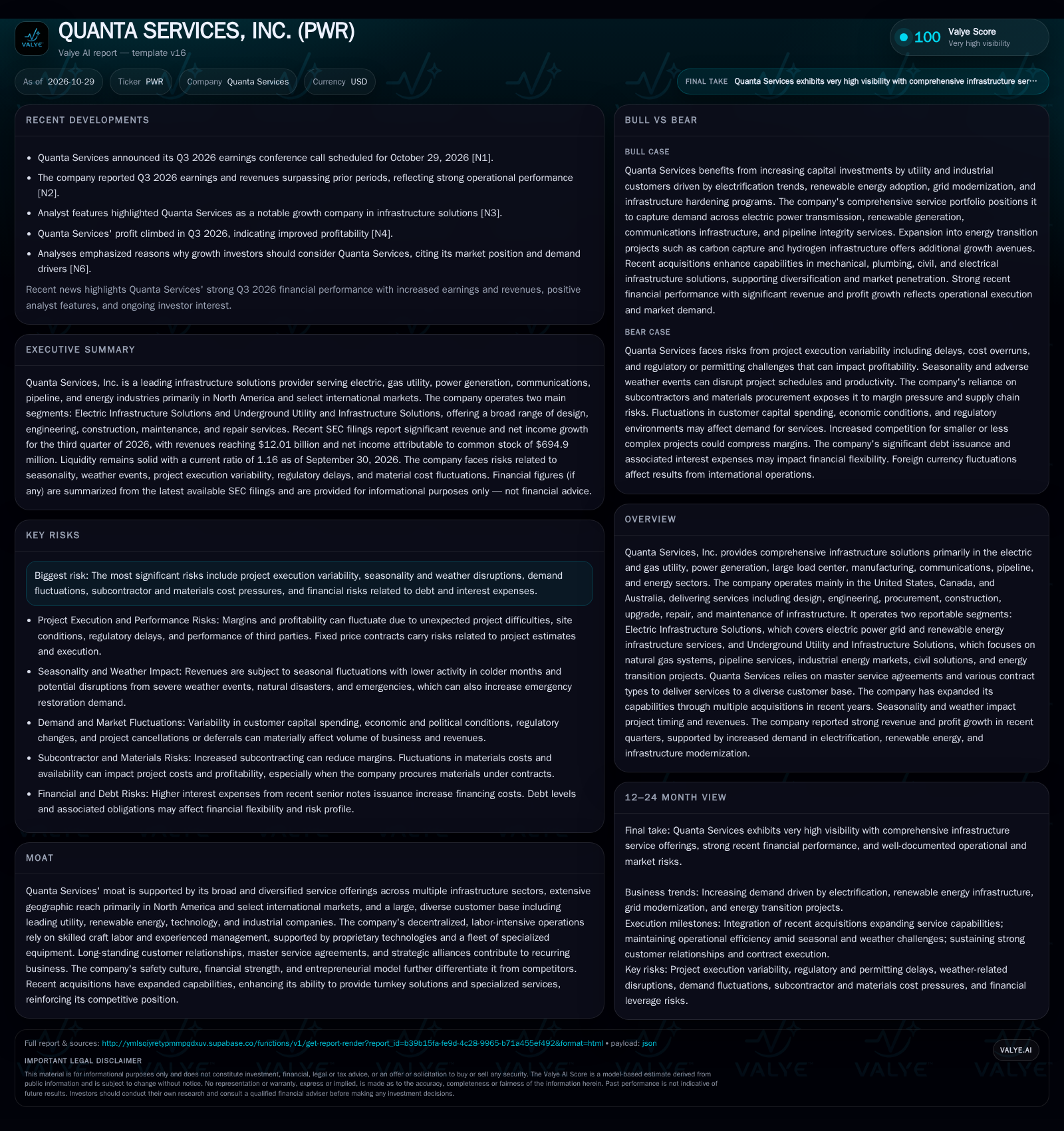
Quanta Services delivered a 57% year-over-year revenue jump and doubled net income in Q3 2026, fueled by surging demand for electric infrastructure and enhanced capabilities from recent acquisitions. While its operating model enables broad service reach and project scale, it remains exposed to project execution risk, weather-driven seasonality, and input cost pressures. The company’s future trajectory will depend on its ability to integrate acquisitions, manage a labor-intensive cost base, and capture recurring, high-margin work in the energy transition.
Quanta Services, Inc. is at the center of North America’s infrastructure buildout, riding a wave of electrification, grid modernization, and energy transition projects. The company’s latest quarterly results highlight a sharp acceleration in both revenue and profit, reflecting heightened demand from utilities, renewables, and industrial clients. Yet Quanta’s decentralized, project-driven business model—dependent on skilled labor, complex contract structures, and integration of recent acquisitions—means that growth brings heightened execution risks and margin volatility. As the utility and energy landscape evolves, the company’s ability to manage scale, cost variability, and recurring service penetration will determine its staying power.
Q3 2026: Rapid Expansion and Profit Gains Mark a Pivotal Period
Quanta Services posted revenues of $12.01 billion for the three months ended September 30, 2026, representing a 57.4% increase over the prior-year period. This surge was driven by a $3.63 billion increase in the Electric Infrastructure segment and a $755.7 million rise in Underground Utility and Infrastructure Solutions [S2]. Net income attributable to common stock doubled year-over-year to $694.9 million, while operating income nearly doubled as well [S2]. These gains coincide with the completion of multiple acquisitions in 2024 and 2025, which broadened the company’s capabilities in mechanical, process, civil, and electrical infrastructure [S1]. Liquidity remains descriptive, with $2.32 billion in cash and a current ratio of 1.16 as of quarter-end [S2]. The company’s strong financial performance is set against continued seasonality and project execution risks, which remain central to its operating environment.
How Quanta Makes Money: Contract Mix, Labor Economics, and Operating Leverage
Quanta’s revenue engine is built on a portfolio of contracts spanning master service agreements (MSAs), repair/maintenance deals, and fixed or variable-price construction and engineering projects [S1]. The company’s economics are shaped by the mix of recurring (maintenance, repair) versus project-based (large installations, upgrades) work. MSAs and long-term customer relationships can provide a measure of revenue visibility and recurring cash flow, particularly for utilities and large industrial clients. However, fixed-price contracts, while offering higher revenue potential, expose Quanta to cost overruns and execution risk if labor or materials costs escalate unexpectedly.
The business is fundamentally labor-intensive: skilled craft labor, experienced operators, and a large fleet of owned and leased equipment form the backbone of operations [S1]. This structure creates high variable costs tied to labor, subcontracting, and materials. Operating leverage can be favorable during periods of high utilization, as incremental revenues from large projects can outpace fixed overhead. Yet, this leverage also cuts the other way—project delays, weather disruptions, or input cost spikes can rapidly erode margins. Recent acquisitions may increase overhead and integration costs in the near term, with the potential for synergies if cross-segment capabilities unlock new project types or customer verticals.
Scale, Service Breadth, and Integration: Where Quanta Stands in the Infrastructure Ecosystem
Quanta’s competitive position is anchored by its ability to deliver turnkey solutions across electric, gas, communications, and energy infrastructure, serving a diverse customer base that spans utilities, renewables, hyperscalers, and industrials [S1]. Its scale and geographic reach—primarily in North America, with select international presence—enable participation in large, complex projects that smaller or regional players may be unable to service. The company’s decentralized operating model allows local responsiveness, but also increases the complexity of quality control and risk management.
Recent acquisitions have deepened Quanta’s bench in mechanical, civil, and aviation services, enhancing its ability to offer integrated solutions [S1]. This breadth can be a moat in winning large, multi-phase contracts and in cross-selling to established clients. However, the market remains fragmented, with competition from local contractors on smaller jobs and from large engineering, procurement, and construction (EPC) firms on megaprojects. Substitution risk is low for core electric and gas utility work, but new entrants leveraging digital project management or modular construction techniques could pressure margins over time. Switching costs for customers may be moderate where MSAs and long-term relationships exist, but are lower in commoditized or price-driven segments.
Unlocking Recurring Revenue and Margin Expansion Through Energy Transition
The most favorable outcome for Quanta Services would be a sustained increase in multi-year, recurring service contracts from utilities and industrials investing in electrification, grid modernization, renewables integration, and energy transition infrastructure. As capital budgets rise for grid resilience, distributed energy, and next-generation communications, Quanta could secure a greater mix of high-margin, lower-variability work—particularly if recent acquisitions enhance its ability to provide bundled, turnkey solutions.
Confirmation of this scenario would be visible through a rising proportion of revenue from MSAs and maintenance contracts (if disclosed), expanding backlog, and stable or rising segment margins—especially in the Electric Infrastructure unit. Additional signs would include successful integration of acquisitions, growth in cross-segment project wins, and customer retention or expansion with major utilities and hyperscalers. If Quanta can demonstrate improving margins alongside top-line growth, it would suggest effective management of cost variability and labor productivity.
Managing Growth With Volatility: The Most Likely Trajectory
The most plausible path forward is that Quanta Services continues to benefit from robust demand in electric and gas infrastructure, with periodic surges tied to utility capital cycles, renewables buildout, and grid resilience mandates. Revenue growth may moderate from Q3 2026’s exceptional pace, but remain solid as electrification and energy transition projects drive project pipelines. The cost structure will likely remain variable, with operating leverage in strong quarters and margin compression during seasonal or weather-related slowdowns.
Execution risks—including project delays, labor shortages, and input cost volatility—will persist, leading to quarter-to-quarter swings in profitability. Integration of recent acquisitions may provide incremental capabilities but also introduce near-term overhead and cultural complexity. Evidence confirming this scenario would include continued revenue and earnings growth, but with fluctuating margins and working capital swings. Signs of stable or improving customer concentration and project backlog would support this middle case, while unexpected margin dips or integration setbacks could challenge it.
Execution Missteps and Demand Volatility Could Erode Profitability
In a less favorable scenario, project execution difficulties—such as cost overruns, regulatory delays, or weather disruptions—could erode margins and dampen earnings, particularly on fixed-price contracts. A downturn in utility or industrial capital spending, possibly tied to economic softness or regulatory uncertainty, could compress volumes and lead to underutilization of labor and equipment. Integration challenges from recent acquisitions might result in inefficiencies, lost customers, or cultural friction.
Confirmation would come from missed revenue or profit targets, shrinking margins, or negative project write-downs. Rising days sales outstanding (if disclosed), increased reliance on subcontractors, and adverse trends in customer retention or contract renewal rates would also be warning signs. If the company’s cost base proves too inflexible during a downturn, cash flow pressure could emerge, especially if working capital needs spike amid project delays or disputes.
What Will Determine Quanta’s Staying Power in the Next Infrastructure Cycle?
The proportion of revenue coming from long-term master service agreements and recurring maintenance contracts (if disclosed) would clarify the company’s revenue visibility and margin stability.
Segment operating margins, especially in Electric Infrastructure and Underground Utility, will indicate whether scale and integration are driving improved profitability or if cost pressures are rising.
Backlog growth and composition—by customer type, contract duration, and project size—would provide insight into future revenue streams and demand durability.
Acquisition integration progress, measured by cross-segment project wins or disclosed synergy capture, will show whether recent deals are enhancing the business or adding complexity.
Customer concentration and retention rates (if disclosed), particularly among major utilities, renewables, and hyperscalers, will reveal stickiness and risk of revenue swings.
Working capital trends—including days sales outstanding and inventory turnover (if disclosed)—would help test whether growth is translating into cash generation or absorbing liquidity.
Seasonal revenue swings and project delay frequency, especially in Q1 versus Q3/Q4, will test the company’s ability to manage weather and timing risks.
Disclaimer: This is research-only, informational analysis and not investment advice. It may include AI-generated interpretation and general industry context. Always verify important details using primary sources.

Comments