
Bristol Myers Squibb in 2026: Productivity Drive, Pipeline Expansion, and the Battle Against Generic Erosion
Bristol Myers Squibb’s latest quarter demonstrates operational resilience, with new product approvals and cost-saving initiatives offsetting legacy portfolio pressures. The company’s dual focus on pipeline expansion—via R&D and acquisitions—and strict productivity targets will shape its competitive standing as generic threats intensify.
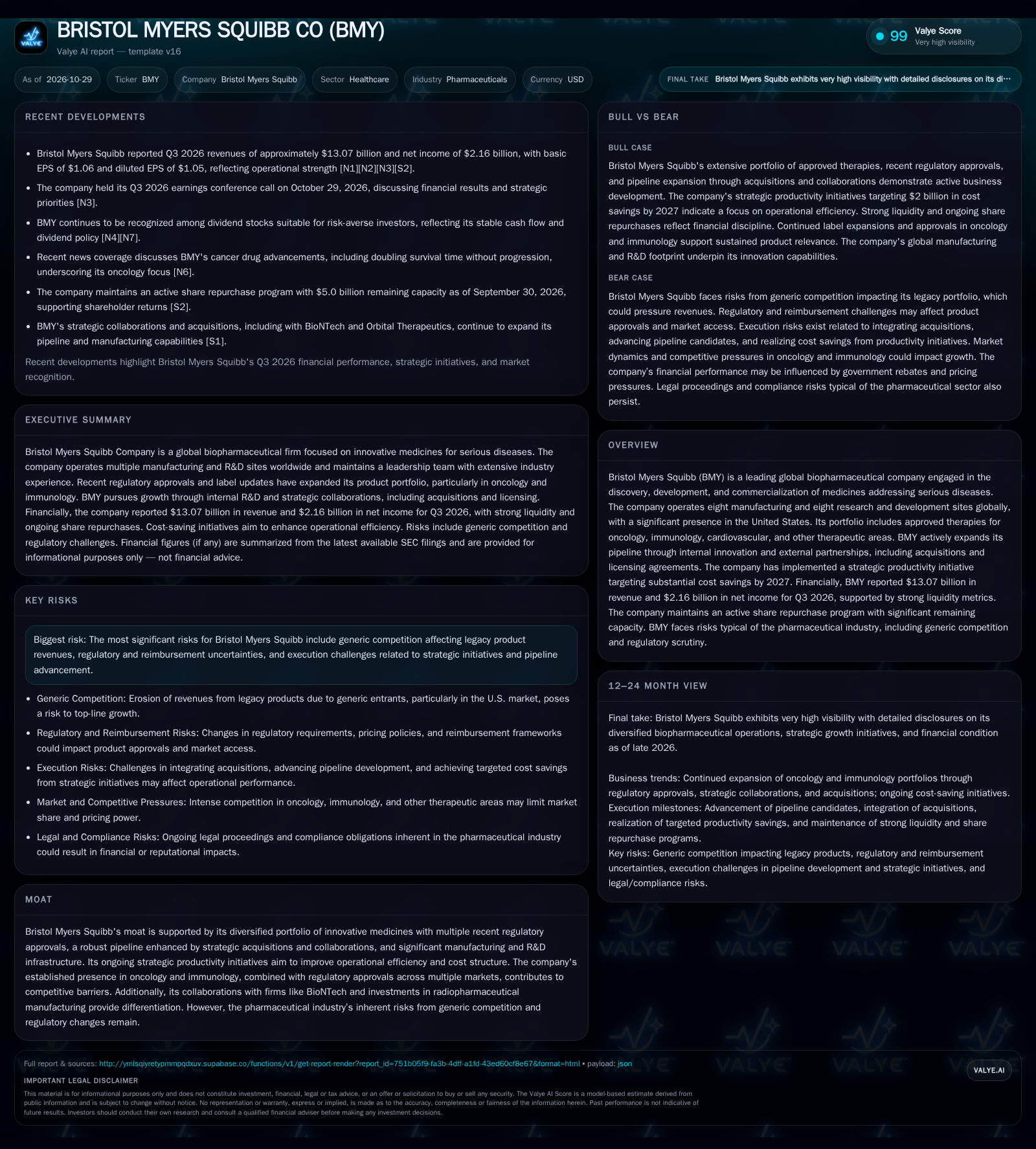
Bristol Myers Squibb (BMY) enters late 2026 with a stable top line, reported liquidity position, and a diversified drug portfolio, but faces mounting generic competition in its legacy business. Strategic cost-cutting, pipeline expansion through both innovation and M&A, and recent regulatory wins in oncology and immunology are pivotal to its future trajectory. Execution on productivity initiatives and integration of new assets are critical watchpoints, as is the pace of generic erosion and regulatory shifts in pricing and reimbursement. [S2] [N1] [N2] [N3]
Bristol Myers Squibb’s 2026 performance underscores the company’s ability to balance innovation-led growth with the realities of generic competition and regulatory risk. Recent regulatory wins, a robust pipeline, and disciplined cost management have stabilized earnings, even as legacy product erosion threatens long-term growth. The strategic focus on pipeline expansion—through both internal R&D and targeted acquisitions—along with an aggressive productivity program, will determine whether BMY can outpace the industry’s headwinds and deliver sustainable shareholder value.
Operational Resilience Amidst Flat Revenue and Cost-Cutting Ambitions
Bristol Myers Squibb reported Q3 2026 revenues of $13.07 billion and net income of $2.16 billion, signaling continued operational strength in the face of a challenging market environment. Full-year 2025 revenues were approximately $48.2 billion—essentially flat compared to 2024—as growth in the company’s newer therapies and Eliquis was offset by generic erosion in its legacy portfolio [S2] [N1] [N2] [N3].
Recent regulatory approvals and label expansions, particularly in oncology and immunology, have fortified the company’s Growth Portfolio. This includes new indications for Breyanzi, Camzyos, and Opdivo + Yervoy combinations, as well as streamlined monitoring requirements for some therapies [S1].
BMY is in the midst of a strategic productivity initiative targeting $2.0 billion in cost savings by the end of 2027, with efforts to streamline R&D, manufacturing, and commercial operations [S2]. The company reported a current ratio of 1.59 for the period. [S2]
How BMY’s Revenue Mix and Cost Structure Shape Value Creation
BMY’s economics hinge on a diversified portfolio spanning oncology, immunology, cardiovascular, and specialty therapies. The company generates high-margin revenue from patented drugs, but faces rapid margin compression as products lose exclusivity and generic competition accelerates. The 2025 revenue stagnation signals that legacy product erosion is already offsetting gains from newer therapies.
Commercial economics in pharmaceuticals typically favor established products with regulatory exclusivity, as fixed costs in R&D and manufacturing are leveraged across global sales. However, as the company’s legacy drugs lose exclusivity, the high fixed-cost base can become a liability—requiring aggressive cost management to sustain margins.
The $2 billion cost-saving initiative, if executed effectively, could restore operating leverage and free up capital for reinvestment in pipeline assets.
The interplay between BMY’s revenue mix and cost structure also highlights the critical importance of lifecycle management strategies. As exclusivity periods expire, the company’s ability to extend product lifecycles through label expansions, formulation improvements, or new indications can materially influence revenue trajectories and delay margin erosion. Additionally, the fixed-cost nature of pharmaceutical manufacturing and R&D means that volume fluctuations can disproportionately impact profitability, underscoring the need for scalable operational models that can adjust cost bases in response to market dynamics. Effective portfolio prioritization, therefore, becomes a strategic lever to allocate resources toward higher-margin, growth-oriented assets while managing declining products with minimal incremental investment.
Competitive Dynamics: Portfolio Breadth, Pipeline Depth, and Industry Headwinds
BMY’s competitive position is driven by its breadth of approved therapies, global manufacturing and R&D infrastructure, and a robust pipeline enhanced by acquisitions and collaborations. Recent deals with companies like BioNTech and Orbital Therapeutics signal strategic intent to expand into advanced modalities, such as radiopharmaceuticals and next-generation immunotherapies [S1].
However, the pharmaceutical landscape remains intensely competitive, particularly in oncology and immunology, where both large pharma peers and nimble biotech entrants vie for market share. The erosion of legacy products due to generics is a structural headwind faced by all mature pharma companies, but the ability to continually refresh the portfolio with differentiated, high-value assets is what separates long-term winners from laggards.
BMY’s productivity initiative and strategic collaborations may provide a cost and innovation edge, but the company remains exposed to regulatory risk, pricing pressures, and the inherent uncertainty of clinical development.
Pipeline Execution and Productivity Drive a Margin and Growth Renaissance
If BMY successfully brings late-stage pipeline assets to market—particularly in oncology, immunology, and radiopharmaceuticals—while executing on its $2 billion cost-saving plan, the company could achieve a positive inflection in both growth and margins. Regulatory approvals and label expansions, if sustained, would reinforce the Growth Portfolio’s momentum and mitigate the impact of legacy erosion.
Signs that would confirm this scenario include: accelerating revenue contributions from newly approved drugs, ongoing regulatory wins, visible progress on cost reductions, and evidence of successful integration of acquired assets like Orbital Therapeutics.
Conversely, failure to demonstrate pipeline productivity or to realize targeted cost savings would call this scenario into question.
Offsetting Generic Drag with Steady Growth Portfolio Gains
The most plausible near-term outcome is a continuation of recent trends: modest growth in the Growth Portfolio and Eliquis, largely offset by ongoing generic erosion in the Legacy Portfolio. Flat or low-single-digit revenue growth is likely, with margin stability contingent on delivering at least a portion of the targeted cost savings.
This scenario would be confirmed by quarterly results showing stable or slightly improving operating margins, continued regulatory approvals, and resilient liquidity. Evidence that would falsify this base case includes a sharp acceleration in generic erosion, regulatory setbacks, or an inability to deliver cost savings as planned.
Accelerating Legacy Erosion and Execution Missteps Undermine Value
A negative outcome could materialize if generic competition intensifies faster than anticipated, outpacing the Growth Portfolio’s ability to compensate. Regulatory or payer-driven pricing pressure, clinical trial failures, or integration difficulties with acquired assets could further erode margins and cash generation.
Confirmation of this scenario would come from sequential revenue declines, margin contraction despite cost-saving efforts, missed pipeline milestones, or signs of financial strain (such as a reduction in share repurchases or liquidity drawdown). A significant regulatory or legal setback could compound these risks.
Furthermore, the downside risks extend beyond immediate generic competition to encompass broader macroeconomic and policy uncertainties. For instance, shifts in healthcare reimbursement frameworks or increased scrutiny on drug pricing could compress margins further, especially if cost-saving measures fail to keep pace. Clinical development setbacks, such as trial delays or failures, would not only impact near-term pipeline prospects but could also dampen investor confidence and constrain capital availability. In this context, execution discipline across R&D, commercial, and integration activities is essential to mitigate cascading effects that could exacerbate financial and operational challenges.
Milestones That Will Define BMY’s Ability to Outpace Structural Headwinds
Quarterly revenue growth rates for the Growth Portfolio versus the rate of legacy product erosion.
Progress toward the $2 billion cost-saving target—actual cost reductions reported and their impact on operating margins.
New regulatory approvals, label expansions, or major clinical milestones for late-stage pipeline assets.
Revenue and integration updates from recent acquisitions and collaborations, such as Orbital Therapeutics and BioNTech.
Trends in Eliquis revenue and any developments regarding generic entry or pricing/reimbursement changes.
Share repurchase activity and the company’s willingness or ability to sustain capital returns in the face of changing cash flows.
If disclosed, R&D productivity metrics such as time-to-market for new drugs, clinical trial success rates, or pipeline attrition.
Disclaimer: This is research-only, informational analysis and not investment advice. It may include AI-generated interpretation and general industry context. Always verify important details using primary sources.

Comments