
Mastercard’s Digital Payments Expansion: AI, Crypto, and the Next Phase of Platform Economics
Mastercard’s 2026 results reflect a business at the intersection of payment technology and financial infrastructure, with AI-driven solutions, tokenization, and crypto integration reshaping its service mix. The question is whether these innovations will deepen Mastercard’s network effects or face counterpressure from regulatory, technological, and competitive shifts.
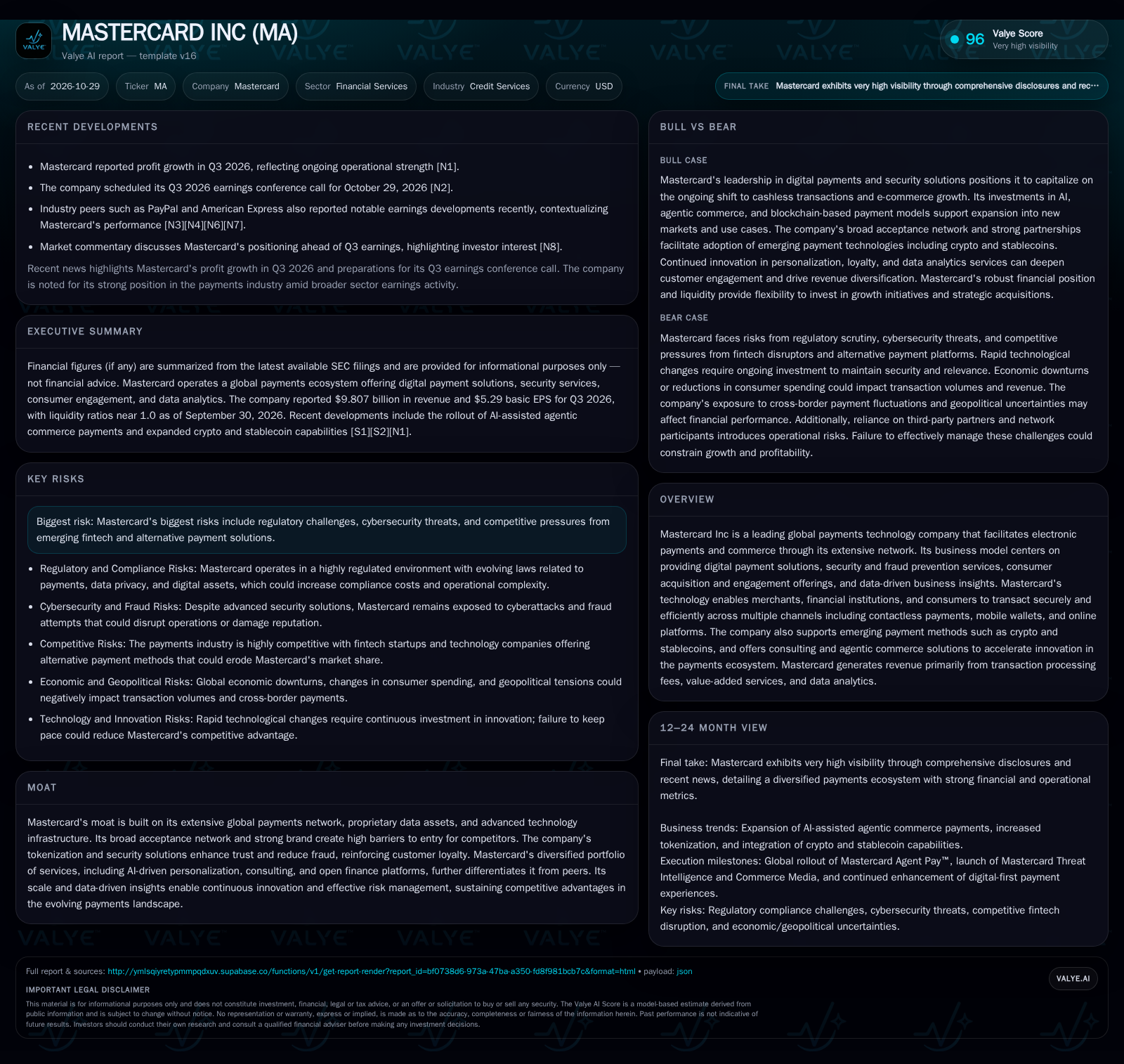
Mastercard reported $9.807 billion in Q3 2026 revenue, with recent launches in AI-assisted commerce and crypto payment capabilities. While its payments network and security solutions remain core strengths, ongoing innovation in agent-based payments, tokenization, and digital-first services could redefine its economics and competitive landscape. The durability of Mastercard’s moat will be tested by fintech competition, regulatory scrutiny, and the pace of customer adoption for new digital payment solutions. [S1] [S2] [N1]
Mastercard’s 2026 operating snapshot shows a global payments leader investing heavily in digital enablement, AI-driven security, and the infrastructure for next-generation commerce. With agentic payments and stablecoin integrations, Mastercard is pushing the boundaries of programmable financial transactions and network extensibility. The company’s challenge will be to convert these technology bets into durable economic advantages, even as the regulatory and competitive environment grows more complex. Investors must grapple with whether Mastercard’s platform innovations can sustain margin expansion and deepen customer lock-in, or whether new entrants and alternative rails will begin to erode its economic moat.
Recent Financial and Strategic Milestones Define Mastercard’s 2026 Profile
Mastercard reported $9.807 billion in revenue for Q3 2026, with basic EPS of $5.29, reflecting ongoing operational strength and scale in the digital payments ecosystem. Net cash provided by operating activities for the first nine months of 2026 was $11.859 billion, down slightly year-over-year, as the company increased investment in acquisitions and property. Recent launches—such as Mastercard Agent Pay™ for AI-assisted agentic commerce, Mastercard Threat Intelligence, and the expansion of crypto and stablecoin payment services—underscore a strategic pivot towards programmable payments, security, and new digital channels. [S1] [S2] [N1]
Payment Network Economics and the Levers of Value-Added Service Growth
Mastercard’s core economics rely on transaction processing fees, value-added services, and data analytics. The underlying model is highly scalable: incremental transaction volume flows through established infrastructure with minimal variable cost, creating significant operating leverage. As digital payments proliferate, the company benefits from both volume growth and the opportunity to layer additional services—such as fraud prevention, tokenization, AI-driven analytics, and loyalty solutions—on top of basic payment rails.
Tokenization, used in 40% of 2025 transactions, may reduce fraud and chargebacks, potentially lowering network costs and boosting net revenue per transaction if adopted more broadly. Agentic commerce and programmable payments could introduce new pricing models, such as micro-fees for automated transactions or premium charges for advanced security and authentication layers. However, these innovations require ongoing R&D and capital outlays, as reflected in higher investing cash flows in 2026. The expansion into digital media (Commerce Media™) and cyber threat intelligence represents a push for revenue diversification, but the success of these new platforms will depend on customer adoption and the ability to capture a meaningful share of spend insights and advertising budgets.
The scalability of Mastercard’s payment network is underpinned by its ability to leverage fixed infrastructure costs while capturing incremental revenue from transaction volume growth. This dynamic creates substantial operating leverage, but it also means that sustaining growth requires continuous innovation in value-added services to prevent commoditization of the core transaction fees. For example, the integration of AI-driven fraud detection not only reduces losses but also can justify premium pricing by enhancing security assurance for merchants and issuers. However, the cost-benefit balance of these innovations depends on the pace of merchant adoption and the relative reduction in fraud-related expenses, which if insufficient, could pressure margins despite higher service revenues.
Moreover, the shift toward programmable payments and agentic commerce introduces complexity in pricing models and revenue recognition. Micro-fees on automated transactions may scale differently than traditional interchange fees, potentially leading to a more fragmented revenue base that requires advanced analytics to optimize. Additionally, tokenization’s impact on transaction efficiency and fraud reduction could alter cost structures across the network, but widespread adoption depends on issuer and merchant readiness as well as consumer acceptance. If tokenization becomes a standard expectation rather than a differentiator, Mastercard may need to find alternative avenues to monetize these security enhancements effectively.
Network Effects, Security, and the Challenge from Alternative Rails
Mastercard’s competitive advantages historically stem from its vast acceptance network, trusted brand, and proprietary data. These could increase switching costs for merchants, issuers, and consumers, and reinforce the company’s ability to roll out new services at scale. Security innovations—such as tokenization, AI-based fraud detection, and biometric authentication—enhance trust and reduce friction, further entrenching Mastercard’s position.
However, the payments landscape is evolving rapidly. Fintechs, neobanks, and big tech platforms are pushing direct bank transfers, real-time payments, and blockchain-based alternatives that bypass traditional card networks. Mastercard’s response—integrating stablecoins, supporting 130+ crypto co-brand card programs, and enabling open finance—may help defend relevance, but exposes the firm to new regulatory and operational risks. The company’s ability to maintain pricing power and network effects will hinge on its success in embedding itself as the default orchestrator of both legacy and next-generation payment flows, rather than being relegated to a commoditized utility layer.
Mastercard’s entrenched network effects derive not only from its acceptance footprint but also from the data network that informs risk management, personalized offers, and loyalty programs. This data-driven ecosystem could increase switching costs that extend beyond simple payment acceptance, embedding Mastercard deeper into customer value chains. However, as open finance initiatives and decentralized finance platforms gain traction, the exclusivity of Mastercard’s data assets may erode if consumers and merchants gain more control over their financial data. The company’s ability to innovate in data monetization while navigating privacy regulations will be critical to maintaining its competitive edge in an increasingly transparent and interoperable payments environment.
Furthermore, the rise of alternative rails such as real-time payments and blockchain-based solutions challenges Mastercard’s role as an intermediary. While integration with stablecoins and crypto programs positions the company to participate in these emerging ecosystems, it also exposes Mastercard to operational risks and potential margin compression due to increased competition and regulatory scrutiny. The firm’s success will depend on its capability to orchestrate interoperability across legacy and new payment systems, ensuring seamless user experiences and maintaining pricing power. Failure to do so could relegate Mastercard to a commoditized infrastructure provider with limited value-added differentiation.
If Agentic Commerce and Crypto Integration Drive Platform Stickiness
A favorable scenario unfolds if Mastercard’s investments in AI-assisted agentic commerce and programmable payments catalyze new transaction types, unlock incremental volume, and enable premium pricing for advanced security and automation. If stablecoin flows and crypto-based payments meaningfully expand, Mastercard could capture cross-border and digital-native transaction growth that would otherwise migrate to decentralized or non-traditional rails.
Confirmation would come from a rising share of tokenized and agent-initiated transactions, growth in revenue from value-added services, and evidence that Commerce Media™ and Threat Intelligence platforms are gaining traction with enterprise customers. If these innovations translate into higher take rates, improved retention, and sustained double-digit revenue growth—even as traditional card volumes plateau—Mastercard’s economic moat could deepen, and margin expansion might resume.
Digital Payments Growth Continues, but Margins Face Mixed Forces
The most plausible outcome is that Mastercard continues to benefit from the secular shift to digital and contactless payments, with modest volume growth in established markets and faster expansion in underpenetrated geographies and use cases. Value-added services and security solutions likely contribute a growing share of revenue, but margin expansion is tempered by increased R&D, compliance, and technology investment needs.
This scenario would be confirmed by steady transaction and service revenue growth, flat to slightly rising operating margins, and continued investment in platform capabilities. Signs that tokenization and agentic commerce are being adopted, but not yet fundamentally altering network economics, would support this middle path. Regulatory and competitive headwinds remain manageable but constrain outsize profitability gains.
If Alternative Payment Rails and Regulation Undermine Network Economics
A negative chain of events could occur if fintech disruptors, real-time payment schemes, and crypto-native platforms rapidly gain market share, eroding Mastercard’s transaction volumes and bargaining power. If regulators impose interchange fee caps, mandate open access, or restrict data monetization, Mastercard’s core economics could come under pressure—especially if value-added services fail to offset lost transaction revenue.
This scenario would be evidenced by declining transaction volumes, pricing concessions to retain large merchants and issuers, and margin compression despite ongoing investment. Additional warning signs would include stalled adoption of new digital platforms, customer migration to alternative rails, or high-profile security breaches undermining trust in Mastercard’s technology.
Milestones That Will Test Mastercard’s Digital Transformation Thesis
The share of total transaction volume conducted via tokenized credentials and agentic commerce flows—if disclosed—would indicate the pace of next-generation payment adoption.
Revenue and margin contribution from new platforms such as Commerce Media™ and Threat Intelligence—segmented if available—would help test whether diversification efforts are gaining traction.
Customer acquisition, retention, and cross-sell metrics for crypto and stablecoin payment programs would reveal the impact of Mastercard’s push into programmable and digital-native payments.
R&D and technology spend as a percentage of revenue would show whether innovation investments are scaling efficiently or weighing on margins.
Updates on regulatory investigations, fee cap discussions, or open banking mandates in key markets would clarify the risk of margin pressure and forced business model changes.
Any disclosed merchant or issuer churn rates—particularly among large enterprise customers—would signal competitive pressure or switching to alternative rails.
Incidence and remediation of major security or fraud events would test the resilience and credibility of Mastercard’s AI-driven security stack.
Disclaimer: This is research-only, informational analysis and not investment advice. It may include AI-generated interpretation and general industry context. Always verify important details using primary sources.

Comments