
Eli Lilly’s Next Act: Pipeline Momentum, Obesity Therapies, and the Shifting Economics of Pharmaceutical Leadership
Eli Lilly’s 39% Q3 2026 revenue surge and strong pipeline advances highlight both the promise and complexity of scaling innovation in a fiercely competitive global drug market. As new obesity and diabetes therapies show clinical and commercial promise, pressure from generics, regulatory scrutiny, and payer access dynamics loom large over future profitability.
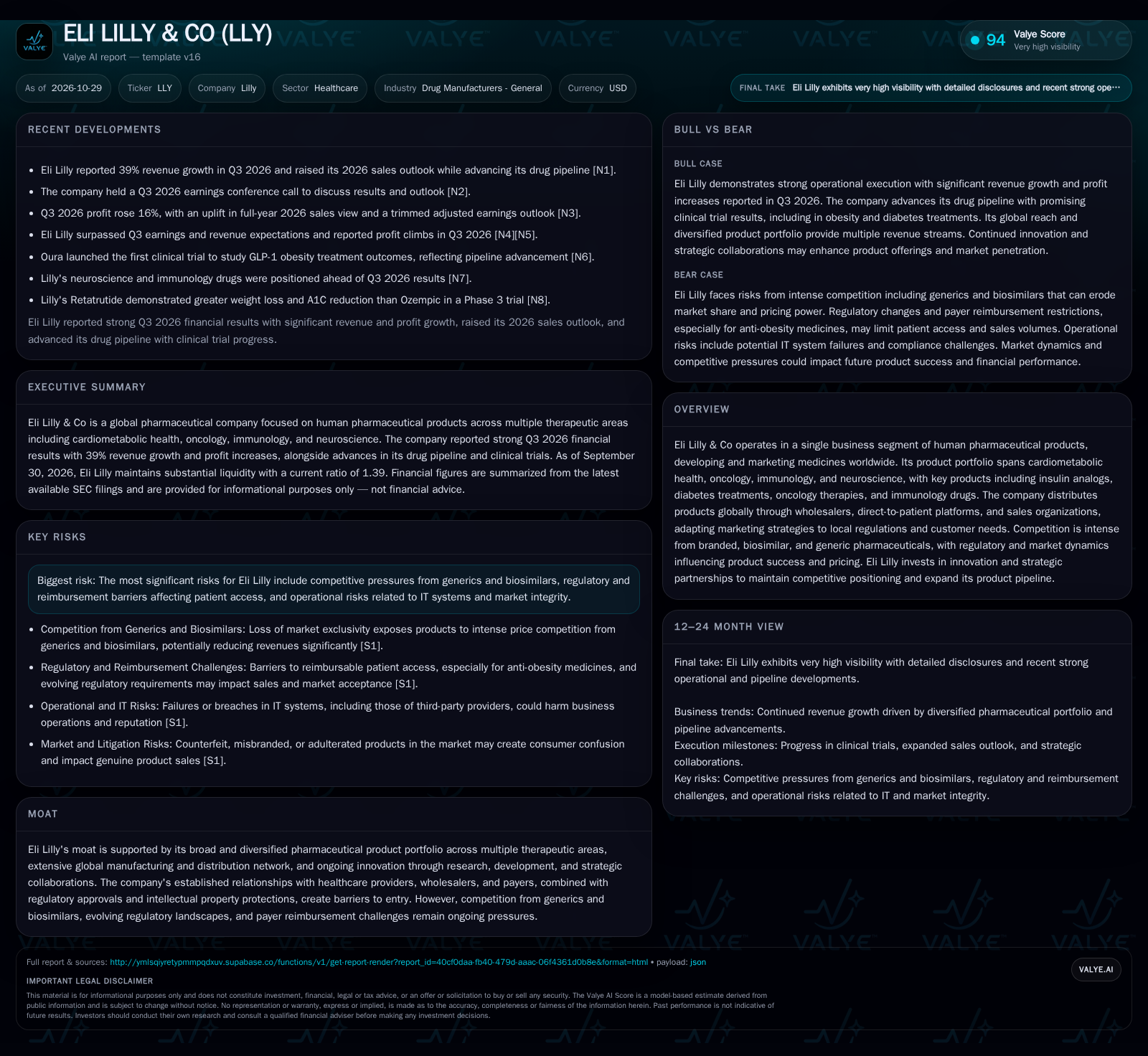
Eli Lilly posted 39% revenue growth in Q3 2026, lifted its full-year sales outlook, and reported strong profit gains, driven by advances across its diversified pharmaceutical portfolio and promising clinical trial results—especially in obesity and diabetes. The challenge: sustaining growth as competitive, regulatory, and reimbursement headwinds intensify.
Eli Lilly’s Q3 2026 performance underscores the company’s ability to convert scientific breakthroughs into commercial momentum, with 39% revenue growth and a raised sales outlook reflecting the strength of its diversified portfolio. Recent clinical wins—especially for its next-generation obesity therapy Retatrutide—underscore the value of innovation in a market where payer access, pricing pressure, and generic competition threaten even the most successful franchises. The central question for investors is not whether Lilly can grow, but whether it can defend and expand its margins as the pharmaceutical industry’s economics shift toward high-volume, lower-price chronic therapies and global reimbursement scrutiny.
Q3 2026: Surging Revenue, Clinical Milestones, and an Evolving Profit Profile
Eli Lilly reported a striking 39% year-over-year revenue increase in Q3 2026, with total revenue at $24.4 billion and net income of $6.45 billion. The company raised its full-year sales outlook, citing momentum across its diversified portfolio, but simultaneously trimmed its adjusted earnings guidance—a signal that while topline growth is robust, margin pressures or investment needs may be rising [N1] [N3] [S2].
On the innovation front, Lilly’s Retatrutide delivered greater weight loss and A1C reduction than Ozempic in Phase 3 trials, positioning it as a potential next-generation leader in the obesity and diabetes market [N8]. The company’s cash and equivalents totaled $4.89 billion as of September 30, 2026, with a current ratio of 1.39 [S2].
These developments matter because they highlight both the commercial upside from new therapies and the operational complexities of scaling across global markets where reimbursement, access, and competitive pressure are intensifying.
How Lilly Converts Pipeline Innovation Into Profits—And Where the Margins Are Squeezed
Eli Lilly’s business model relies on discovering, developing, and commercializing innovative medicines, with revenue generated from branded pharmaceuticals across cardiometabolic health, oncology, immunology, and neuroscience [S1]. Historically, the economics of branded drugs have offered high gross margins due to patent protection and premium pricing—especially in the U.S.—but these economics are increasingly challenged by patent expiries, biosimilar entry, and payer-driven price negotiation.
The company’s recent revenue surge is plausibly driven by the rapid uptake of novel drugs, particularly in obesity and diabetes. These high-volume chronic therapies can deliver blockbuster sales, but their economics differ from traditional specialty drugs: payer scrutiny is higher, access can be limited by reimbursement hurdles, and pricing pressure is acute due to the size of the target population.
Operating leverage is substantial during periods of new product launch and rapid volume growth, as fixed R&D and infrastructure costs are spread over a larger sales base. However, as products mature and face generic or biosimilar competition, margins compress—necessitating continuous pipeline renewal and geographic expansion to sustain profit growth. Capital needs are significant, given the scale of clinical trials, regulatory compliance, and manufacturing investments required to bring next-generation therapies to market.
Navigating a Landscape of Generics, Biosimilars, and Global Payer Leverage
Lilly’s competitive moat rests on its broad portfolio, global manufacturing and distribution network, and sustained investment in R&D and strategic partnerships [S1]. Intellectual property and regulatory exclusivity have historically provided strong barriers to entry, but the company now faces relentless competition from generics and biosimilars—particularly as key drugs lose exclusivity.
In the obesity and diabetes segment, Lilly’s main competition comes from other branded pharmaceutical innovators vying for share in a rapidly expanding market. However, as these therapies become standards of care, payers and governments have greater leverage to demand price concessions, restrict coverage, or encourage step therapy—pressuring margins and limiting unfettered growth.
The threat of substitution from biosimilars is especially acute in mature categories like insulin, while pipeline differentiation (e.g., superior efficacy or safety) is required to defend share in newer therapeutic areas. The company’s ability to secure favorable reimbursement, maintain formulary positioning, and demonstrate clear clinical value will determine the durability of its competitive advantages.
If Obesity and Diabetes Therapies Become the Next Blockbusters
A favorable outcome would see Lilly’s next-generation obesity and diabetes drugs—such as Retatrutide—achieve rapid regulatory approvals, broad payer reimbursement, and high patient adoption, driving sustained double-digit revenue and profit growth. The superior clinical results versus Ozempic in Phase 3 trials suggest a plausible path to best-in-class status and substantial market share gains [N8].
Expansion into new geographies, successful launch of additional indications, and continued pipeline productivity in oncology, immunology, and neuroscience would further diversify the revenue base and reduce reliance on any single franchise.
Evidence confirming this scenario would include continued outperformance versus consensus sales expectations, rapid uptake metrics for new launches, positive reimbursement decisions from major payers, and additional positive late-stage trial results.
Sustained Growth, but Margin Compression as Competition and Payers Push Back
The most likely scenario is that Lilly continues to grow revenue through a mix of new product launches, geographic expansion, and incremental pipeline advances, but faces ongoing margin pressure as competition, biosimilar entry, and payer cost containment efforts intensify. Obesity and diabetes therapies will drive topline momentum, but reimbursement restrictions and price negotiations will temper profit expansion.
Mature franchises—especially in insulin and established oncology—will see gradual erosion from generics and biosimilars, requiring pipeline innovation to offset declines. Operating leverage will be positive during early-stage growth of new products, but fixed-cost absorption may become a challenge if pricing power erodes or if R&D productivity wanes.
Confirming this scenario would be steady, but moderating, revenue growth, stable to slightly declining margins, and evidence of competitive pricing in key geographies. Falsification would require either a sudden loss of exclusivity for a major product without adequate pipeline replacement, or a regulatory setback that impairs access to large patient populations.
When Patent Cliffs and Reimbursement Barriers Outpace Innovation
An adverse scenario would see Lilly’s major franchises—especially in insulin, diabetes, or immunology—lose exclusivity faster than the pipeline can replace lost revenues. Simultaneously, if regulatory or payor environments tighten (e.g., restrictive reimbursement for anti-obesity drugs, price caps, or aggressive biosimilar substitution), revenue growth could stall or reverse.
If late-stage clinical assets face setbacks or fail to demonstrate clear differentiation, the company could be forced into price competition, eroding margins and reducing R&D reinvestment capacity. Operational risks—such as compliance failures, supply chain disruptions, or IT breaches—could further impair performance.
Evidence for this scenario would include abrupt revenue declines in key products, rising SG&A or R&D as a percentage of sales without corresponding growth, negative reimbursement decisions, or major clinical trial failures.
What Will Determine Whether Lilly’s Pipeline Momentum Translates Into Durable Value?
Quarterly revenue and profit growth rates for new launches in obesity and diabetes; rapid uptake would support the bullish thesis, while stagnation may signal payer resistance or market saturation.
If disclosed, net price realization versus list price for key therapies, which would clarify the degree of payer and government pricing pressure.
Regulatory approval milestones and label expansions for pipeline drugs, particularly Retatrutide and next-generation cardiometabolic therapies.
Major payer coverage decisions, formulary placements, or reimbursement restrictions in the U.S. and key international markets.
Trends in R&D spending as a percentage of revenue, indicating management’s commitment to pipeline renewal and future-proofing the portfolio.
Market share shifts in core franchises, particularly if biosimilar competition accelerates.
Any material operational disruptions, compliance events, or supply chain issues, which could undermine execution.
Disclaimer: This is research-only, informational analysis and not investment advice. It may include AI-generated interpretation and general industry context. Always verify important details using primary sources.

Comments