
Textron’s Portfolio Realignment: Defense Leverage, Industrial Separation, and the Search for Strategic Focus
As Textron lifts its earnings outlook and prepares to spin off its Industrial segment, the company stands at a strategic crossroads. Its defense backlog, led by programs like Bell’s MV-75, provides stability—but government funding risks, macroeconomic headwinds, and execution challenges around the planned separation will shape the next phase of value creation.
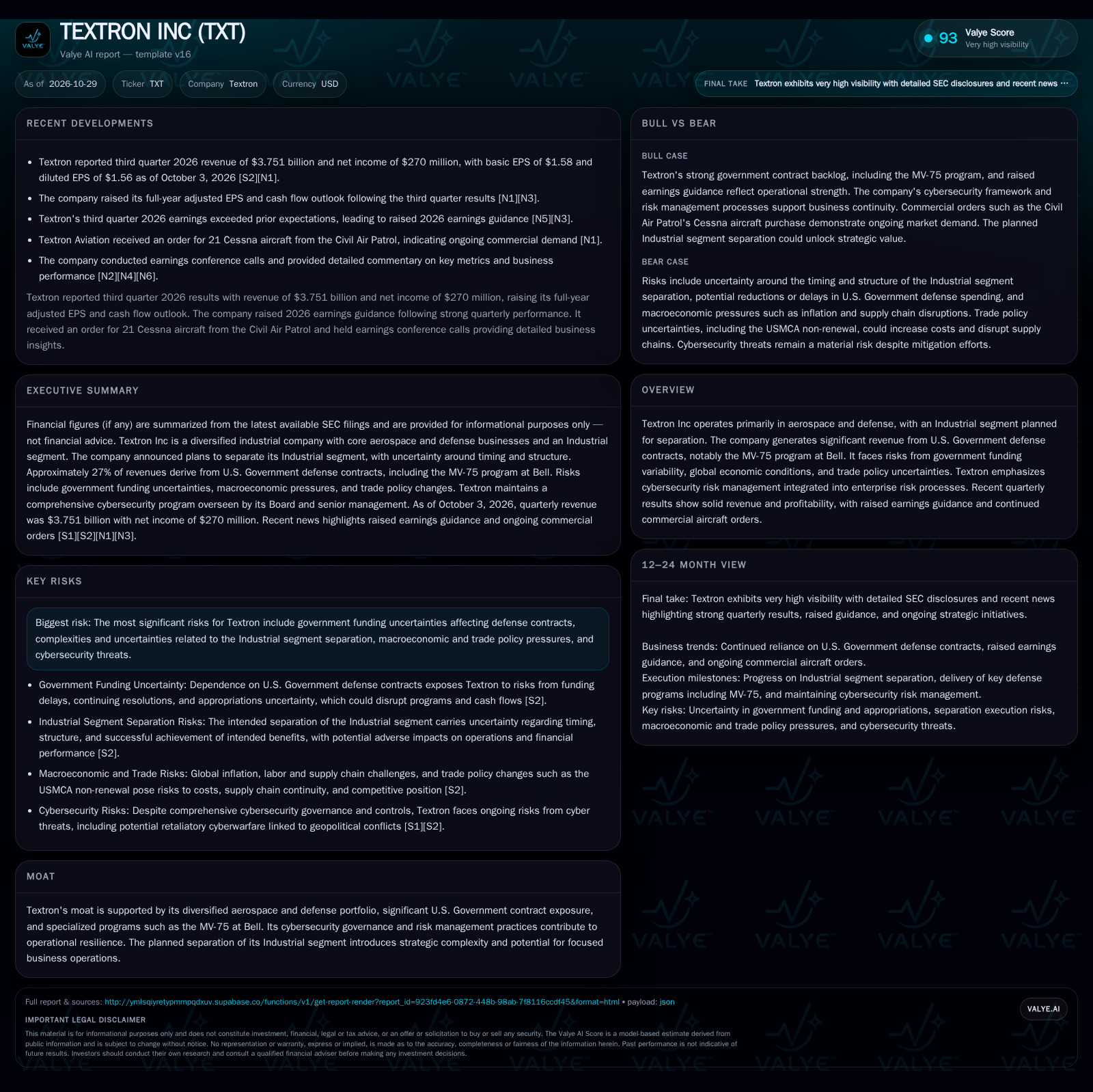
Textron’s raised earnings guidance and strong Q3 results come amid a pivotal plan to separate its Industrial segment, sharpening its focus on aerospace and defense. With nearly a third of revenues tied to U.S. government contracts—especially the expanding MV-75 program—Textron’s fortunes remain closely linked to federal spending cycles. Macro risks, trade policy shifts, and the complexity of executing the separation introduce both upside and downside volatility over the next 12-24 months. [S2] [N1] [N3]
Textron Inc. is entering a period of strategic transformation, driven both by external demand dynamics and internal restructuring. The company’s latest quarterly outperformance and upwardly revised guidance underscore operational momentum, but the planned separation of its Industrial segment signals a deeper intent to sharpen its identity around aerospace and defense. With a heavy reliance on U.S. government contracts—especially the expanding MV-75 program—Textron faces both the stability of defense backlogs and the volatility of federal appropriations. Macro headwinds, trade policy uncertainty, and execution risk around the separation will be key swing factors for value realization in the coming quarters. [S2] [N1] [N3]
Earnings Upside, Portfolio Realignment, and Defense Backlog: The Current Landscape
Textron’s Q3 2026 results delivered $3.751 billion in revenue and $270 million in net income, with basic EPS of $1.58, exceeding prior expectations and leading management to raise both full-year adjusted EPS and cash flow guidance. This operational strength is occurring as the company prepares to separate its Industrial segment, though with no definitive timeline or structure yet disclosed. The core aerospace and defense businesses remain anchored by a robust contract portfolio: approximately 27% of total revenues are tied to U.S. government entities, with the Bell MV-75 program emerging as a significant and growing component of backlog. The company’s commercial aviation business continues to generate orders, as evidenced by a 21-aircraft deal with the Civil Air Patrol. However, Textron faces acute risks from government funding cycles, macroeconomic volatility, and the complexity of executing a major business separation. [S2] [N1] [N3] [N5]
How Textron’s Revenue Mix and Cost Structure Shape Margin Trajectory
Textron’s business model blends high-visibility government contracts with more cyclical commercial and industrial revenues. Aerospace and defense programs, particularly those like Bell’s MV-75, typically operate on multi-year contracts with fixed or cost-plus structures, offering revenue stability and the potential for high margins when production is scaled efficiently. These contracts can provide substantial operating leverage as fixed costs are absorbed over large production runs, but are also sensitive to government appropriations timing and budget resets.
The Industrial segment—soon to be separated—has historically contributed more volatile, lower-margin earnings, subject to macro cycles, commodity costs, and trade policy shifts. Spinning off this segment could clarify the margin profile of the remaining portfolio, potentially lifting blended margins if aerospace and defense become a larger share of mix.
Textron’s commercial aviation business (Cessna, Beechcraft) operates in a competitive, price-sensitive environment, with order flows tied to macro cycles. Orders like the Civil Air Patrol’s 21 Cessnas are positive, but the business is exposed to input cost inflation and demand fluctuations. Across the portfolio, capital needs are moderate, with significant investment required for R&D and production ramp-ups on new defense programs. If the Industrial separation proceeds, capital allocation and potential financial flexibility could shift, with potential for targeted reinvestment or shareholder returns depending on post-spin priorities.
Specialization vs. Scale: Where Textron Stands in Aerospace and Defense
Textron’s competitive moat is built on a diversified product set, strong government relationships, and specialized programs like the Bell MV-75. In defense, the company benefits from barriers to entry such as regulatory approvals, technical expertise, and long-standing customer ties. However, it is not immune from competition: larger defense contractors can leverage scale, broader portfolios, and deeper lobbying resources, while pure-play aerospace or industrial peers may be more agile or focused.
The planned Industrial segment separation could sharpen Textron’s strategic focus and increase management attention on aerospace and defense, where switching costs for government programs and high integration requirements for customers create stickier revenue streams. Yet, as a mid-sized player, Textron remains vulnerable to shifts in defense priorities, competitive rebidding, and technological disruption. In commercial aviation, differentiation is harder to sustain, with pricing and service being primary levers, and order books subject to macro swings and customer fleet strategies.
Cybersecurity is a growing differentiator in defense contracting, and Textron’s integrated risk management and board oversight may enhance its standing with government customers—but this is a moving target as adversaries and requirements evolve.
Strategic Focus Unlocks Margin Expansion and Defense Growth
If Textron executes a timely and value-accretive separation of its Industrial segment, it could unlock a higher-margin, more focused aerospace and defense platform. A successful spin-off would clarify the company’s financial profile, improve management alignment, and enable targeted capital allocation to core defense and aviation programs. Continued strength in government contracting—especially if the MV-75 program expands or new awards are secured—could drive backlog growth and operating leverage.
Upside confirmation would come from clear communication of spin-off timing and structure, sustained or rising blended margins post-separation, additional large defense contract wins, and a track record of capital deployment aligned with strategic priorities. Outperformance in commercial aviation, evidenced by growing order books and stable pricing despite macro headwinds, would further support the upside case.
Incremental Progress Amid Policy and Execution Uncertainty
The most plausible scenario is that Textron delivers steady results anchored by government backlog and selective commercial demand, while the Industrial separation progresses gradually with intermittent updates. Defense revenues remain resilient but exposed to the timing of U.S. government appropriations and the risk of continuing resolutions or budget delays. The MV-75 program continues as a growth engine, but expansion is paced by the broader funding environment.
Margins and cash flow improve moderately if input cost inflation is contained and supply chain pressures ease; commercial aviation recovers in line with macro trends, but not at a breakout pace. Confirmation of this scenario would be regular backlog and delivery updates, stable-to-improving margins, and incremental progress on the separation, even if the precise structure takes time to finalize.
Separation Delays, Defense Funding Cuts, and Margin Compression
An adverse scenario would see the Industrial segment separation delayed or abandoned, creating ongoing distraction and uncertainty for management and investors. If U.S. government defense spending is disrupted by budget cuts, funding delays, or political gridlock, key programs like the MV-75 could see order reductions or deferments, eroding backlog and cash flow.
Concurrently, persistent inflation, labor shortages, or supply chain disruptions could compress margins across both aerospace and commercial businesses. Trade policy shocks—such as the non-renewal of USMCA—could raise costs and disrupt cross-border supply chains, especially for the remaining industrial operations if the separation stalls. Evidence for this scenario would include slippage in separation milestones, declining defense backlog, margin deterioration, and negative revisions to earnings guidance.
Milestones That Will Shape Textron’s Strategic Value Creation
Progress updates on the Industrial segment separation, including concrete timing, structure, and management’s articulation of post-spin priorities.
Quarterly backlog changes, especially for the Bell MV-75 program and other major defense contracts, as an indicator of future revenue visibility.
Margin trends by business segment post-separation, if disclosed, to assess whether the portfolio realignment is delivering on promised financial benefits.
Order flow and delivery rates in commercial aviation, including Cessna and Beechcraft, as a proxy for market demand and competitive positioning.
Impact of U.S. government appropriations cycles—including continuing resolutions, shutdown risks, and program-level funding updates—on defense revenues.
Cost inflation and supply chain disruption metrics, if disclosed, to monitor risks to profitability and delivery schedules.
Updates on cybersecurity incidents or investments, which would test the resilience of Textron’s risk management claims.
Disclaimer: This is research-only, informational analysis and not investment advice. It may include AI-generated interpretation and general industry context. Always verify important details using primary sources.

Comments